
Have you ever asked Siri a question, received a personalized recommendation on Netflix, or chatted with ChatGPT and wondered what is actually happening behind the screen? If you have ever searched for how does artificial intelligence work, you are not alone. Artificial intelligence has become a major part of everyday technology, powering search engines, smartphones, recommendation systems, virtual assistants, fraud detection, and content-generation tools.
Although AI can seem complicated, its basic working process is easier to understand than you might expect. At its core, AI uses data, algorithms, and trained models to identify patterns and produce useful results. Depending on the system, that result could be a prediction, recommendation, classification, decision, or newly generated piece of content.
Many modern AI systems use machine learning, which allows models to learn patterns from examples instead of relying entirely on manually written instructions. The process begins with data, continues through processing and training, and eventually reaches inference, where the trained model applies what it has learned to new information.
In this guide, we will break down how artificial intelligence works step by step, from collecting data to training an AI model and generating the final output.
How Does AI Work Step by Step?
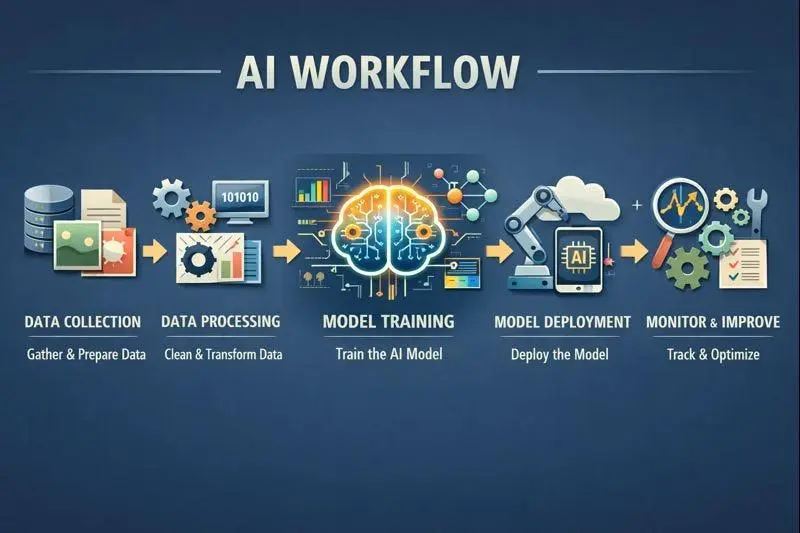
At a basic level, artificial intelligence works by taking information as input, processing that information, identifying useful patterns, and producing an output.
The overall AI workflow can be simplified into these stages:
- Data is collected and prepared.
- Algorithms analyze the prepared data.
- An AI model learns patterns during training.
- The trained model receives new input.
- The model processes the input during inference.
- The system generates an appropriate output.
Consider an email spam filter. Developers can train a model using thousands of emails labeled as “spam” or “not spam.” During training, the model analyzes these examples and adjusts its internal parameters to recognize patterns associated with each category.
When a new email arrives, the trained model examines its content and estimates which category it belongs to. If the patterns strongly resemble those found in spam examples, the system can classify the message as spam.
The same basic workflow appears in many AI applications. A recommendation system analyzes user behavior, a computer vision system analyzes images, and a language model processes text.
The technology behind each system can be very different, but the central idea remains the same: input → processing → learned patterns → output.
How Does AI Collect Data?
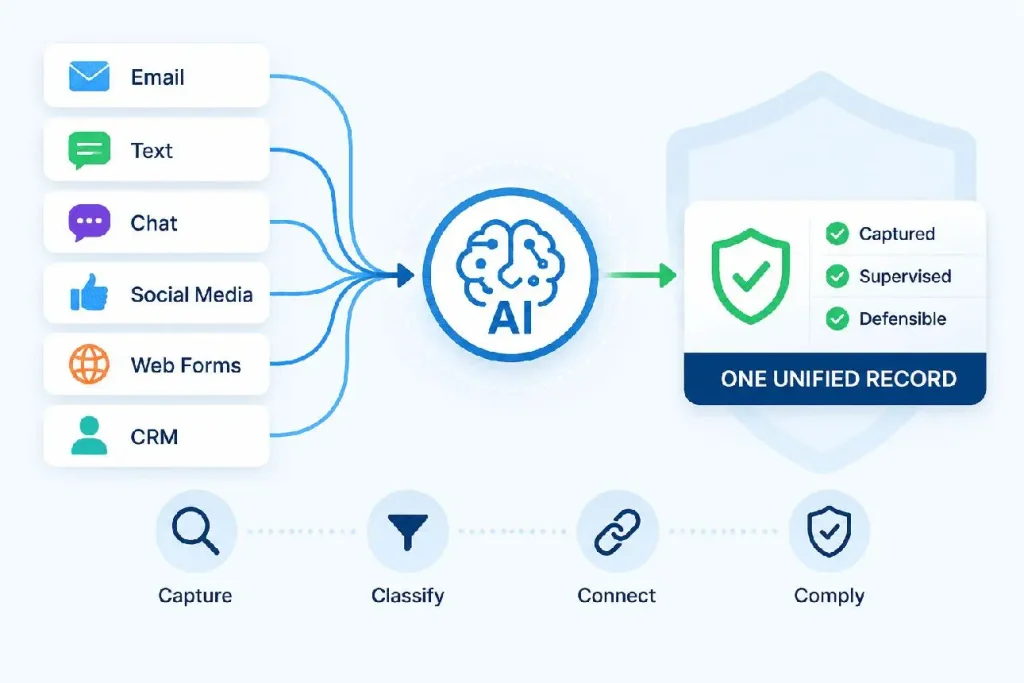
Data is the starting point for most modern AI systems. Without relevant information, a machine learning model has little basis from which to learn useful patterns.
The type of data required depends on the task. A speech-recognition system needs audio and language data, while an image-recognition system requires visual examples. A recommendation system may rely on information about searches, clicks, purchases, ratings, and other user interactions.
AI systems can obtain information from many different sources, including websites, digital documents, databases, images, videos, audio recordings, sensors, scientific datasets, and business records.
For example, a recommendation system can analyze what users watch, search for, purchase, or interact with. Over time, these interactions can provide information that helps the system identify patterns in preferences.
However, collecting a huge amount of information does not automatically produce a good AI system. Data quality matters just as much as data quantity. Data may contain errors, missing information, incorrect labels, or patterns that do not properly represent the situations the model will encounter later.
Developers therefore need to consider whether the data is relevant, accurate, sufficiently diverse, and appropriate for the intended task.
Once useful information has been collected, it needs to be prepared before an AI model can effectively learn from it.
How Does AI Process Data?

Raw data is rarely ready to be given directly to an AI model. Information collected from real-world sources can contain duplicate records, missing values, errors, inconsistent formats, or irrelevant material.
Data processing prepares this information so that algorithms and models can work with it more effectively.
The exact process depends on the type of information being used. Text, images, audio, video, and numerical records may require different preparation methods.
For example, text can be divided into smaller units and converted into numerical representations that a model can process. Images can be represented using numerical pixel values and other learned features. Audio can also be transformed into numerical representations suitable for analysis.
Data may also be separated into different groups for training and evaluation. A model can be trained using one portion of the dataset while separate information is used to evaluate how well it performs on examples it has not seen before.
This is important because a model that performs well only on its training examples may not perform well in real-world situations.
Good data processing gives an AI system a stronger foundation. Once the information is cleaned, organized, and converted into a useful format, algorithms can begin learning relationships within it.
How Do AI Algorithms Work?

An algorithm is a set of mathematical or logical steps designed to solve a problem or perform a task. In artificial intelligence, algorithms provide the methods used to analyze data, identify relationships, make predictions, and train models.
Different problems require different approaches. A classification method can determine whether an email is spam. A regression method can estimate a numerical value such as a property price. Other approaches can identify groups within data or help generate new content.
One important difference between traditional programming and machine learning is how the system obtains its behavior.
Traditional software generally relies on instructions explicitly written by programmers. A machine learning system can instead use an algorithm that allows a model to adjust its internal parameters based on data.
For example, rather than manually creating a rule for every possible fraudulent transaction, developers can train a fraud-detection model using historical examples. The model can identify statistical relationships that help it distinguish between legitimate and suspicious transactions.
This does not mean humans disappear from the process. Developers still select the data, define the task, choose an appropriate approach, configure the training process, and evaluate the results.
Algorithms provide the mathematical framework that allows an AI system to learn from examples.
How Does AI Learn From Data?
AI systems learn from data by identifying patterns and relationships that help them perform a particular task.
In supervised machine learning, a model receives examples along with known answers. It produces a prediction, compares that prediction with the expected result, and measures the difference. The model then adjusts its internal parameters to improve future predictions.
This process can be repeated across thousands, millions, or even larger numbers of examples.
Imagine an AI system that needs to recognize handwritten numbers. It can be trained using many images labeled with the correct number. At first, the model may make many mistakes. As training continues, it adjusts its parameters and becomes better at recognizing visual patterns associated with each digit.
There are several major approaches to machine learning. Supervised learning uses labeled examples, unsupervised learning looks for structures or patterns without predefined labels, and reinforcement learning uses feedback such as rewards or penalties.
One important goal is generalization. A useful AI model should not simply memorize its training examples. It should learn patterns that allow it to perform well on new examples.
This ability to learn useful patterns from examples is one of the defining ideas behind modern machine learning.
How Does AI Training Work?
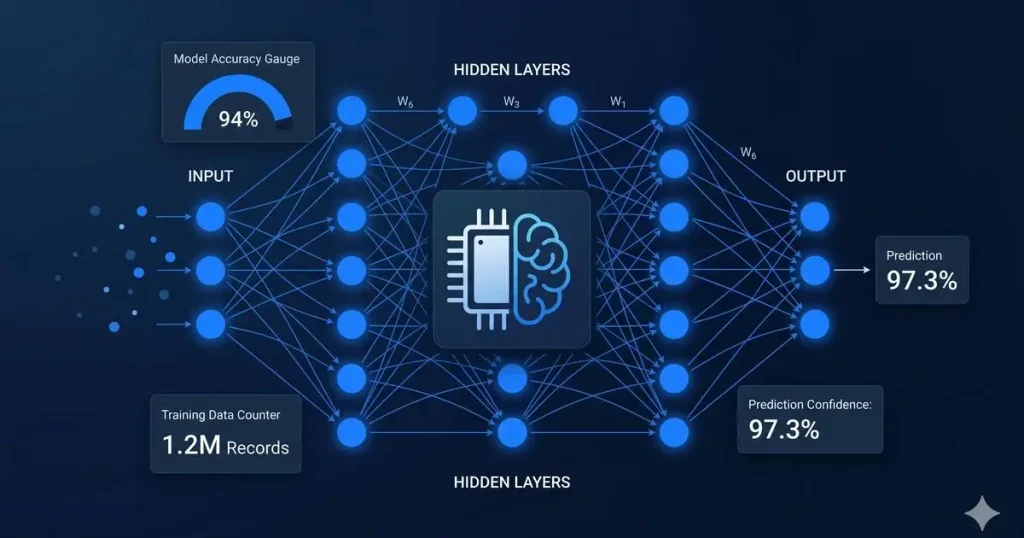
AI training is the process through which a model learns from data and adjusts its internal parameters to improve its performance.
A simplified training process works like this:
- The model receives an example from the training data.
- It produces a prediction or output.
- The prediction is compared with the expected result.
- A loss function measures the error.
- The model’s parameters are adjusted.
- The process is repeated with many other examples.
The loss function provides a mathematical measurement of how far the model’s output is from the desired result. An optimization process then adjusts the model’s parameters in an attempt to reduce that error.
This cycle can happen many times. One complete pass through a training dataset is commonly called an epoch.
For example, a fraud-detection model may be trained using historical transactions labeled as fraudulent or legitimate. Each training step helps the model adjust its parameters so that it can become better at distinguishing between the two categories.
Large AI models can require enormous amounts of data and computing power. Training can involve a huge number of mathematical operations and may take substantial time and resources.
It is also important to distinguish training from inference. Training is when the model learns and its parameters are adjusted. Inference happens later, when the trained model applies what it has learned to new input.
How Do Machine Learning Models Work?
A machine learning model is a mathematical system that has learned patterns from training data and can apply those patterns to new information.
During training, the model’s internal parameters are adjusted to represent useful relationships within the data. Once training is complete, the model can receive new input and calculate an output.
For example, imagine a model designed to estimate house prices. During training, it may receive information about property size, location, number of rooms, property type, and historical prices.
The model can learn statistical relationships between these features and property values. When it receives information about a new property, it can use those learned relationships to estimate a price.
Machine learning models can range from relatively simple methods, such as linear regression and decision trees, to highly complex neural networks.
The model’s output depends on the task it was trained for. It might classify an image, predict a number, identify unusual activity, recommend content, or generate text.
Rather than containing a simple list of human-written instructions for every situation, a trained model contains learned parameters that represent patterns discovered during training.
The quality of its output depends on many factors, including the quality of the training data, model architecture, training process, and the relationship between new input and the examples used during training.
One of the most important model architectures in modern AI is the neural network.
How Do Neural Networks Work?
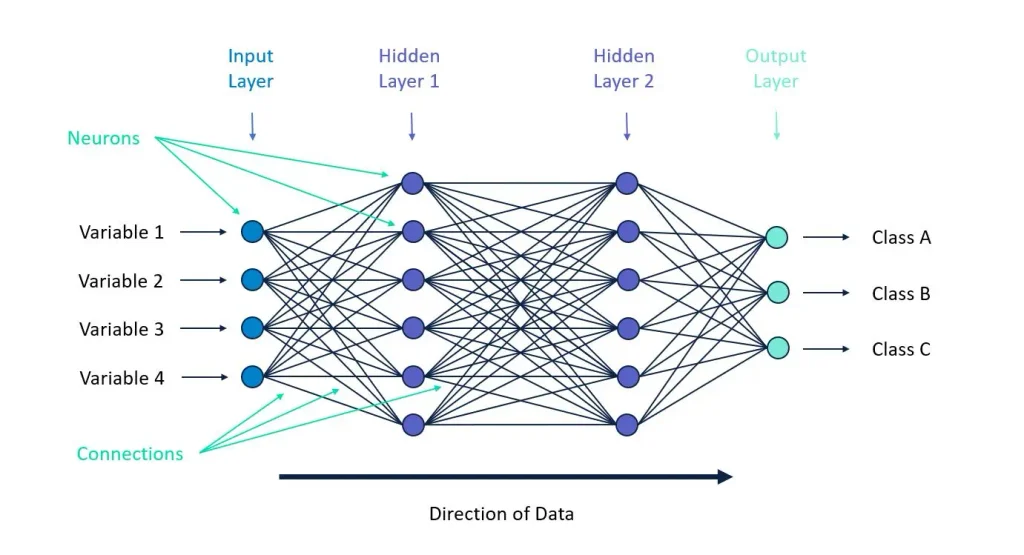
A neural network is a type of machine learning model made up of interconnected computational units commonly called neurons or nodes.
Although neural networks are loosely inspired by biological neurons, artificial neural networks work through mathematical calculations rather than operating like a human brain.
A basic neural network contains an input layer, one or more hidden layers, and an output layer.
Information enters through the input layer and moves through the network. Connections between nodes have numerical weights that influence how the information is transformed.
During training, these weights are adjusted according to the errors made by the model. Over many training steps, the network can learn which combinations of features are useful for its task.
For example, consider an image-recognition system. Early layers may learn simple visual features such as edges, lines, and colors. Later layers can combine these features into shapes and more complex structures.
Eventually, deeper parts of the network can represent features associated with objects such as faces, vehicles, animals, or buildings.
Neural networks are particularly useful for complex information such as images, audio, video, and natural language.
The more layers a neural network has, the more complex representations it can potentially learn. Networks with many layers form the foundation of deep learning.
How Does Deep Learning Work?
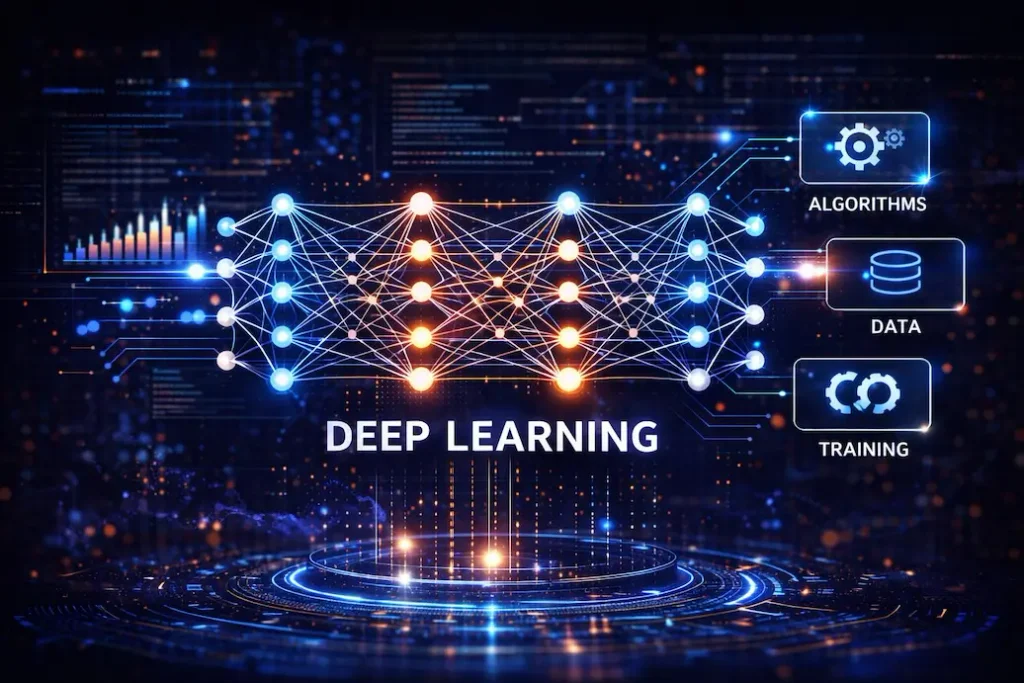
Deep learning is a branch of machine learning that uses neural networks with multiple layers to learn complex patterns from large amounts of data.
The word “deep” refers to the depth of the network. Each layer transforms the information it receives and passes a new representation to the next layer.
Consider an image-recognition model. An early layer might identify simple edges and colors. Middle layers can combine those features into shapes and textures. Deeper layers can use those representations to identify more complex objects.
This layered approach allows deep learning models to learn useful features automatically rather than requiring developers to manually define every important characteristic.
Deep learning is used in many areas of modern AI, including computer vision, speech recognition, natural language processing, recommendation systems, language models, and generative AI.
Training deep learning models can require large datasets and powerful computing hardware because the networks may contain millions, billions, or even more adjustable parameters.
One of the major strengths of deep learning is its ability to work with complex and unstructured data. Instead of relying entirely on manually written rules, the model can learn multiple levels of representation from examples.
These learned representations help the system identify patterns that can then be used for prediction, classification, generation, and other tasks.
How Does AI Recognize Patterns?
Pattern recognition is one of the most important capabilities of many AI systems. It involves identifying recurring structures, relationships, and statistical features within data.
During training, an AI model receives many examples and adjusts its parameters to become better at identifying patterns that are relevant to its task.
For example, an image-recognition model can learn visual patterns that help distinguish between different objects. A speech-recognition model can learn relationships between sounds and language. A recommendation system can identify patterns between user behavior and content preferences.
Pattern recognition is also used in areas such as fraud detection, search, medical image analysis, natural language processing, and predictive analytics.
The model does not necessarily understand these patterns in the same way a human does. Instead, it uses statistical relationships learned from data to determine what output is appropriate for a given input.
This distinction is important. An AI system can recognize highly complex patterns without having human-like consciousness or understanding.
Once an AI model has learned useful patterns, it can apply them to information it has not previously seen. This is where inference and prediction become important.
How Does AI Make Predictions and Decisions?

After training, an AI model can receive new information and use its learned parameters to produce a prediction or support a decision.
This process is generally called inference.
During inference, the model normally does not adjust its parameters in the same way it does during training. Instead, it applies the patterns already encoded in the model to the new input.
For example, a weather prediction system can analyze current atmospheric conditions and produce a forecast based on patterns learned from historical data.
A fraud-detection system can examine a financial transaction and estimate how closely it resembles patterns associated with fraudulent activity.
Many AI systems produce probabilities rather than absolute certainty. A model might determine that an input has a 90% probability of belonging to one category and a lower probability of belonging to another.
In some applications, these predictions are combined with additional rules or thresholds.
For example, a financial system could flag a transaction for additional review when the estimated risk exceeds a particular threshold.
The prediction or decision is then passed to the next stage, where the system converts it into an understandable and useful output.
How Does AI Generate an Output?
After an AI model processes new input, it produces a result that can be presented to a user or another computer system.
The type of output depends on what the AI application is designed to accomplish.
A classification model might produce a label such as spam or not spam. A recommendation system might generate a list of suggested products or movies. A computer vision system might identify objects in an image.
A language model can generate text based on the user’s prompt.
For example, when you ask a voice assistant about the weather, the system processes your request, determines what information is required, and produces a response that can be displayed or spoken.
Internally, AI models perform mathematical calculations using numerical representations. The application then converts those calculations into a form that users can understand.
The final output could be text, a number, a recommendation, an image, audio, a classification, or an alert.
This is the stage where the work performed by the AI model becomes visible to the user.
Modern generative AI systems take this process further by creating new content rather than simply assigning labels or making numerical predictions.
How Does Generative AI Work?
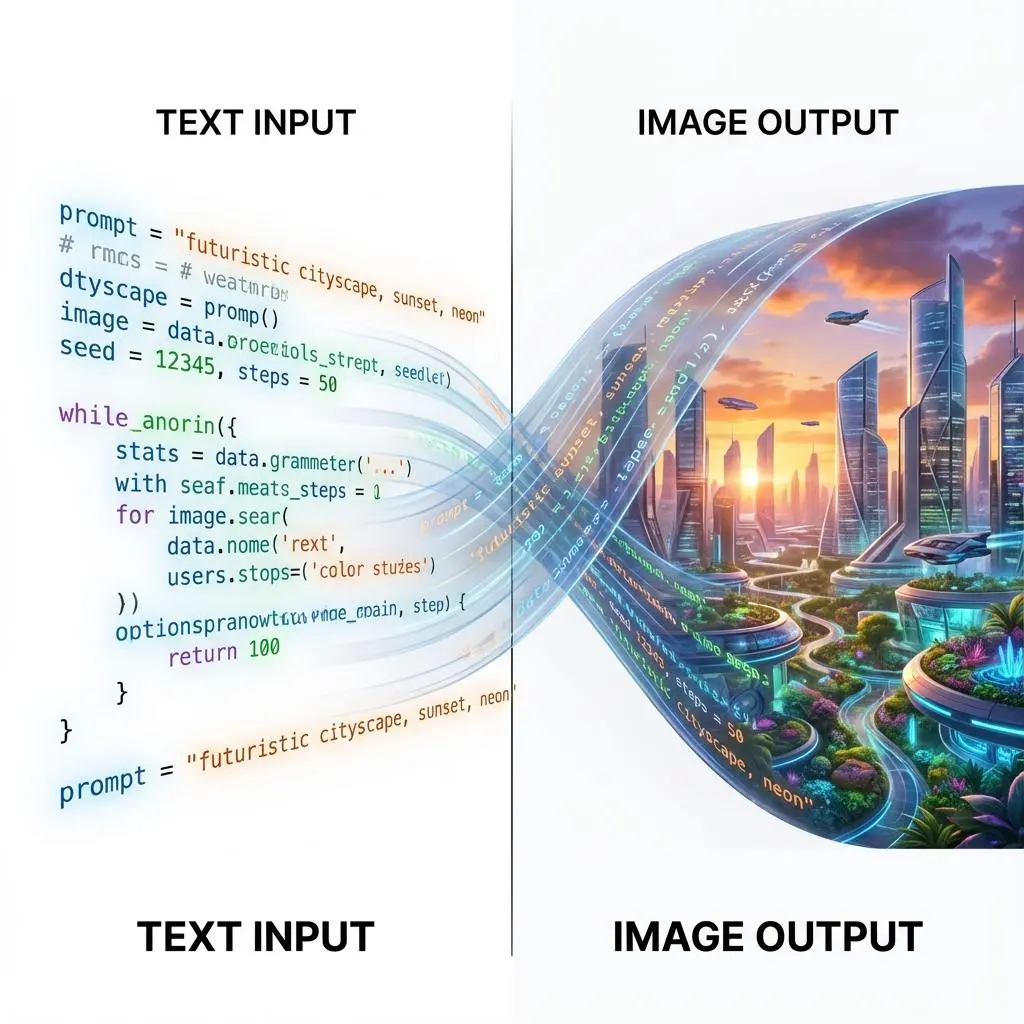
Generative AI refers to AI systems designed to create new content such as text, images, audio, video, or code.
ChatGPT is an example of a generative AI application. AI image generators are another example.
Generative models are trained on large datasets so that they can learn patterns and structures within a particular type of content.
For example, a language model learns statistical relationships within text. It develops representations that help it determine which tokens are likely to follow others in a particular context.
When a user enters a prompt, the model processes the input and generates an output based on the patterns represented in its parameters.
For many language models, generation occurs token by token. The model predicts a suitable next token based on the context, adds it to the sequence, and continues the process until the response is complete.
This means generative AI is not simply retrieving one pre-written response from a database. Instead, it is generating an output from learned patterns based on the input and context.
Different generative AI systems use different architectures, datasets, and training techniques, so they do not all operate in exactly the same way.
However, they share the broader AI concepts of data, training, learned representations, inference, and output generation.
How Does AI Improve Over Time?
AI systems can improve through new data, retraining, fine-tuning, better model architectures, improved evaluation, and other development methods.
However, it is important not to assume that every AI system continuously learns from every interaction. Most deployed models do not automatically change their internal parameters each time a person uses them.
Instead, developers can introduce improvements through controlled updates.
For example, a spam filter can be retrained using newer examples of unwanted messages. As spam techniques change, updated training data can help the model recognize newer patterns.
Fine-tuning is another approach. Developers can take an existing model and provide additional training on a more specific dataset to improve its performance for a particular task.
AI systems can also be improved through:
- Higher-quality training data
- More diverse examples
- Better model architectures
- Fine-tuning
- Improved training methods
- Better evaluation and testing
User feedback can also help developers identify weaknesses. If a system consistently performs poorly in a particular situation, developers can investigate the problem and determine whether changes to the data, model, or application are necessary.
This means AI improvement is often deliberate rather than automatic.
How Does AI Work in Real-World Applications?
The concepts discussed throughout this article come together in the AI systems people use every day.
Voice assistants use speech recognition and natural language processing to interpret requests and generate responses. Recommendation systems analyze user behavior to suggest products, movies, music, or other content.
Computer vision systems can analyze images and videos to identify objects, detect patterns, or perform specific visual tasks.
AI is also used in customer service, fraud detection, search engines, translation, predictive analytics, and content generation.
In healthcare, AI systems can assist with certain tasks such as analyzing medical images or identifying patterns in clinical data, depending on the application and appropriate professional oversight.
Despite their differences, many of these applications follow the same broad process:
Data is collected and processed → a model learns patterns → new input is provided → inference takes place → the system generates an output.
The exact technology can be extremely sophisticated, but the basic principle remains understandable.
Artificial intelligence is not one single technology or one universal algorithm. It is a broad field that includes machine learning, neural networks, deep learning, natural language processing, computer vision, and generative AI.
Understanding the journey from data to learning, inference, and output gives you a practical foundation for understanding what happens inside many AI systems.
Conclusion
Understanding how artificial intelligence works becomes much easier when the technology is viewed as a connected process rather than a mysterious black box.
It starts with data. That data is collected, processed, and used to train a model. During training, the model learns patterns by adjusting its internal parameters. Once training is complete, the model can receive new information and apply what it has learned during inference.
The result can be a prediction, recommendation, classification, decision, or newly generated piece of content.
Technologies such as machine learning, neural networks, deep learning, and generative AI use these principles in different ways. The exact architecture and training process can vary significantly from one AI system to another, but the fundamental journey remains similar.
Data → Training → Learning → Inference → Output
Once you understand this basic workflow, the technology behind everyday AI tools becomes much easier to follow. Whether you are using a recommendation system, voice assistant, image-recognition tool, or generative AI application, the system is ultimately using computational methods to process information and produce useful results.
Frequently Asked Questions
-
What is artificial intelligence?
Artificial intelligence is a field of technology that enables computer systems to perform tasks that can involve pattern recognition, prediction, language processing, classification, and content generation.
-
How does artificial intelligence learn?
Many AI systems learn through machine learning. The model is trained using examples and adjusts its internal parameters to identify patterns that help it perform a specific task.
-
What is the difference between AI training and inference?
Training is the process in which a model learns from data and adjusts its parameters. Inference happens after training, when the model applies those learned parameters to new input to produce an output.
-
Does AI think like a human?
AI can perform tasks that appear intelligent, but it does not necessarily think or understand information in the same way humans do. AI models use computational processes and patterns learned from data.
-
How does generative AI create content?
Generative AI models learn patterns from training data and use those learned representations to generate new content based on an input. Depending on the system, the output can be text, images, audio, video, or code.