
Have you ever asked your phone a question and received an answer in seconds? Or noticed how Netflix, YouTube, or an online store seems to understand what you might want to watch or buy next? These experiences are powered, at least in part, by artificial intelligence. But what is artificial intelligence, and how does it actually work?
In simple terms, artificial intelligence, or AI, is a field of computer science focused on creating systems that can perform tasks that typically require human intelligence. These tasks can include understanding language, recognizing images and speech, finding patterns in data, solving problems, making predictions, and supporting decisions. Modern AI often uses algorithms and large amounts of data to identify patterns and produce useful results without requiring programmers to write a separate instruction for every possible situation.
AI is no longer limited to research laboratories or science-fiction stories. It is already part of smartphones, search engines, streaming platforms, online shopping, healthcare, banking, education, and countless other areas of modern life.
In this guide, you’ll learn how artificial intelligence works, the different types of AI, the role of machine learning and deep learning, real-world applications, its benefits and challenges, and what the future of AI may look like.

Artificial intelligence refers to the ability of computer systems and machines to perform tasks that normally require certain forms of human intelligence. Depending on the system, these tasks may involve understanding spoken or written language, recognizing objects in images, identifying patterns, generating content, solving problems, making predictions, or assisting with decisions.
AI is not a single program or piece of software. It is a broad field that includes different techniques, models, and technologies designed for different purposes. Some AI systems are built to recognize patterns in data, while others process language, analyze images, recommend content, or generate new material such as text, images, audio, video, or code.
Modern AI systems often depend on algorithms, statistical methods, and data. During development, a model can be trained on relevant examples so that it learns patterns associated with a particular task. When the trained model receives new information, it can use those learned patterns to generate a prediction, classification, recommendation, or other output.
It is important to understand that AI does not necessarily think or understand the world in the same way a human does. A system can perform an impressive task without possessing human-like consciousness, emotions, or general understanding. Its capabilities depend heavily on how it was designed, trained, and evaluated.
Today, AI ranges from highly specialized applications to increasingly capable systems that can perform multiple types of tasks. Understanding this distinction makes it easier to appreciate both what artificial intelligence can accomplish and where its limitations remain.
How Does Artificial Intelligence Work?
At a basic level, artificial intelligence works by combining data, algorithms, computational methods, and models to produce useful outputs. The exact process varies depending on the type of AI system, but many modern applications involve training a model to recognize patterns in examples and then using that model to process new information.
The process often begins with data. Depending on the application, this might include text, images, audio, video, numbers, sensor readings, or other forms of information. Before the data can be used effectively, it may need to be collected, organized, cleaned, labeled, or transformed into a suitable format.
During training, an AI model processes examples and adjusts internal parameters according to a defined learning objective. In supervised machine learning, for example, the model can compare its predictions with known answers and gradually reduce its errors. Other approaches use different methods to learn useful representations or behaviors from data.
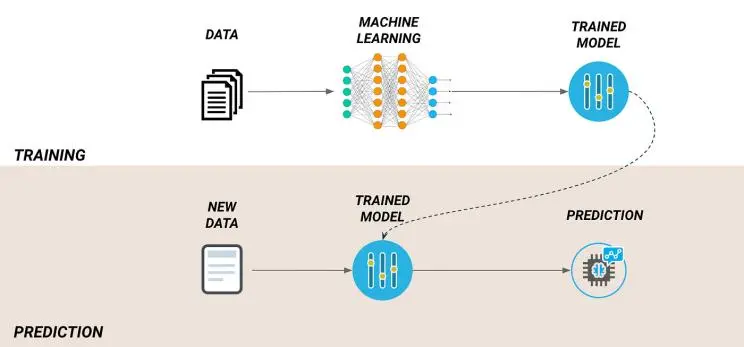
After training, the model can be evaluated using data it has not previously encountered. This helps developers determine how well it can generalize beyond its training examples. A model that performs well on its training data but poorly on new data may have learned the training examples too closely rather than learning patterns that transfer to real-world situations.
Many advanced AI systems use neural networks. These networks contain layers of interconnected computational units that transform information as it passes through the model. Deep learning uses neural networks with many layers and has become particularly important for tasks involving images, speech, language, and other complex forms of data.
Once deployed, an AI system can use what it has learned to analyze new inputs and generate outputs. Depending on the application, that output might be a recommendation, prediction, classification, generated response, or automated action.
Why Is Artificial Intelligence Important?
Artificial intelligence has become important because it can help people and organizations work with large amounts of information, automate certain tasks, and develop new ways of solving problems. Its impact is not limited to one industry. AI is being incorporated into technology products, businesses, scientific research, healthcare, finance, education, manufacturing, transportation, and many other fields.
One major reason organizations use AI is automation. Certain repetitive tasks can be performed by software instead of requiring people to handle every step manually. Customer-service systems, document processing, data analysis, scheduling, and other routine activities can sometimes be supported or automated with AI.
AI can also help people identify patterns in large datasets. In healthcare, for example, researchers and medical professionals can use AI-based systems to analyze medical images or other information as part of broader workflows. In finance, machine learning can be used to identify unusual transaction patterns that may warrant further investigation.
Another important aspect of AI is its ability to support personalization. Recommendation systems can analyze patterns in user behavior to suggest movies, music, products, articles, or other content. This can make digital services more relevant to individual users.
The rise of generative AI has expanded the conversation even further. Systems capable of generating text, images, audio, video, and code have introduced new possibilities for creativity, communication, research, and software development.
At the same time, AI should not be viewed as automatically correct or superior to human judgment. Its usefulness depends on the quality of its data, design, evaluation, and deployment. In many important situations, human oversight remains essential.
What Are the Main Types of AI?
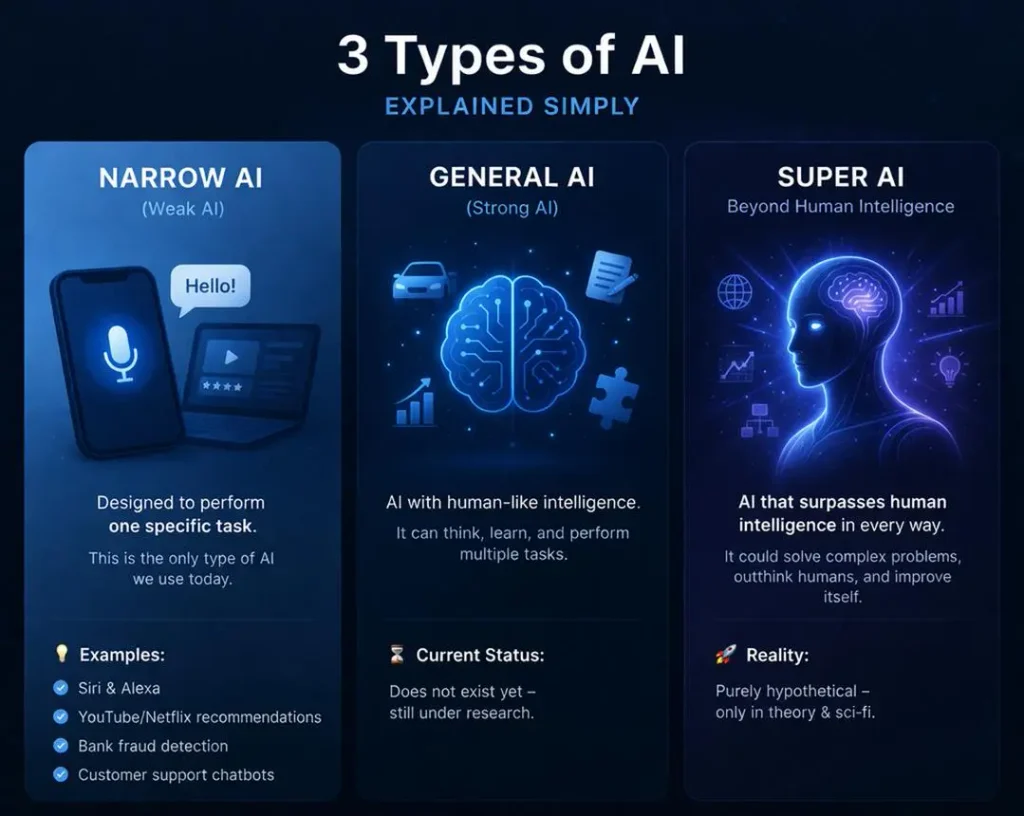
Artificial intelligence can be classified in different ways, and there is no single classification that covers every AI system. One commonly discussed framework categorizes AI according to its level of capability: narrow AI, artificial general intelligence, and artificial superintelligence.
Narrow AI, sometimes called weak AI, refers to systems designed to perform specific tasks or a defined range of related tasks. Most AI applications available today fall into this category. A recommendation system may be highly effective at suggesting content, for example, while a speech-recognition system may specialize in converting spoken language into text.
Artificial general intelligence, commonly known as AGI, describes a hypothetical form of AI that could perform a broad range of intellectual tasks with a level of flexibility comparable to humans. Such a system would not be restricted to one narrow application and would theoretically be able to learn and adapt across many different domains. AGI has not been established as a achieved form of technology today, and there is ongoing debate about how it should be defined and measured.
Artificial superintelligence refers to a hypothetical system whose intellectual capabilities would exceed those of humans across a very broad range of domains. This remains a speculative concept rather than an existing technology.
AI can also be categorized according to how systems operate, such as reactive systems and systems that use learned information or memory-like mechanisms. These classifications are useful for understanding AI, but they should not be treated as rigid categories that describe every modern system perfectly.
What Is Narrow AI?
Narrow AI refers to an artificial intelligence system designed to perform a specific task or a limited group of related tasks. It does not possess general-purpose intelligence and cannot automatically transfer its capabilities to completely unrelated problems.
Most AI that people interact with today can be described as narrow AI. Voice assistants can recognize speech and respond to requests, recommendation systems can suggest content based on patterns in user behavior, and spam filters can identify messages that appear unwanted or suspicious.
The strength of narrow AI comes from specialization. A system designed for a particular task can become extremely capable within that domain. For example, an AI system trained for image classification may identify particular objects or patterns with high accuracy under appropriate conditions. That same system, however, would not suddenly know how to write an essay, operate a vehicle, or conduct a conversation unless it had been designed and trained for those capabilities.
Many narrow AI systems use machine learning, and some rely on deep learning. Their performance depends on factors such as training data, model architecture, objectives, testing methods, and the environment in which the system is used.
The term “narrow” therefore does not mean that the technology is weak or unimportant. It simply describes the scope of the system. A highly specialized AI can be remarkably capable while still remaining limited to the task for which it was developed.
What Is Generative AI?
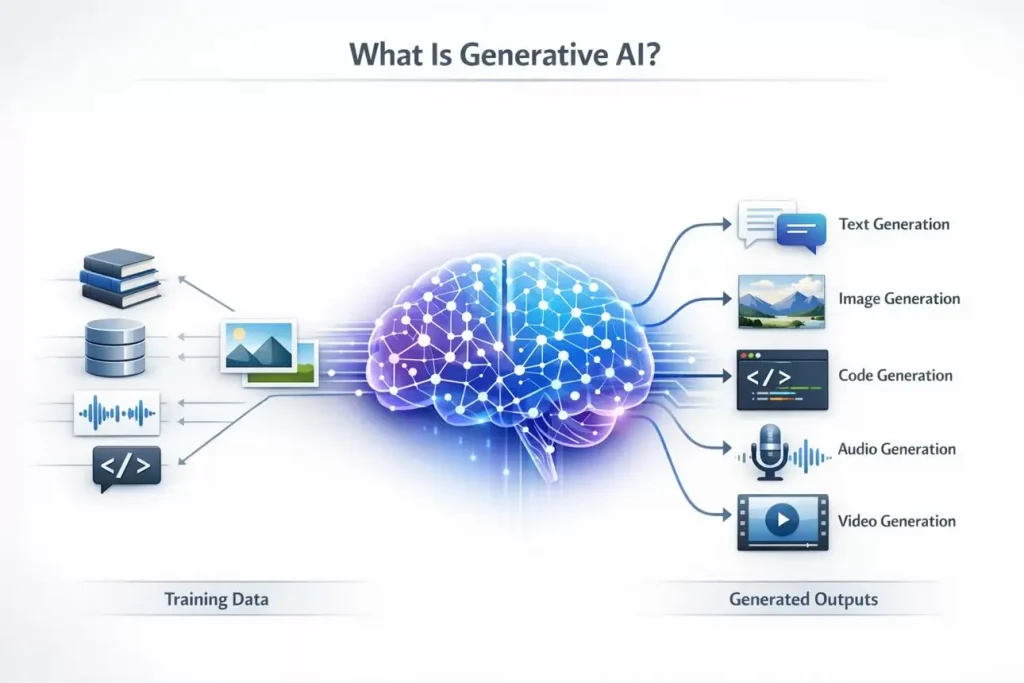
Generative AI is a category of artificial intelligence designed to generate new content in response to an input or prompt. Depending on the system, that content can include text, images, audio, video, software code, or other forms of media.
Traditional AI applications often focus on tasks such as classification, prediction, recommendation, or pattern recognition. Generative AI adds another capability: producing new outputs based on patterns learned during training. For example, a language model can generate a written response to a prompt, while an image-generation model can create an image based on a textual description.
Many modern generative AI systems are built using deep learning. Transformer-based architectures have become particularly influential in language and multimodal applications because they can process relationships between elements of information and use context to generate outputs.
Generative AI has quickly become useful in areas such as writing assistance, software development, design, education, research, marketing, and customer support. People can use these systems to brainstorm ideas, summarize information, create drafts, analyze content, or generate creative material.
However, generated content is not automatically accurate simply because it appears fluent or convincing. Generative AI systems can produce incorrect information, fabricated details, or misleading outputs. These errors are sometimes described as AI hallucinations. For that reason, important information generated by AI should be reviewed and verified when accuracy matters.
What Is Machine Learning in AI?
Machine learning is a subset of artificial intelligence that enables computer systems to learn patterns from data and use those patterns to make predictions or decisions. Instead of programmers manually defining every rule for every situation, machine learning algorithms can identify relationships within examples during a training process.
A machine learning system generally begins with data relevant to the problem it is designed to solve. The algorithm then uses that data to learn a model. During training, the model adjusts its internal parameters according to an objective, such as reducing prediction errors.
There are several major approaches to machine learning. In supervised learning, models learn from labeled examples in which the desired output is known. This approach can be used for tasks such as classifying emails or predicting numerical values. Unsupervised learning works with data without predefined labels and can help identify patterns, structures, or groups within the information. Reinforcement learning uses feedback in the form of rewards or penalties to help a system learn how to make decisions within an environment.
Machine learning is used in many everyday technologies, including recommendation systems, spam detection, predictive text, fraud detection, and image recognition. It also provides an important foundation for deep learning.
The key idea is that machine learning allows systems to learn useful patterns from data rather than relying entirely on manually written rules. However, the quality of the resulting model still depends on factors such as data quality, model design, training methodology, and evaluation.
What Is Deep Learning?
Deep learning is a specialized area of machine learning that uses artificial neural networks with multiple computational layers. These networks are loosely inspired by biological neural networks, but they are mathematical and computational systems rather than replicas of the human brain.
The word “deep” refers to the multiple layers through which information is processed. Different layers can learn different representations of the input, allowing the model to identify increasingly complex patterns.
For example, in an image-recognition system, earlier layers may learn to detect simple visual features such as edges or shapes. Later layers can combine those features into more complex representations that help the model recognize objects, faces, or other patterns.
Deep learning has played a major role in advances in computer vision, speech recognition, natural language processing, and generative AI. It is particularly useful when working with large and complex datasets where manually defining all relevant features would be difficult.
Training deep learning models can require substantial amounts of data and computing resources. Modern systems often use specialized hardware to accelerate the mathematical operations involved in training and inference.
Despite its capabilities, deep learning is not a form of human-like thinking. A model can learn highly sophisticated statistical representations while still making unexpected mistakes when presented with unfamiliar situations or information outside the conditions for which it was designed.
What Are Some Real-World Examples of AI?
Artificial intelligence is already present in many products and services that people use every day. In many cases, users interact with an AI-powered feature without thinking about the technology behind it.
Voice assistants are one familiar example. Systems such as Siri, Alexa, and Google Assistant can process spoken language, identify user requests, and provide responses or perform supported actions. These capabilities rely on technologies such as speech recognition and natural language processing.
Recommendation systems are another common application. Streaming services can analyze patterns in viewing or listening behavior to recommend content that may be relevant to a particular user. Online retailers can similarly use algorithms to recommend products based on browsing activity, previous purchases, and other signals.
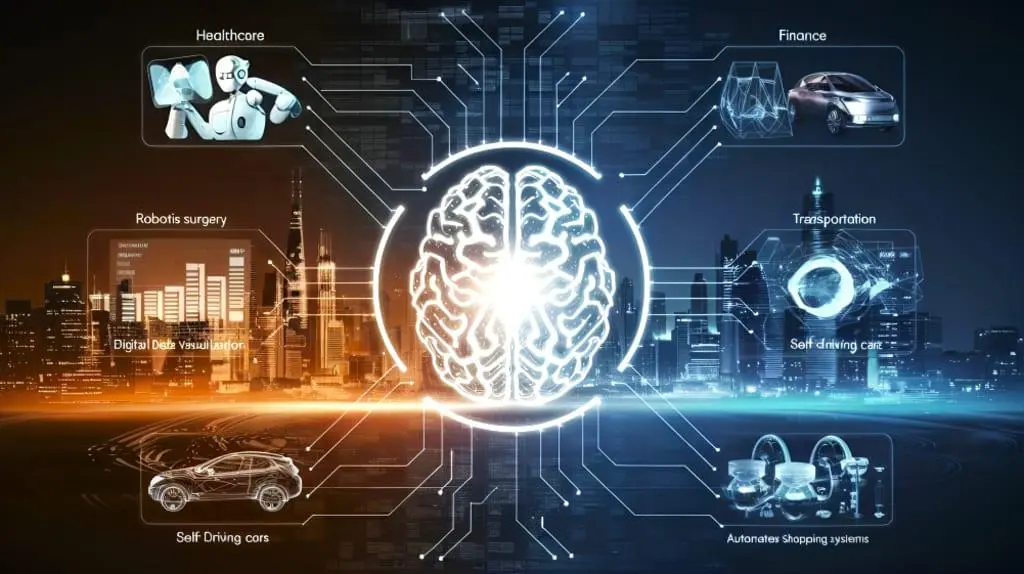
Financial institutions use machine learning in areas such as fraud detection, where systems can analyze transactions and identify patterns that may indicate suspicious activity. AI can also support customer-service operations and other financial workflows.
Healthcare is another major area of AI research and application. AI-based tools can assist with medical image analysis, research, administrative processes, and other tasks. These systems are generally intended to support professional workflows rather than replace the expertise and responsibility of qualified healthcare professionals.
Autonomous driving technology also uses AI for tasks such as interpreting sensor information and identifying objects in the vehicle’s surroundings. Meanwhile, generative AI has introduced applications that allow users to create text, images, audio, and code from natural-language instructions.
These examples show that AI is not one isolated technology. It is a collection of methods being applied to a wide range of practical problems.
How Is AI Used in Everyday Life?
Artificial intelligence has become part of everyday digital experiences, often operating in the background rather than appearing as a separate product. People may encounter AI when using smartphones, searching the internet, watching videos, shopping online, writing messages, or navigating to a destination.
Smartphones use AI-related technologies for features such as speech recognition, predictive text, image processing, facial recognition, and personalized suggestions. These systems analyze information and use learned patterns to provide useful features or automate certain interactions.
Social media platforms also use algorithms to organize and recommend content. The posts, videos, advertisements, and other material shown to users can be influenced by signals such as previous interactions, viewing behavior, and engagement patterns.
Navigation applications can process large amounts of information about roads, traffic, and routes to provide estimated travel times and route recommendations. Email services use machine learning to detect spam and categorize messages, helping users manage large inboxes.
Online shopping platforms use recommendation systems to suggest products that may be relevant to a user’s interests or previous activity. Chatbots can also answer common customer-service questions without requiring a human agent to handle every interaction.
Entertainment services use similar technologies to personalize recommendations for movies, shows, music, and other content.
These applications demonstrate how AI can become embedded into software without requiring users to understand the underlying models. The technology may be complex, but its purpose in everyday products is often straightforward: analyze information and provide a useful response, recommendation, prediction, or automated action.
How Is AI Used in Business?
Businesses use artificial intelligence in a wide range of functions, from customer support and marketing to operations, analytics, software development, and research. The specific value of AI depends on the business problem, available data, implementation quality, and the level of human oversight involved.
Customer service is one common application. AI-powered chatbots can handle routine questions, provide information, and direct customers toward appropriate resources. More complex cases can still be transferred to human representatives.
Marketing teams can use machine learning to analyze customer behavior, segment audiences, personalize experiences, and identify patterns in campaign performance. Predictive models can also help businesses estimate demand or identify trends in their data.
In manufacturing and supply chain operations, AI can support demand forecasting, quality inspection, inventory planning, and predictive maintenance. By analyzing equipment data, some systems can identify patterns associated with potential failures and allow organizations to investigate problems earlier.
Businesses also use AI for document processing, data analysis, fraud detection, risk assessment, and software development. Generative AI has expanded these applications by helping employees draft content, summarize documents, generate code, and work with large amounts of information.
Human resources departments may use AI-assisted tools for tasks such as organizing applications or identifying information in resumes, although these applications require careful evaluation because automated systems can reproduce biases present in their data or design.
Ultimately, successful business use of AI is not simply about adopting the newest technology. Organizations need to consider accuracy, privacy, security, costs, compliance, and appropriate human oversight before deploying AI in important workflows.
What Are the Benefits of Artificial Intelligence?
Artificial intelligence can provide several practical benefits when it is designed and used appropriately. One of its most visible advantages is automation. AI can assist with repetitive processes, allowing people to spend more time on tasks that require creativity, judgment, communication, or specialized expertise.
AI can also process large datasets at a scale that would be difficult for people to handle manually. This makes it useful for identifying patterns, generating predictions, and supporting data-driven analysis.
Another potential benefit is personalization. Recommendation systems can use information about user behavior to provide more relevant content, products, or services. In education and software applications, AI can also support experiences that adapt to individual needs or interactions.
AI can improve productivity by helping people complete certain tasks more quickly. Generative AI, for example, can assist with drafting, summarization, brainstorming, coding, and other forms of knowledge work. The usefulness of these tools still depends on human review and the quality of the output.
Artificial intelligence can also contribute to accessibility. Speech recognition, translation, image description, and other AI-supported technologies can help people interact with digital information in different ways.
However, these benefits are not guaranteed simply because AI is involved. A poorly designed or poorly evaluated system can produce unreliable results, create additional work, or introduce new risks. The real benefit comes from applying the technology to an appropriate problem with suitable data, testing, safeguards, and oversight.
What Are the Risks and Challenges of AI?
Artificial intelligence also creates important challenges that need to be considered alongside its potential benefits. One major issue is privacy. AI systems may process large amounts of information, including data that can be sensitive or personally identifiable. How that information is collected, stored, shared, and used can have significant consequences.
Bias is another challenge. Machine learning systems learn from data and design choices, and those inputs can contain historical or social biases. If these issues are not identified and addressed, an AI system may produce unfair outcomes in areas such as employment, lending, or access to services.
Employment is another area of concern. Automation can change the tasks people perform and may reduce demand for some forms of work while creating demand for other skills and occupations. The effects can vary significantly across industries, jobs, and economies.
Transparency can also be difficult. Some complex AI models are difficult to interpret in detail, making it challenging to understand why a particular output was produced. This can become especially important when AI is used in high-stakes environments.
Security and misuse present additional concerns. AI can be used to create convincing fraudulent content, automate certain forms of cyber abuse, or generate misleading media. Deepfakes and synthetic content can make it more difficult to distinguish authentic material from fabricated material.
AI systems can also make mistakes. Over-relying on an automated system without appropriate human review can allow errors to go unnoticed.
These challenges have increased attention toward responsible AI development, including privacy protections, fairness testing, security measures, transparency, accountability, and appropriate human oversight.
What Is the Difference Between AI, Machine Learning, and Deep Learning?
Artificial intelligence, machine learning, and deep learning are related terms, but they describe different levels of the same broader concept.
Artificial intelligence is the broadest term. It refers to the field of creating systems capable of performing tasks associated with forms of human intelligence, such as reasoning, language processing, pattern recognition, prediction, and decision-making. AI does not always require machine learning. Some earlier AI systems, for example, relied heavily on predefined rules.
Machine learning is a subset of AI. It focuses on methods that allow systems to learn patterns from data and use those patterns to make predictions or decisions. Instead of manually specifying every rule, developers train models using examples and evaluate how well those models generalize to new data.
Deep learning is a subset of machine learning. It uses multilayer neural networks to learn complex representations from data. Deep learning has become particularly important for areas such as computer vision, speech recognition, natural language processing, and generative AI.
The relationship can therefore be understood as nested categories. Artificial intelligence is the broader field, machine learning is one major approach within AI, and deep learning is a specialized approach within machine learning.
This distinction is useful because the three terms are often used interchangeably in everyday discussions even though they do not mean exactly the same thing.
What Is the Future of Artificial Intelligence?
The future of artificial intelligence is likely to involve continued improvements in the capabilities, efficiency, and integration of AI systems. Recent research and industry data also provide a broader view of how AI capabilities and adoption are developing. However, exactly how quickly these changes will occur and what form they will take remains uncertain.
Generative AI is one area receiving significant attention. Future systems may become more capable at working with combinations of text, images, audio, video, and other types of information. This could expand their use in areas such as software development, education, research, design, communication, and content production.
Researchers are also exploring systems with broader reasoning and problem-solving capabilities. Artificial general intelligence remains a debated and hypothetical concept, and there is no universally accepted test that establishes when such a system has been achieved.
AI is also likely to become more deeply integrated into existing products and infrastructure. Healthcare, transportation, manufacturing, education, scientific research, and other sectors are already exploring ways to incorporate AI into their workflows.
Robotics could also benefit from advances in AI, particularly as systems become better at interpreting their surroundings and responding to changing environments. At the same time, increased capability may make questions about safety, accountability, privacy, employment, and regulation even more important.
The future of AI will therefore depend on more than technical progress. Researchers, businesses, governments, and society will also need to determine how these systems should be developed, tested, deployed, and governed.
Artificial intelligence is already changing the way people interact with technology. As the field continues to develop, understanding both its capabilities and limitations will become increasingly important.
History of Artificial Intelligence
The history of artificial intelligence stretches back several decades, long before modern AI assistants and generative AI became part of everyday life. The field developed gradually through advances in mathematics, logic, computer science, computing power, and machine learning. Each period introduced new ideas that helped shape the AI technologies we use today.
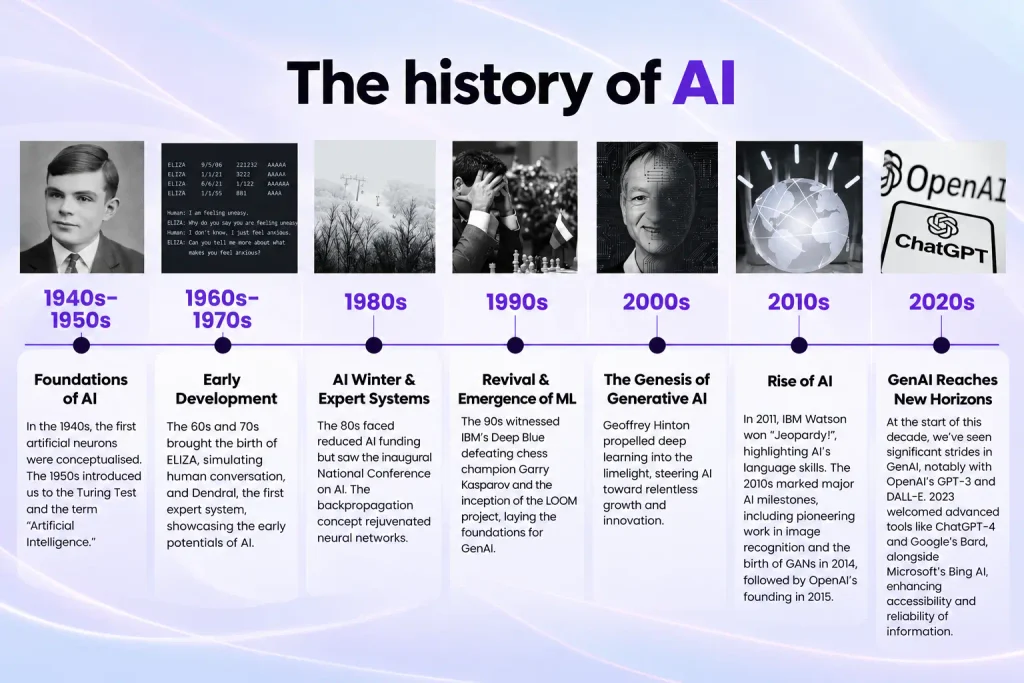
1943–1950: The Early Foundations of AI
The foundations of modern AI began taking shape in the 1940s as researchers explored whether mathematical models could represent how biological neurons process information. Early work on artificial neural networks helped establish the idea that machines could potentially perform forms of information processing inspired by the human brain.
In 1950, British mathematician and computer scientist Alan Turing published his influential paper “Computing Machinery and Intelligence.” He raised the question of whether machines could demonstrate intelligent behavior and introduced what later became known as the Turing Test.
1956: The Birth of Artificial Intelligence
The year 1956 is widely associated with the formal beginning of artificial intelligence as an academic field. At the Dartmouth Summer Research Project on Artificial Intelligence, researchers gathered to explore whether aspects of human intelligence could be described precisely enough for machines to simulate them.
The term “artificial intelligence” was used to describe this emerging area of research. The meeting helped establish AI as a distinct field and encouraged researchers to investigate machine reasoning, problem-solving, language, and learning.
1960s–1970s: Early AI Programs
During the 1960s and 1970s, researchers developed computer programs capable of solving specific problems using symbolic reasoning and predefined rules. Some systems could play games, solve mathematical problems, understand limited forms of natural language, or demonstrate basic reasoning abilities.
These early achievements generated considerable optimism about the future of AI. However, computers at the time had limited processing power and memory, and AI systems struggled when faced with complex real-world environments.
1980s: Expert Systems
During the 1980s, expert systems became an important area of AI development. These systems were designed to reproduce the decision-making processes of human specialists within specific domains by using collections of rules and knowledge.
Businesses and organizations explored expert systems for areas such as medical diagnosis, finance, and technical troubleshooting. Although useful in certain situations, maintaining large rule-based systems could be difficult, particularly when knowledge became complex or changed over time.
1990s: Machine Learning Gains Momentum
During the 1990s, AI research increasingly shifted toward statistical methods and machine learning. Instead of relying entirely on manually written rules, researchers developed systems that could learn patterns from data.
One notable milestone came in 1997, when IBM’s Deep Blue defeated world chess champion Garry Kasparov in a match. Although Deep Blue was not a general intelligence system, its success demonstrated the ability of specialized computing systems to perform extremely complex tasks within a defined domain.
2000s: More Data and Greater Computing Power
The 2000s brought major changes to AI as the internet generated enormous quantities of digital data and computing hardware became increasingly powerful. Researchers gained access to larger datasets and improved machine learning techniques.
AI began becoming more practical for applications such as search engines, recommendation systems, speech recognition, fraud detection, and image processing. These developments created the foundation for the rapid advances that followed.
2010s: The Deep Learning Revolution
The 2010s marked a major turning point for artificial intelligence. Improvements in neural networks, large datasets, and graphics processing units helped deep learning models achieve significant advances in image recognition, speech recognition, and natural language processing.
In 2012, a deep neural network called AlexNet achieved a major result in the ImageNet image-recognition competition, helping demonstrate the practical potential of deep learning at scale.
In 2016, Google DeepMind’s AlphaGo defeated professional Go player Lee Sedol. The achievement attracted worldwide attention because Go has an enormous number of possible moves and had long been considered a difficult challenge for AI.
2020s: The Rise of Generative AI
The 2020s introduced another major phase in the development of AI: the rapid growth of generative AI. Advances in large language models, transformers, and other deep learning architectures made it possible for AI systems to generate increasingly sophisticated text, images, audio, video, and computer code.
AI assistants and generative tools became accessible to the general public, changing how people interact with artificial intelligence. Instead of using AI only behind the scenes, people could directly communicate with AI systems using ordinary language.
This period also brought greater attention to AI safety, misinformation, privacy, copyright, employment, and responsible development. As AI capabilities continue to expand, researchers and policymakers are increasingly focused not only on what these systems can do, but also on how they should be developed and used.
The Future of AI
The history of artificial intelligence shows a progression from theoretical ideas and rule-based programs to machine learning, deep learning, and highly capable generative systems. The field has experienced both periods of rapid progress and periods when expectations exceeded available technology.

Today, AI continues to evolve quickly. Future developments may lead to more capable systems, broader applications, and deeper integration into everyday technology. At the same time, the history of AI demonstrates that technological progress is rarely linear, making the future difficult to predict with certainty.
Conclusion
Artificial intelligence has evolved from an ambitious idea in computer science into a technology that is now part of everyday life. From voice assistants and recommendation systems to machine learning, deep learning, and generative AI, the field has developed significantly over the past several decades. Today, AI can help analyze information, recognize patterns, generate content, automate tasks, and support people across a wide range of industries.
Understanding AI also means understanding its limitations. Artificial intelligence does not automatically think or understand the world like a human, and its outputs can be affected by the data, models, and systems behind it. Issues such as privacy, bias, security, misinformation, and changing job requirements also make responsible development and human oversight increasingly important.
As AI continues to advance, its role in technology, business, education, healthcare, and everyday life is likely to grow. Learning the fundamentals of artificial intelligence gives you a clearer understanding of both the opportunities it creates and the challenges that come with it.
Whether you are completely new to AI or simply want to understand the technology behind the tools you use every day, knowing how artificial intelligence works is becoming an increasingly valuable part of being digitally informed.
Frequently Asked Questions About Artificial Intelligence
-
Is artificial intelligence the same as machine learning?
No. Artificial intelligence is the broader field, while machine learning is one approach used to build AI systems. Machine learning allows systems to learn patterns from data, whereas AI can also include approaches that do not rely on machine learning.
-
Is AI already being used today?
Yes. AI is already used in areas such as search, recommendation systems, voice recognition, fraud detection, image analysis, customer service, content generation, and many other applications.
-
What is generative AI?
Generative AI is a type of AI that can create new content such as text, images, audio, video, or code based on learned patterns and user inputs.
-
Can AI think like a human?
Current AI systems can perform many tasks associated with human intelligence, but that does not mean they think, understand, or experience the world in the same way humans do. Their capabilities depend on their models, training, data, and design.
-
Will artificial intelligence replace human jobs?
AI can automate or change certain tasks within jobs, but its effects vary across occupations and industries. It can also create demand for new skills and roles. The overall impact depends on how organizations adopt the technology and how workers and economies adapt.