
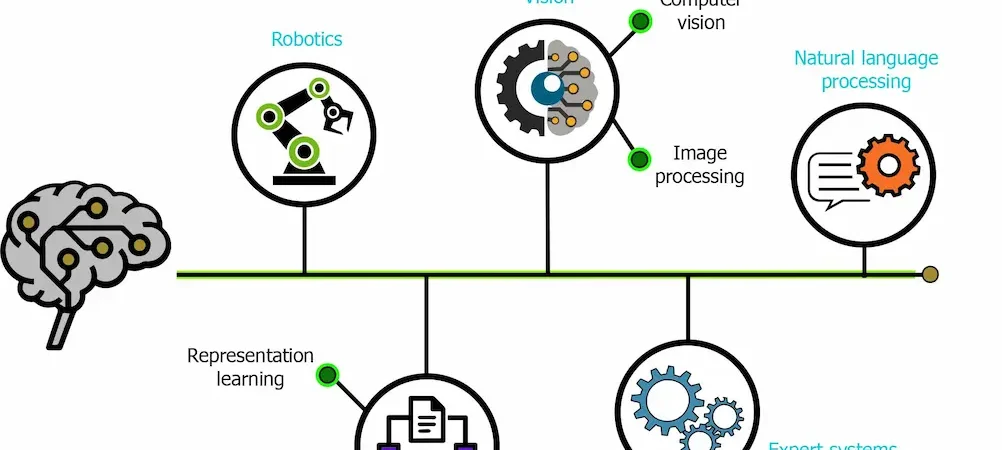
Artificial intelligence is no longer limited to research laboratories or science-fiction movies. Today, AI recommends videos, answers questions through chatbots, recognizes objects in images, understands spoken language, helps businesses analyse data, and creates text, images, audio, and other content. With so many different applications around us, it is natural to ask: what are the main types of AI?
The answer is more complex than it may seem because artificial intelligence is not a single technology or one type of system. AI can be classified in different ways, including by its capabilities, functionality, technologies, and applications.
In this article, we will explore 15 important AI categories and technologies. We will begin with capability-based categories such as: Narrow AI, Artificial General Intelligence (AGI), and Artificial Superintelligence (ASI).
Next, we will examine functionality-based categories, including: Reactive Machines, Limited Memory AI, Theory of Mind, and Self-Aware AI.
Finally, we will look at important AI technologies and approaches such as: Generative AI, Machine Learning, Deep Learning, Natural Language Processing, Computer Vision, Robotics, Expert Systems, and Reinforcement Learning.
These categories should not be treated as one single classification system. Some describe the level of intelligence an AI system is expected to have, while others describe how a system functions or the technology it uses. Some are already widely used, while others remain theoretical or are still developing.
Understanding these differences makes it easier to see how AI works today and where it could develop in the future. Let’s begin with the most widely used category: Narrow AI.
What Is Narrow AI?
Narrow AI, also called Artificial Narrow Intelligence (ANI) or Weak AI, is designed to perform specific tasks within a defined area. It does not have broad human-like intelligence. Instead, it is built and trained to handle problems or functions.
For example, a recommendation system can analyse your previous activity and suggest movies or products. A voice assistant can recognize spoken commands and respond to them. Similarly, an AI system designed to detect objects in photographs may be highly effective at image recognition without being able to perform unrelated tasks.
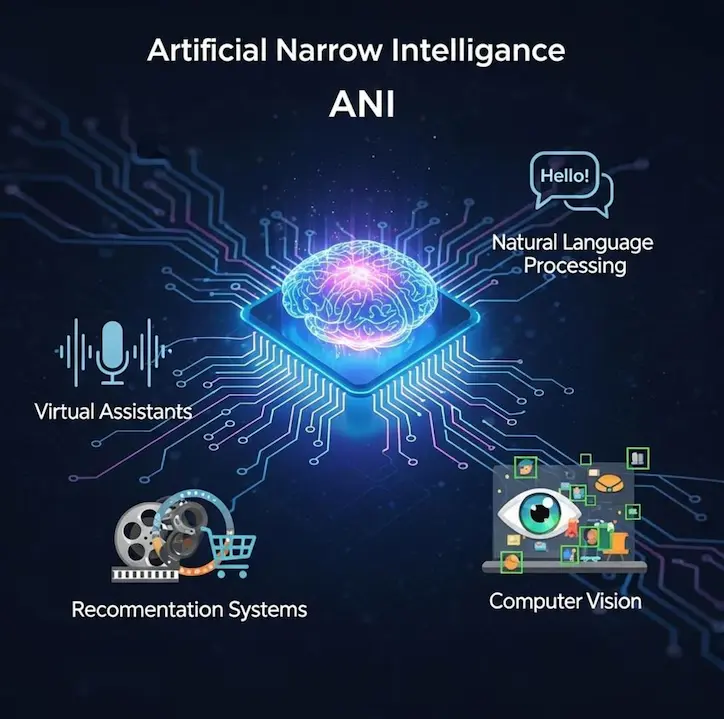
The important point is that being narrow does not mean being simple or unintelligent. A Narrow AI system can be extremely sophisticated within its specific task. Its limitation is its scope.
Most AI applications people interact with today fall into this category. Search engines, recommendation systems, spam filters, fraud detection systems, translation tools, and many customer-service chatbots are examples of AI designed for specific purposes.
Narrow AI is therefore the practical foundation of modern artificial intelligence. It can automate tasks, identify patterns, make predictions, and assist people without possessing general human-like intelligence.
What Is Artificial General Intelligence (AGI)?
Artificial General Intelligence (AGI) refers to a theoretical form of AI that would be capable of understanding and performing a wide range of intellectual tasks rather than being limited to one specific area.
A true AGI system would be expected to learn new tasks, apply knowledge from one situation to another, reason through unfamiliar problems, and adapt to changing circumstances. In this sense, AGI is often compared with the broad flexibility of human intelligence.
For example, imagine an AI system that could learn mathematics, write a report, understand a new software application, plan a complex project, learn a new language, and then use knowledge from one task to solve another. That would be much closer to the general-purpose intelligence associated with AGI.
However, AGI remains a theoretical concept rather than an established category of widely deployed AI systems. Current AI systems can be highly capable, but capability across many tasks does not automatically mean that they have achieved human-level general intelligence.
AGI is important in discussions about the future of AI because it raises questions about reasoning, learning, adaptability, autonomy, safety, and the relationship between artificial and human intelligence.
What Is Artificial Superintelligence (ASI)?
Artificial Superintelligence (ASI) describes a hypothetical form of artificial intelligence that would exceed human intellectual capabilities across virtually all areas.
Unlike Narrow AI, which focuses on specific tasks, or the theoretical concept of AGI, which aims for broad human-like intelligence, ASI represents an even more advanced hypothetical stage. Such a system could theoretically outperform humans in scientific reasoning, mathematics, strategic planning, creativity, learning, and other intellectual activities.
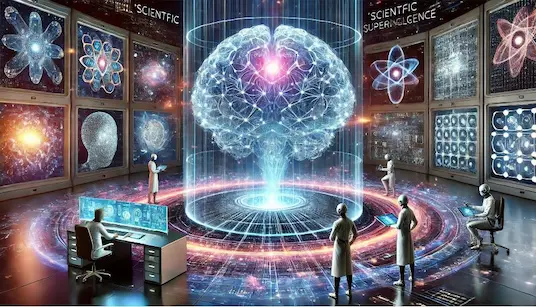
ASI is currently hypothetical. There is no established evidence that a system with artificial superintelligence exists.
The concept is nevertheless important because it appears frequently in discussions about the long-term development of AI. Researchers, policymakers, and technology experts consider questions about control, safety, alignment, decision-making, and potential social consequences when discussing highly advanced AI.
It is also important not to confuse today’s powerful AI tools with ASI. A system can produce impressive results in specific areas while still having significant limitations outside those areas.
Understanding ASI is therefore less about describing today’s technology and more about exploring a possible future stage of artificial intelligence.
What Are Reactive Machines?
Reactive Machines are a basic category of AI systems that respond to current inputs without using stored experiences to learn from previous interactions.
These systems analyse the situation presented to them and produce an appropriate response based on their programmed rules or learned behaviour. They do not maintain a traditional memory of past experiences that can be used to improve future decisions.
A classic example often discussed is IBM’s Deep Blue, the chess-playing system that defeated world chess champion Garry Kasparov. Deep Blue evaluated possible chess positions and selected moves based on its programming and computational analysis rather than developing a human-like memory of previous games.
The concept of reactive AI helps explain an important distinction between responding to an input and learning from historical information.
Reactive Machines are limited compared with more advanced AI systems because they cannot use a continuing memory of previous experiences in the same way that Limited Memory AI can. However, they demonstrate an important foundation of intelligent machine behaviour: analysing an input and producing a response.

What Is Limited Memory AI?
Limited Memory AI refers to AI systems that can use information from previous data or observations to improve their decisions and predictions.
Many modern AI applications can be understood through this concept. Instead of responding only to the current input, the system can use historical information during training or, in some cases, information from recent interactions or observations.
For example, a self-driving vehicle needs to process information about nearby vehicles, pedestrians, road conditions, traffic signals, and other objects. This information helps the system make decisions about acceleration, braking, steering, and navigation.
Recommendation systems also rely heavily on historical information. A platform may analyse previous viewing, searching, or purchasing behaviour to predict what a user may be interested in next.
Limited Memory AI is therefore closely connected with modern machine learning systems. These systems use data to identify patterns and produce predictions or decisions.
However, “limited memory” does not mean that every AI system remembers conversations or experiences in a human-like way. The type and duration of information available to a system depend on how it is designed.
What Is Theory of Mind AI?
Theory of Mind AI refers to a hypothetical type of AI that would be able to understand aspects of human mental states, such as emotions, intentions, beliefs, and perspectives.
Humans naturally attempt to understand what other people may be thinking or feeling. For example, when someone speaks in a certain tone or changes their facial expression, we may infer that they are angry, confused, excited, or worried.
A true Theory of Mind AI would need to go beyond recognizing visible signals. It would need to interpret these signals in context and understand that different people can have different beliefs, goals, emotions, and perspectives.
This concept is still largely theoretical. Current AI systems can recognize certain patterns in language, speech, facial expressions, or behaviour, but this does not necessarily mean they genuinely understand human mental states in the human sense.
Theory of Mind is important because it represents a potential step toward more socially capable AI systems. Such systems could potentially communicate more naturally with people and respond more appropriately to complex social situations.
What Is Self-Aware AI?
Self-Aware AI is a hypothetical form of artificial intelligence that would possess some form of self-awareness or understanding of its own internal state and existence.
This concept goes beyond simply processing information or recognizing human emotions. A self-aware AI would theoretically understand itself as an entity and could potentially recognize its own thoughts, states, or experiences.
There is currently no confirmed self-aware AI system in the scientific or technological sense described by this concept.
Self-aware AI is therefore primarily discussed in theoretical research, philosophy, and future-oriented conversations about artificial intelligence. It raises difficult questions about consciousness, subjective experience, identity, and whether a machine could ever possess something comparable to human self-awareness.
It is important to distinguish this idea from AI systems that use words such as “I” or appear conversational. Producing human-like language does not by itself demonstrate consciousness or self-awareness.
For now, Self-Aware AI remains a hypothetical category rather than a current technological reality.
What Is Generative AI?
Generative AI refers to AI systems designed to generate new content based on patterns learned from existing data. Depending on the model, this content can include text, images, audio, video, computer code, and other forms of digital media.
Generative AI has become one of the most visible areas of artificial intelligence because people can interact with these systems directly. For example, a user can provide a text prompt and receive an article draft, an image, a piece of code, or a summarized explanation.
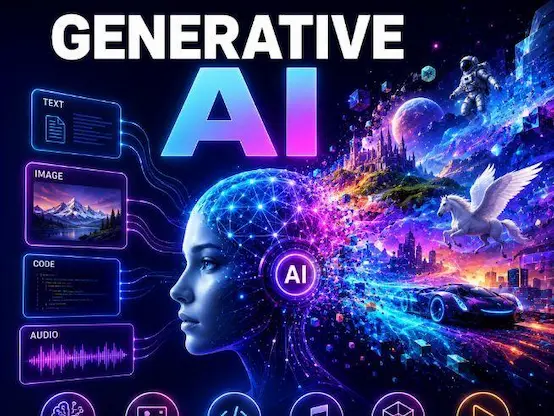
Large language models are a major example of generative AI. They process patterns in language and generate responses based on the input they receive. Image-generation models work differently but follow the same broad idea of learning patterns from data and using those patterns to create new outputs.
Generative AI can support writing, design, programming, education, marketing, research, and many other activities.
However, generated content is not automatically correct. AI systems can produce inaccurate information, biased outputs, or content that requires human review. This makes human oversight and verification important when using generative AI for important tasks.
What Is Machine Learning?
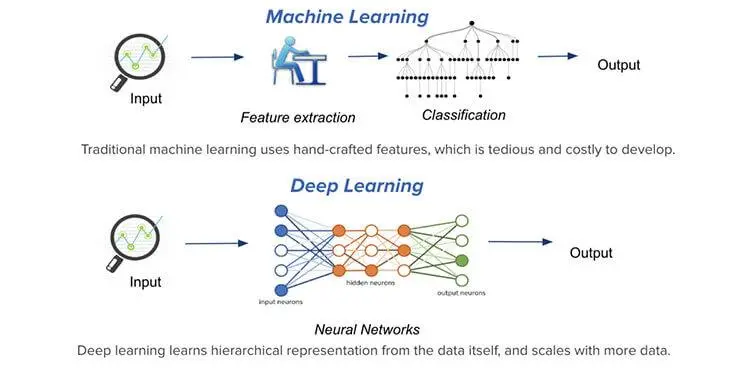
Machine Learning (ML) is an approach to artificial intelligence in which systems learn patterns from data and use those patterns to make predictions, classifications, or decisions.
Traditional software generally follows explicit instructions written by programmers. Machine learning allows a system to identify useful patterns from examples and data rather than requiring every possible rule to be manually programmed.
For example, a spam-filtering system can be trained using examples of spam and legitimate emails. Over time, the model can learn patterns that help it classify new messages.
Machine learning is used in many areas, including recommendation systems, fraud detection, search engines, forecasting, image recognition, and customer analytics.
There are different approaches to machine learning. Supervised learning uses labelled examples, while unsupervised learning looks for patterns in data without predefined labels. Reinforcement learning uses feedback from actions and outcomes to improve behaviour.
Machine learning is therefore an important foundation of modern AI, but it is not identical to AI. AI is the broader field, while machine learning is one major approach used to build intelligent systems.
What Is Deep Learning?
Deep Learning is a specialized approach within machine learning that uses multi-layered neural networks to learn complex patterns from large amounts of data.
A neural network is a mathematical model loosely inspired biological neurons are connected. Deep learning uses many layers within these networks, allowing models to learn increasingly complex representations of information.
For example, in image recognition, early layers may identify simple visual patterns such as edges and shapes. Later layers can combine these patterns to recognize more complex structures and objects.
Deep learning has contributed significantly to advances in computer vision, speech recognition, natural language processing, and generative AI.
It is especially useful when large datasets and substantial computing resources are available. However, deep learning models can require significant amounts of data, processing power, and careful training.
The relationship can be summarized simply: deep learning is a type of machine learning, and machine learning is one approach within the broader field of AI.
What Is Natural Language Processing (NLP)?
Natural Language Processing (NLP) is an area of AI focused on enabling computers to process, analyse, understand, and generate human language.
Human language is complex because the meaning of words can depend on context, tone, grammar, cultural references, and the relationship between different parts of a sentence. NLP uses computational methods and machine learning techniques to work with this complexity.
NLP is used in many everyday applications. Search engines use language processing to understand queries. Translation systems convert text from one language to another. Chatbots process user questions and generate responses. Email applications can identify spam or suggest text while writing.
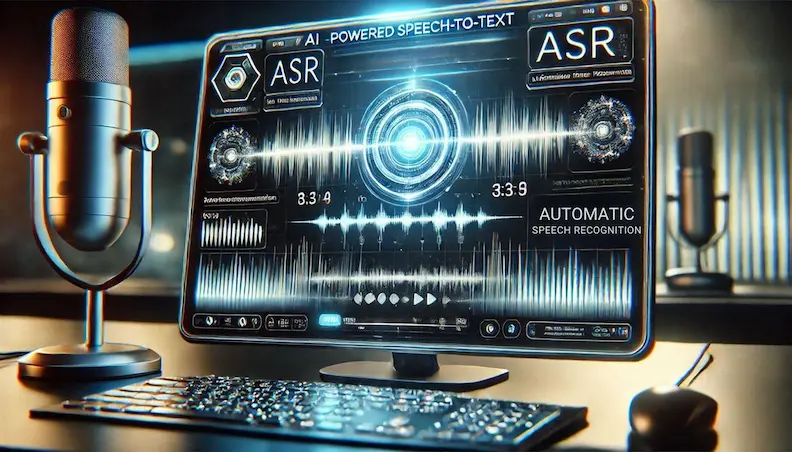
Modern NLP systems can perform tasks such as text classification, sentiment analysis, translation, summarization, question answering, speech-related processing, and text generation.
Large language models have significantly expanded the capabilities of NLP by allowing AI systems to process and generate human-like text across many subjects.
Despite these advances, NLP systems can still misunderstand context, produce incorrect information, or struggle with ambiguous language. Human review remains important when accuracy matters.
What Is Computer Vision?
Computer Vision is an area of AI that enables computers to analyse and interpret information contained in images and videos.
Human vision allows us to recognize objects, read signs, understand scenes, and detect movement. Computer vision attempts to perform related tasks using cameras, images, algorithms, and machine learning models.
For example, computer vision can be used to identify objects in photographs, detect faces, inspect products in factories, analyse medical images, or help autonomous systems understand their surroundings.
A computer vision system typically processes visual information and looks for patterns that help it classify or interpret what it sees. Modern deep learning techniques have significantly improved performance in many computer vision tasks.
Computer vision is used across industries, including healthcare, manufacturing, transportation, retail, security, agriculture, and robotics.
However, computer vision is not perfect. Lighting conditions, unusual objects, image quality, bias in training data, and unfamiliar environments can affect performance. This is why real-world computer vision systems often require careful testing and monitoring.
What Is Robotic AI?
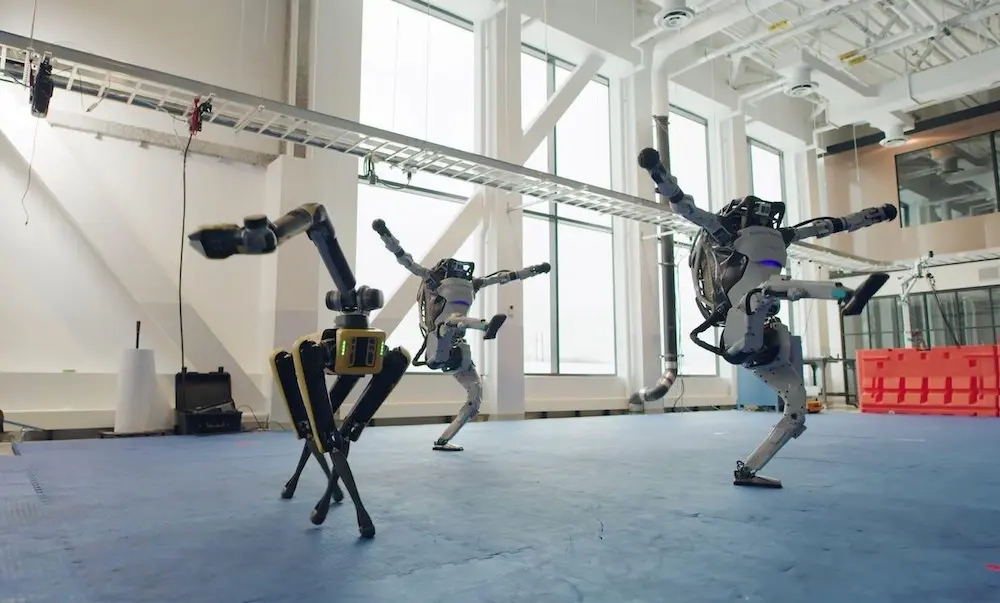
Robotic AI combines artificial intelligence with physical machines that can sense their environment, process information, and perform actions.
A robot may use cameras, sensors, software, and AI models to understand its surroundings and determine how to respond. This allows robots to perform tasks that require more than simple mechanical movement.
For example, robots can be used in factories to move materials, assemble products, inspect equipment, or perform repetitive tasks. AI-powered robots can also be used in warehouses, agriculture, healthcare research, and other environments.
Robotic AI often combines several AI technologies. Computer vision can help a robot recognize objects, machine learning can help it identify patterns, and reinforcement learning can help it improve certain behaviours through feedback.
The physical environment makes robotics particularly challenging. A robot must deal with changing conditions, unexpected objects, movement, safety requirements, and limited information.
As AI systems become more capable, robotics could allow intelligent software to interact with the physical world in increasingly useful ways.
What Are Expert Systems?
Expert Systems are AI systems designed to solve problems or provide recommendations within a specific domain by using structured knowledge and rules.
Traditional expert systems commonly use a knowledge base containing domain information and an inference mechanism that applies rules to the available information.
For example, an expert system could be designed to help identify possible causes of a technical problem based on symptoms and predefined rules. In another context, it could support decision-making by comparing information against a collection of expert knowledge.
Expert systems were especially important during earlier stages of AI development and helped demonstrate how computers could support specialized decision-making.
Modern AI has expanded beyond traditional rule-based expert systems by using machine learning and other data-driven approaches. However, the basic idea remains useful in areas where explicit rules, domain knowledge, explainability, or controlled decision processes are important.
Expert systems are therefore a useful part of AI history and remain relevant in certain specialized applications.
What Is Reinforcement Learning?
Reinforcement Learning (RL) is a machine learning approach in which an agent learns how to make decisions by interacting with an environment and receiving feedback in the form of rewards or penalties.
Instead of being given the correct answer for every situation, the system learns which actions tend to produce better outcomes.
For example, an AI agent playing a game can receive a positive reward for achieving a goal and a negative outcome for making poor decisions. By repeating interactions, it can learn strategies that increase the likelihood of receiving higher rewards.
Reinforcement learning has been used in areas such as games, robotics, resource management, and optimization.
The basic process involves an agent, an environment, actions, and feedback. The agent observes the environment, chooses an action, receives feedback, and updates its strategy.
Reinforcement learning is different from supervised learning because the system is not simply trained on labelled examples containing the correct answer. Instead, it learns through interaction and feedback.
This makes reinforcement learning particularly interesting for problems where an AI system must make a sequence of decisions rather than a single prediction.
Conclusion
The types of AI can be understood in several different ways, and this distinction is important. Narrow AI, AGI, and ASI describe AI according to its potential level of capability. Reactive Machines, Limited Memory, Theory of Mind, and Self-Aware AI describe AI according to how it functions or the level of cognitive capability it represents.
Other categories, including Generative AI, Machine Learning, Deep Learning, NLP, Computer Vision, Robotics, Expert Systems, and Reinforcement Learning, describe technologies, approaches, or application areas used to build and apply AI systems.
Many of these technologies are already part of everyday life, while AGI, ASI, Theory of Mind, and Self-Aware AI remain theoretical or developing concepts. Understanding these differences helps you avoid treating every AI system as the same thing.
As artificial intelligence continues to develop, these categories will become increasingly useful for understanding what AI can do today, what researchers are working toward, and how different AI technologies are applied in the real world.
Frequently Asked Question
What are the main types of AI?
The main categories commonly discussed include Narrow AI, AGI, ASI, Reactive Machines, Limited Memory AI, Theory of Mind, Self-Aware AI, Generative AI, Machine Learning, Deep Learning, NLP, Computer Vision, Robotic AI, Expert Systems, and Reinforcement Learning. However, these do not all belong to one classification system.
Which type of AI is used today?
Narrow AI represents the type of AI widely used in real-world applications today. Recommendation systems, voice assistants, fraud detection, image recognition, search systems, and many other AI applications are designed for specific tasks.
Is AGI available today?
AGI is generally considered a theoretical concept describing AI with broad, human-like general intelligence. Current AI systems can perform many impressive tasks, but that does not by itself establish that AGI has been achieved.
What is the difference between machine learning and deep learning?
Machine learning is a broad approach in which systems learn patterns from data. Deep learning is a specialized type of machine learning that uses multi-layered neural networks to learn complex patterns.
What is the difference between AI and Generative AI?
Artificial intelligence is the broader field of creating systems that can perform tasks associated with intelligent behaviour. Generative AI is a category of AI designed to create new content, such as text, images, audio, video, or code, based on patterns learned from data.