
Think about the last time you unlocked your phone with your face, asked a voice assistant for directions, or watched a show that a streaming app recommended just for you. Each of those moments was powered by artificial intelligence. It works quietly in the background, and most of us use it dozens of times a day without noticing.
So, what are the benefits of artificial intelligence, and why are governments, schools, hospitals, and businesses investing so heavily in it? In short, AI helps people work faster, make better decisions, reduce mistakes, and solve problems that were once too complex or too time-consuming to handle.
In this guide, you will learn what AI is, how it works, and where it creates real value. We will look at its advantages for businesses, students, and everyday life, share real-world examples, and talk honestly about its limits. By the end, you will know how to start using AI in a practical way.
What Is Artificial Intelligence (AI)?
Artificial intelligence is the ability of a computer system to perform tasks that normally require human intelligence. These tasks include understanding language, recognizing images, learning from experience, solving problems, and making decisions.
A simple way to picture it: a traditional program follows fixed instructions written by a person. An AI system, on the other hand, learns patterns from data and uses them to handle situations it has never seen before. If you want a deeper technical definition, IBM’s overview of artificial intelligence is a trustworthy place to start.

AI is an umbrella term. Several related fields sit under it:
- Machine learning: systems that improve by studying data instead of following hand-written rules.
- Deep learning: a more advanced form of machine learning that uses layered neural networks, inspired loosely by the human brain.
- Natural language processing (NLP): technology that lets computers understand and produce human language.
- Computer vision: technology that lets machines interpret photos and video.
- Generative AI: tools that create new text, images, audio, or code from a prompt.
Most of the AI you meet today is called narrow AI, meaning it is built to do one job very well, such as translating text or detecting fraud. The idea of a machine that thinks like a human across every subject, known as general AI, remains a research goal rather than a reality.
How Does Artificial Intelligence Work?
At its core, AI works through a simple cycle: data goes in, a model finds patterns, and the system produces a prediction or an action. Understanding this cycle makes the benefits easier to appreciate.
First comes data. AI systems learn from large collections of information, such as customer purchases, medical scans, written text, or sensor readings. The more relevant and accurate the data, the better the results.
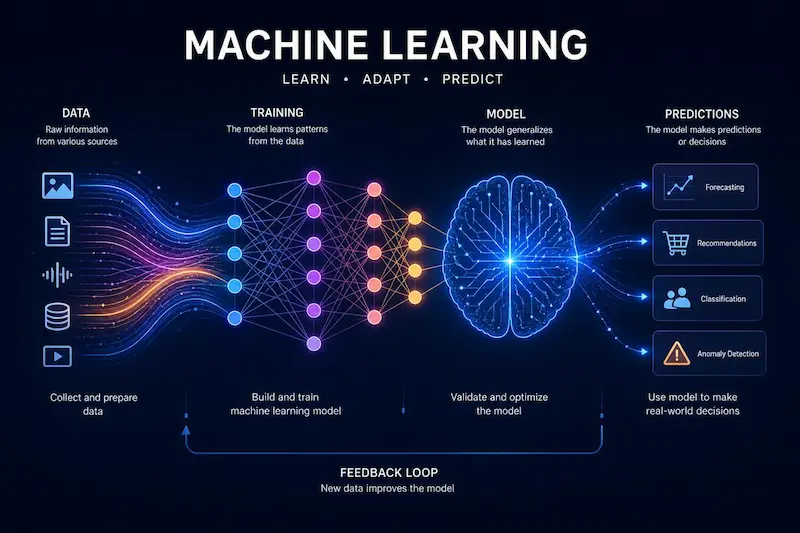
Next comes training. During training, an algorithm studies the data and adjusts itself over and over. For example, a model that learns to spot spam emails sees thousands of examples labeled “spam” and “not spam.” Gradually, it picks up the clues that separate the two, like suspicious links or unusual wording.
Then comes prediction, sometimes called inference. Once trained, the model can look at a brand-new email and decide whether it is spam within a fraction of a second. The same idea powers product recommendations, voice recognition, and route planning.
Finally, there is feedback and improvement. Many systems keep learning as people use them. When you skip a song or correct a translation, you are quietly teaching the system to do better next time.
This is why AI is so useful. It can scan millions of data points in seconds, spot patterns humans would miss, and repeat the same task thousands of times without getting tired.
What Are the Main Benefits of Artificial Intelligence?
The advantages of AI show up in almost every field. Here are the most important ones, explained with practical examples.

1. Automation of repetitive tasks. AI can take over routine work such as data entry, sorting emails, scheduling appointments, and processing invoices. A finance team that once spent hours matching receipts to expenses can now let software do it in minutes. This frees people to focus on creative, strategic, and human-centered work.
2. Faster and better decision-making. AI can analyze huge amounts of information and highlight what matters. A retailer, for instance, can use AI to see which products are likely to sell out next week and reorder in time. Decisions based on data are usually more consistent than decisions based on guesswork.
3. Fewer human errors. Tired people make mistakes, especially during repetitive work. AI systems stay consistent. In banking, AI tools check thousands of transactions for errors or fraud with a level of accuracy that is hard to match manually.
4. Round-the-clock availability. Humans need rest, but AI does not. A chatbot can answer common customer questions at 3 a.m., on weekends, and during holidays, so customers never wait for the office to open.
5. Personalization at scale. Streaming services, online stores, and learning apps use AI to tailor suggestions to each person. A shop with a million customers can still make each one feel understood, because AI studies their preferences individually.
6. Cost savings and higher productivity. By automating tasks and reducing waste, AI helps organizations do more with the same resources. Research tracked by the Stanford AI Index Report shows that AI adoption and investment have grown rapidly, which reflects how many organizations now see measurable value in it.
7. Safer working conditions. Robots and AI-guided machines can handle dangerous jobs, such as inspecting gas pipelines, working in extreme heat, or handling hazardous materials. This keeps people out of harm’s way.
8. Faster discoveries and innovation. In science and medicine, AI can test ideas in simulation, scan research papers, and find hidden connections in data. This speeds up everything from drug discovery to climate modeling.
Together, these benefits explain why AI is often called a general-purpose technology, much like electricity or the internet. It improves many industries at once instead of only one.
What Are the Benefits of Artificial Intelligence for Businesses?
For companies, the benefits of artificial intelligence are both practical and measurable. Whether you run a small online shop or a global enterprise, AI can improve how you sell, serve, and operate.

Better customer service. AI chatbots and virtual assistants handle common questions instantly, such as order tracking, return policies, or password resets. Human agents then focus on complex or sensitive cases. The result is shorter wait times and happier customers.
Smarter marketing. AI helps businesses understand who their customers are and what they want. It can group audiences by behavior, predict who is likely to buy, and suggest the best time to send an email. Many marketers also use generative AI to draft ad copy, product descriptions, and social posts, then refine them by hand to keep their brand voice.
Improved sales forecasting. Predictive analytics studies past sales, seasonal patterns, and market trends to estimate future demand. A restaurant chain, for example, can predict how much stock each branch needs, which cuts food waste and avoids empty shelves.
Stronger fraud detection and security. Banks and payment companies rely on AI to flag unusual activity in real time. If your card is suddenly used in another country, the system notices the pattern and can block the payment before serious damage is done.
More efficient operations. In logistics, AI plans delivery routes that save fuel and time. In manufacturing, predictive maintenance uses sensor data to warn managers that a machine is likely to fail soon, so repairs happen before costly breakdowns.
Smarter hiring and HR. AI tools can help sort applications, schedule interviews, and answer employee questions about policies. Used carefully, with human review, they save recruiters a great deal of time.
Competitive advantage. Businesses that use AI well can move faster than competitors who do not. According to McKinsey’s research on the state of AI, a growing share of organizations now use AI in at least one business function, and many report cost reductions or revenue gains in areas where they apply it.
A practical tip for small businesses: you do not need a big budget or a data science team. Start with one clear problem, such as answering repetitive customer emails, and use an affordable AI tool to solve it. Once you see results, expand step by step.
What Are the Benefits of Artificial Intelligence for Students?
Students may be among the biggest winners of the AI revolution. Used wisely, AI acts like a patient tutor that is available at any hour.

Personalized learning. Every student learns at a different pace. AI-powered learning platforms adjust the difficulty of lessons based on how well a learner is doing. If you struggle with fractions, the app gives you more practice there. If you master a topic quickly, it moves you ahead.
Instant help with difficult topics. When a concept does not make sense, an AI assistant can explain it in simpler words, give an analogy, or walk through an example step by step. You can ask the same question five different ways without feeling embarrassed.
Better study habits. AI tools can turn your notes into flashcards, build practice quizzes, summarize long chapters, and help you create a revision schedule. These features save time on preparation so you can spend more time actually learning.
Writing and language support. Grammar checkers and writing assistants point out unclear sentences and suggest improvements. Language learners can practice conversation with an AI partner and get gentle corrections. Translation tools also make it easier to read research in other languages.
Research assistance. AI can help students find relevant sources, organize ideas, and understand dense academic papers. It is a good starting point, but you should always verify facts against reliable sources.
Accessibility. AI tools like speech-to-text, text-to-speech, and live captions make education more accessible for students with disabilities or those learning in a second language.
Career readiness. Learning to work with AI is now a valuable skill. Students who understand how to use these tools responsibly will be better prepared for modern workplaces.
One important reminder: AI should support your learning, not replace it. Copying answers without understanding them may help in the short term, but it will not build real knowledge. Use AI to explain, practice, and check your work, and do the thinking yourself.
What Are the Benefits of Artificial Intelligence in Everyday Life?
You do not need to work in tech to benefit from AI. It is already woven into daily routines in ways that make life easier.

Smartphones and voice assistants. Voice assistants set reminders, play music, send messages, and answer quick questions hands-free. Your phone camera also uses AI to improve photos, blur backgrounds, and sort pictures by faces or places.
Navigation and travel. Map apps use AI to analyze live traffic and suggest the fastest route. They can predict arrival times and warn you about delays, which saves time and fuel on every trip.
Entertainment. Music and video platforms learn what you enjoy and recommend new songs or shows. It is a small convenience, but it saves you from endless scrolling.
Online shopping. AI helps stores show products you are more likely to need, detect fake reviews, and offer smart search that understands what you mean even if you misspell a word.
Smart homes. Smart thermostats learn your schedule and adjust the temperature to save energy. Robot vacuums map your rooms and clean on their own. Security cameras can tell the difference between a person, a pet, and a passing car.
Health and fitness. Smartwatches track heart rate, sleep, and activity, and can alert you to irregular patterns. Fitness apps use AI to suggest workouts that match your goals and progress.
Communication. Email services filter spam and suggest quick replies. Translation apps let people chat across languages in real time, which is helpful when traveling or talking to relatives abroad.
Personal finance. Banking apps categorize your spending, warn you about unusual charges, and help you track budgets automatically.
Individually, these features may seem small. Together, they save hours every week and remove many daily frustrations.
Real-World Examples of Artificial Intelligence Benefits
Examples make the advantages of AI easier to see. Here are some of the most meaningful ones across different industries.
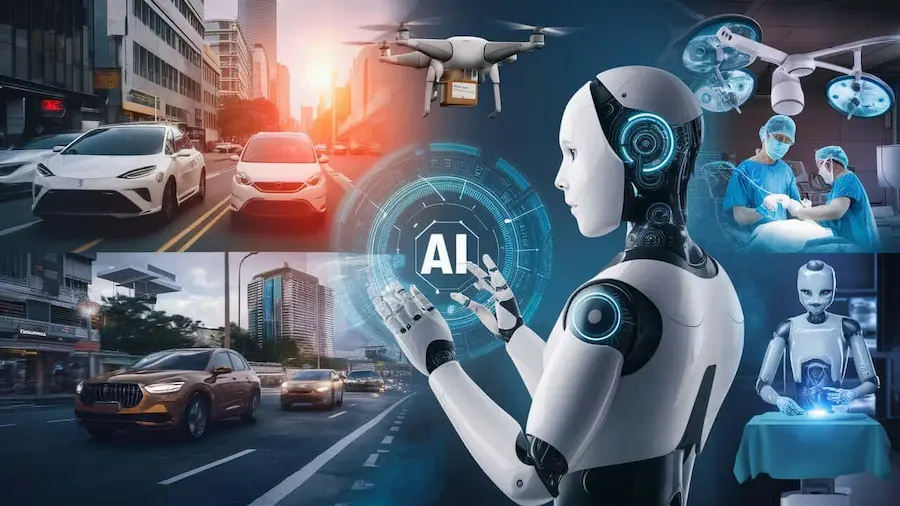
Healthcare: earlier and more accurate diagnosis. AI systems can analyze X-rays, MRIs, and retinal scans to help doctors spot signs of disease earlier. They do not replace doctors, but they act as a second pair of eyes, especially useful in places where specialists are scarce. AI is also helping researchers identify promising drug candidates faster than traditional methods.
Banking: fraud prevention. Major banks use machine learning to monitor millions of transactions every day. When something looks unusual, such as a sudden large purchase far from your home, the system flags it within seconds. This protects customers and reduces financial losses.
Agriculture: smarter farming. Farmers use drones and satellite images with AI to monitor crop health, detect pests, and decide exactly where to water or fertilize. This increases yields while using fewer resources, which is good for both profits and the environment.
Transportation: safer roads. Driver-assistance features such as automatic braking, lane-keeping, and collision warnings use AI to react faster than a distracted human can. Airlines and railways also use AI for scheduling and maintenance planning.
Retail: better inventory and experiences. Large retailers use AI to predict demand, manage stock, and personalize offers. Some stores also use computer vision to track shelves and alert staff when a product runs low.
Education: adaptive learning platforms. Language apps and online learning platforms adjust lessons to each learner’s level. This keeps students challenged without overwhelming them.
Customer support: faster answers. Telecom companies, airlines, and online stores use AI assistants to resolve routine requests like booking changes or billing questions in seconds, leaving people free to handle the trickier problems.
Environment: climate and conservation. AI helps scientists model weather patterns, track deforestation using satellite images, and monitor endangered wildlife through camera traps. Better predictions give governments and communities more time to prepare for floods, storms, and heat waves.
Accessibility: tools that open doors. Apps that describe images aloud for people with vision loss, and captioning tools for people with hearing loss, show how AI can make the world more inclusive.
Each of these examples follows the same pattern: AI handles the heavy data work, and humans make the final judgment calls. That partnership is where the technology performs best.
Are There Any Limitations to Artificial Intelligence?
A balanced view matters. While the benefits of artificial intelligence are significant, the technology also has limits that every user should understand.

It can be wrong. AI systems make mistakes, and generative tools can sometimes produce confident-sounding answers that are inaccurate. Always double-check important facts, numbers, and sources before relying on them.
It depends on data quality. If the training data is incomplete or biased, the results can be unfair or unreliable. For example, a hiring tool trained on skewed past data may favor certain groups unintentionally. This is why human oversight and regular testing are essential.
It lacks real understanding and emotion. AI recognizes patterns, but it does not truly understand context, feelings, or values the way people do. Tasks that need empathy, ethical judgment, or deep creativity still need human involvement.
Privacy and security concerns. AI often relies on large amounts of personal data. Without strong safeguards, that information can be misused or exposed. Avoid sharing sensitive details, such as passwords, financial data, or private health records, with public AI tools.
Job changes. Automation will change many roles. Some tasks will disappear, while new jobs will appear in areas like AI management, data analysis, and human-AI collaboration. Workers who keep learning new skills will be in the best position to adapt.
Cost and complexity. Building advanced AI systems can be expensive and require specialized skills. Smaller organizations often work around this by using ready-made tools instead of building their own.
Environmental impact. Training and running large AI models uses significant electricity. Researchers and companies are working on more efficient systems, but it remains a real concern.
The takeaway is not to avoid AI, but to use it thoughtfully. Treat it as a powerful assistant that needs supervision, not as an unquestionable authority.
How Can You Take Advantage of Artificial Intelligence?
You do not need technical expertise to start benefiting from AI. These practical steps work for beginners, students, and business owners alike.
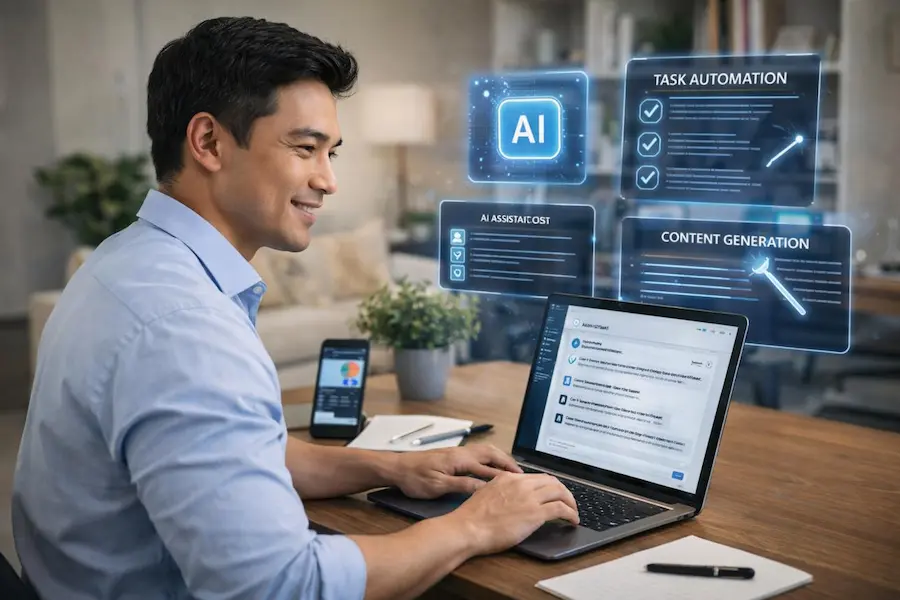
Start with a real problem. Instead of using AI for its own sake, think about what slows you down. Maybe it is writing emails, summarizing meeting notes, organizing your schedule, or studying for exams. Choose one task and try an AI tool on it.
Try beginner-friendly tools. Popular options include AI chat assistants for writing and brainstorming, grammar and writing checkers, transcription tools for meetings and lectures, and design tools that create simple graphics. Most offer free versions, so you can experiment at no cost.
Learn to write clear prompts. The quality of what you get depends on what you ask. Be specific about your goal, your audience, and the format you want. For example, instead of “explain marketing,” try “explain digital marketing to a beginner in five short paragraphs with one example.”
Always review the output. Treat AI-generated content as a first draft. Check facts, fix awkward wording, and add your own experience and voice. This keeps your work accurate and original.
Protect your privacy. Read how each tool handles your data. Avoid entering confidential information, and use strong passwords and privacy settings.
Keep building your skills. Free courses, tutorials, and practice projects can help you understand how AI works and how to use it responsibly. A little knowledge goes a long way, and it makes you more valuable in any career.
Measure the results. If you use AI at work, track the time saved or the quality improved. This helps you decide which tools are worth keeping and where to expand.
The people who benefit most from AI are not necessarily the most technical. They are the ones who stay curious, practice regularly, and combine AI’s speed with their own judgment.
What Is the Future of Artificial Intelligence?
AI is still developing quickly, and the next few years will likely bring even more useful changes.
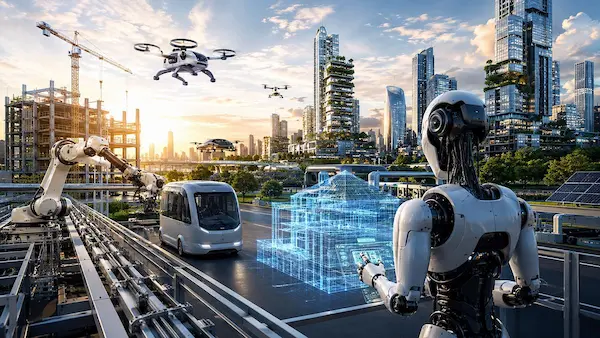
More capable everyday assistants. AI helpers will become better at understanding context, handling multi-step tasks, and working across text, images, audio, and video at the same time. Instead of just answering questions, they will increasingly help complete tasks, such as planning a trip from start to finish.
Healthcare breakthroughs. Expect progress in personalized treatment plans, earlier disease detection, and faster drug development. AI may help doctors tailor care to each patient’s genetics and lifestyle.
Smarter education. Learning platforms will become more adaptive, offering each student a custom path and instant feedback, which could help close learning gaps around the world.
Greener technology. AI will play a growing role in managing power grids, reducing energy waste, improving recycling, and supporting renewable energy.
New kinds of jobs. As routine tasks become automated, demand will grow for people who can guide, check, and creatively apply AI. Skills like critical thinking, communication, and adaptability will matter more than ever.
Stronger rules and responsible AI. Governments and organizations around the world are working on guidelines for safe, fair, and transparent AI. Expect more focus on privacy, accountability, and bias reduction as the technology becomes more powerful.
No one can predict exactly what comes next. What is clear is that AI will keep reshaping how we live and work, and those who understand it early will be better prepared.
Conclusion
The benefits of artificial intelligence reach far beyond technology companies. AI saves time, cuts costs, reduces errors, personalizes experiences, and helps solve problems in healthcare, education, business, farming, and daily life.
At the same time, it is not perfect. AI can make mistakes, reflect bias, and raise real questions about privacy and jobs. The best approach is a balanced one: use AI as a smart assistant, keep humans in charge, and stay willing to learn.
If you are just getting started, pick one small task this week and try an AI tool on it. You may be surprised by how much time you save. The earlier you build comfort with AI, the more ready you will be for a futuure where it plays a bigger role in nearly everything we do.
Frequently Asked Questions
What is the biggest benefit of artificial intelligence?
The biggest benefit is its ability to automate tasks and analyze data at a speed no human can match. This saves time, reduces errors, and supports better decisions across nearly every industry.
How does AI help in everyday life?
AI powers voice assistants, map apps, spam filters, photo enhancements, shopping recommendations, and smart home devices. These tools make daily tasks quicker, easier, and more personalized.
Can AI really help businesses grow?
Yes. Businesses use AI to improve customer service, predict demand, personalize marketing, detect fraud, and cut operating costs. When applied to a clear goal, it can improve both efficiency and revenue.
Is artificial intelligence useful for students?
Absolutely. AI offers personalized practice, simple explanations, study tools, and language support. It works best as a learning partner, not as a shortcut to skip the learning process.
What are the disadvantages of artificial intelligence?
Common concerns include occasional inaccurate results, bias in data, privacy risks, job changes, and environmental costs. Human oversight and responsible use help reduce these risks.