

You swipe your card to buy a coffee, and within moments, your payment begins moving through a network of banks, payment processors, and financial institutions before reaching the coffee shop. Later, that money may help pay employees, cover rent, purchase supplies, or fund another business expense. Multiply this process by millions of payments, loans, investments, and financial transactions, and you begin to see the vast system operating behind everyday economic activity. This is the process people are asking about when they want to understand how does finance work.
Most explanations stop at defining finance, but understanding the actual process requires looking at what happens behind the scenes. Money moves between individuals, businesses, banks, investors, governments, and financial markets, with different participants using it for different purposes. Saving, borrowing, investing, lending, and spending are all connected parts of this larger system.
At its core, finance provides ways to move and manage money across time, people, and organizations. It connects those with available funds to those who need capital, while financial institutions and markets help determine how money is transferred, priced, invested, and managed. Understanding this flow makes it easier to see how everyday financial decisions connect to the wider economy.
Why Does the Financial System Exist?
The financial system exists because people and organizations often have money at different times, in different amounts, and for different purposes. One person may have savings they do not need immediately, while a business may need capital today to purchase equipment or expand. Finance creates mechanisms that allow these different needs to be connected.
Without financial institutions and markets, many economic activities would depend heavily on individuals or businesses having enough cash available at exactly the right time. A small business owner might have to wait years to save enough money for expansion, while someone with surplus savings might have limited opportunities to put that money to productive use.
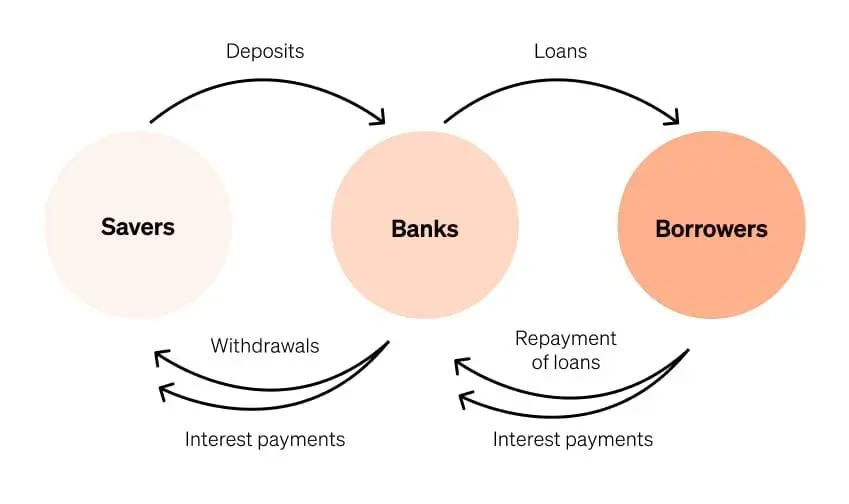
Financial institutions and markets help reduce this mismatch. Bank accounts, loans, bonds, stocks, insurance products, and payment systems all serve different purposes within the financial system. They allow money and financial risk to be transferred between participants according to agreed conditions.
The system also helps distribute risk. Instead of one individual providing all the money needed for a large project, funding can come from multiple lenders or investors. This allows financial risk and potential returns to be shared among participants.
In this sense, finance does more than move money. It creates mechanisms for coordinating capital, risk, time, and economic opportunity.
How Does Money Enter the Financial System?
Money can enter the financial system through many channels, including wages, business revenue, government payments, investment flows, borrowing, and financial transactions. When a worker receives a paycheck and deposits part of it into a bank account, that money becomes part of the financial system. The account allows the person to save, make payments, transfer funds, or potentially earn interest.
Businesses provide another major source of financial activity. When customers purchase products or services, businesses receive revenue that can later be used to pay employees, suppliers, lenders, taxes, or investors.
Government activity also affects the flow of money through the economy. Government spending, taxation, borrowing, and transfers can move funds between different parts of the economy. Central banks influence financial conditions through monetary policy, including changes to policy interest rates and other tools.
International activity provides another channel. Foreign investment, exports, imports, remittances, and cross-border financial transactions can move funds between countries.
It is important to distinguish between money entering circulation and money entering a particular financial institution. Modern economies do not operate through a simple process where every deposit is repeatedly lent out in a fixed mathematical chain. Commercial banks create deposits when they make loans, while their ability to expand lending is constrained by capital, liquidity, regulation, credit demand, and other factors.
How Does Money Move Through the Financial System?
Money moves through the financial system through payments, lending, investment, financial markets, and transfers between accounts and institutions. A simple example starts with a customer buying groceries. The payment moves through a payment network and financial institutions before the merchant receives the funds. The merchant can then use that revenue to pay suppliers, employees, rent, taxes, or lenders.
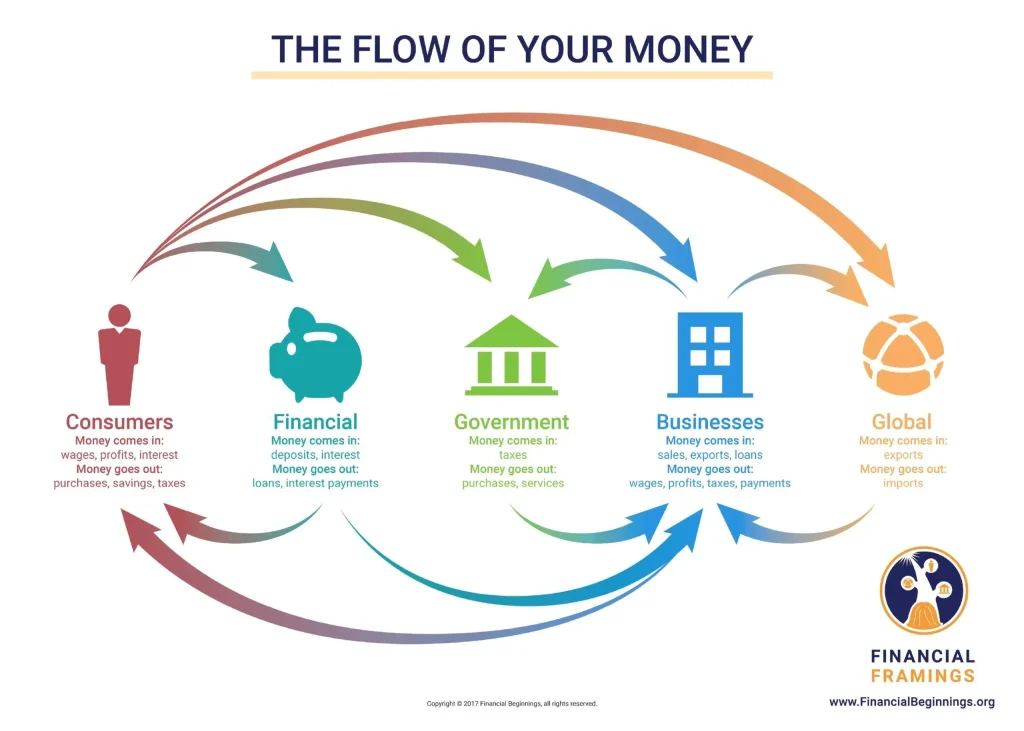
Several channels support this movement.
Payment systems handle everyday transactions such as debit-card payments, bank transfers, wire transfers, and digital payments. They allow money to move between individuals, businesses, and financial institutions.
Credit markets connect lenders and borrowers. Banks provide loans, while companies and governments can raise funds by issuing debt securities such as bonds.
Capital markets connect investors with companies and governments seeking long-term funding. Investors can purchase shares or debt securities, providing capital in exchange for potential returns.
Financial institutions also perform intermediation, meaning they help connect participants who may not otherwise deal directly with one another. Banks and other institutions assess borrowers, process transactions, manage liquidity, and provide financial services.
The result is a constantly changing flow of funds. Money can move from consumers to businesses, businesses to employees and suppliers, investors to companies, and savers to borrowers. The specific transaction may be simple, but millions of these interactions together form the financial system.
How Do People Use Finance in Everyday Life?
People use finance every day, even when they do not think of their activities as financial decisions. Receiving a salary, paying rent, using a credit card, saving for an emergency, taking out a loan, or investing for retirement all involve financial processes.
A household budget provides a simple example. Income comes into the household through employment, business activity, investments, or other sources. Some of that income is used for immediate expenses such as food, utilities, transportation, and housing. Another portion may be used to repay debt, while the remaining amount can be saved or invested.
People also use financial services for larger goals. A mortgage can help someone purchase a home without paying the entire cost upfront. An education loan can provide funding for tuition and related expenses. Retirement accounts and investment products can help people build assets for future needs.
Each decision involves trade-offs. Borrowing provides access to money today but creates future repayment obligations. Saving provides financial reserves but may involve giving up some immediate spending. Investing creates opportunities for growth but also involves the possibility of losing money.
These everyday choices connect households to the broader financial system. Banks, employers, payment networks, lenders, insurers, investment firms, and markets all play roles in helping people manage money across different stages of life.
How Do Businesses Use Finance?
Businesses use finance to fund operations, manage cash flow, purchase assets, pay employees, handle short-term obligations, and pursue growth. Even a small company may need to manage the timing difference between paying suppliers and receiving money from customers.
For example, a manufacturing company may need to purchase raw materials before it receives payment for finished products. A short-term loan or line of credit can help bridge that gap, allowing production to continue without exhausting the company’s available cash.
Businesses can also raise larger amounts of capital through debt and equity financing. A company can issue bonds or obtain loans, creating an obligation to repay borrowed funds according to agreed terms. Alternatively, it can raise equity by selling ownership interests to investors.
These financing methods have different consequences. Debt generally requires scheduled repayment and interest, while equity does not normally require the same type of fixed repayment but gives investors an ownership interest in the company.
Businesses also rely on internal financial management. Budgeting, forecasting, cash-flow management, working capital, and financial planning help companies decide how much money they need and where it should be allocated.
Ultimately, business finance helps transform available capital into productive activity. Companies use funding to purchase resources, operate their businesses, generate revenue, meet obligations, and potentially reinvest profits into future growth.
How Do Banks Work in Finance?
Banks act as financial intermediaries and provide several services that help money move through the economy. They accept deposits, provide loans, process payments, facilitate transfers, and offer other financial products.
When customers deposit money into a bank account, the bank records a liability to the customer and manages the funds within its broader balance sheet. Banks can use their available funding and other sources of liquidity to support lending and investment activities while maintaining sufficient liquidity and capital to meet their obligations.

Modern banking is more complex than simply taking deposits and lending out the same money. When a bank approves a loan, it generally creates a corresponding deposit in the borrower’s account. The bank must manage the resulting balance-sheet risks and comply with applicable capital, liquidity, regulatory, and risk-management requirements.
Banks also help reduce the difficulty of connecting individual savers directly with borrowers. Instead of every person negotiating a separate loan with another individual, banks can evaluate borrowers, process payments, manage accounts, and handle large numbers of transactions.
Other services are equally important. Banks may provide mortgages, business loans, payment processing, foreign-exchange services, credit cards, and savings products.
Because banks sit at important points within the payment and credit system, problems in the banking sector can affect businesses, households, and financial markets. This is one reason banking regulation, supervision, liquidity management, and deposit-protection systems exist.
How Does Borrowing Work?
Borrowing allows an individual, business, or government to use money now while agreeing to repay it later, usually with an additional cost called interest. The borrowing agreement normally specifies the amount borrowed, interest rate, repayment schedule, fees, and other conditions.

Consider an auto loan. If someone borrows $20,000, the borrower receives access to the money immediately but agrees to make scheduled payments over the loan term. Those payments generally include both principal, which reduces the original amount owed, and interest, which compensates the lender for providing the money and taking on risk.
The cost of borrowing depends on several factors. Lenders may consider the borrower’s credit history, income, existing debts, collateral, loan term, and broader market conditions. A borrower considered more likely to default may face a higher interest rate or stricter conditions.
Borrowing can be useful because it allows people and businesses to make purchases or investments without first accumulating the entire amount in cash. A company can finance equipment, for example, and use the resulting production or revenue to help meet its repayment obligations.
However, borrowing also creates a future obligation. The borrower must make payments even if circumstances change. Understanding interest, repayment terms, fees, and credit risk is therefore essential when evaluating any form of debt.
How Does Saving Work?
Saving involves setting aside money for future use instead of spending it immediately. People may keep savings in bank accounts, certificates of deposit, money market products, or other relatively low-risk instruments depending on their goals and circumstances.
Suppose someone sets aside $200 each month. Over time, those contributions can create an emergency fund, provide money for a planned purchase, or build a reserve for future expenses. A bank savings account may also pay interest, allowing the balance to grow gradually.
Saving plays an important role in the financial system because it gives households and organizations a way to preserve purchasing power and prepare for future needs. Deposits also form part of the funding base that banks manage when providing loans and other financial services.

One important concept is compound interest. When interest is added to an account and subsequently earns additional interest, growth can accelerate over longer periods. The actual result depends on the interest rate, compounding frequency, fees, taxes, and how long the money remains invested or deposited.
Saving and investing are related but not identical. Saving generally emphasizes accessibility and preservation of capital, while investing usually involves accepting greater uncertainty in pursuit of potentially higher long-term returns.
For many people, saving is the first practical step toward financial management. It creates a reserve that can reduce dependence on borrowing when unexpected expenses occur.
How Does Investing Work?
Investing involves committing money to an asset with the expectation of receiving income, growth in value, or both over time. Common investments include stocks, bonds, mutual funds, exchange-traded funds, and real estate.
When someone buys shares of a company, they acquire an ownership interest in that business. If the company performs well, the value of its shares may increase, and the company may distribute dividends to shareholders. However, share prices can also fall, meaning investors can lose some or all of their invested capital.

Bonds work differently. A bond generally represents a debt obligation: an investor provides money to an issuer, such as a corporation or government, in exchange for interest payments and repayment according to the bond’s terms. Bond investments still carry risks, including credit risk, interest-rate risk, and market risk.
Investors often use diversification to manage risk by spreading money across different assets, companies, sectors, geographic markets, or asset classes. Diversification cannot eliminate investment losses, but it can reduce dependence on the performance of a single investment.
The financial system makes investing possible at enormous scale. Investors provide capital, while businesses and governments can use that capital for operations, projects, infrastructure, and other activities.
The key difference between saving and investing is not simply that one is “safe” and the other is “risky.” Instead, they involve different combinations of liquidity, risk, time horizon, and expected return.
How Do Financial Markets Work?
Financial markets provide mechanisms through which buyers and sellers can trade financial assets such as stocks, bonds, currencies, and other securities. Many modern financial markets operate electronically, connecting participants across large geographic areas.
One important function of financial markets is helping companies and governments raise capital. For example, a company can issue shares to investors or issue bonds to borrow money from investors. Governments can also issue bonds to finance spending.

Markets also provide liquidity, allowing investors to buy and sell existing securities. For example, after shares have been issued, investors can generally trade those shares with other market participants rather than having to wait for the company itself to return their money.
Prices are influenced by supply and demand as well as expectations about future conditions. Company earnings, economic data, interest rates, geopolitical developments, investor sentiment, and many other factors can affect market prices.
This process is known as price discovery. Buyers and sellers continuously interact, and their willingness to transact at different prices helps determine the market price of an asset.
Financial markets therefore perform more than a simple buying-and-selling function. They help transfer capital between investors and organizations, provide liquidity, create prices for financial assets, and allow participants to manage different forms of financial risk.
How Do Interest Rates Affect Finance?
Interest rates influence the cost of borrowing and the return available from lending or saving. Because so many financial activities involve borrowing or lending, changes in interest rates can affect households, businesses, governments, banks, and investors.
When interest rates rise, new borrowing generally becomes more expensive. Mortgage payments, business financing costs, and other forms of credit may become less attractive or more costly, depending on the specific loan and how quickly its rate adjusts.
Lower interest rates can have the opposite effect. Financing may become cheaper, potentially encouraging households to borrow and businesses to invest. However, the actual effect depends on economic conditions, credit availability, borrower confidence, and other factors.
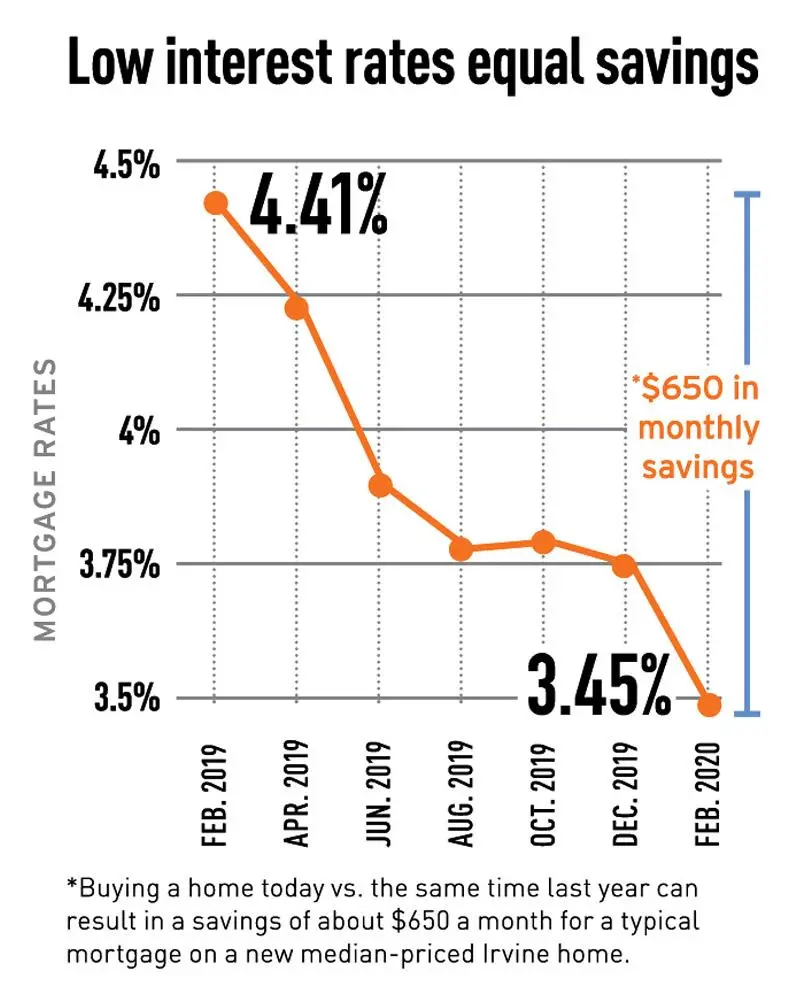
Interest rates also influence investments. When yields on relatively lower-risk assets rise, investors may reassess how much risk they want to take for a particular expected return. Bond prices can also move when market interest rates change because existing bonds may become more or less attractive compared with newly issued securities.
Central banks influence financial conditions through monetary-policy decisions. Their actions can affect borrowing costs, inflation expectations, currency values, financial markets, and economic activity.
This is why interest rates are an important part of the financial system. A change in financing costs can influence decisions across saving, borrowing, investing, spending, and business expansion.
How Does Risk and Return Work in Finance?
Risk and return are closely connected in finance. Investors and lenders generally expect compensation for accepting greater uncertainty, although higher risk does not guarantee a higher return.
Consider two different financial assets. A highly creditworthy government bond may provide relatively predictable payments, while shares in a young company may experience much larger price movements. The stock may generate substantial gains, but it can also experience significant losses.
Risk comes in several forms. Market risk refers to losses caused by movements in broader financial markets. Credit risk is the possibility that a borrower will fail to meet its obligations. Liquidity risk occurs when an asset cannot be sold quickly at a reasonable price. Other risks include inflation risk, interest-rate risk, currency risk, and operational risk.
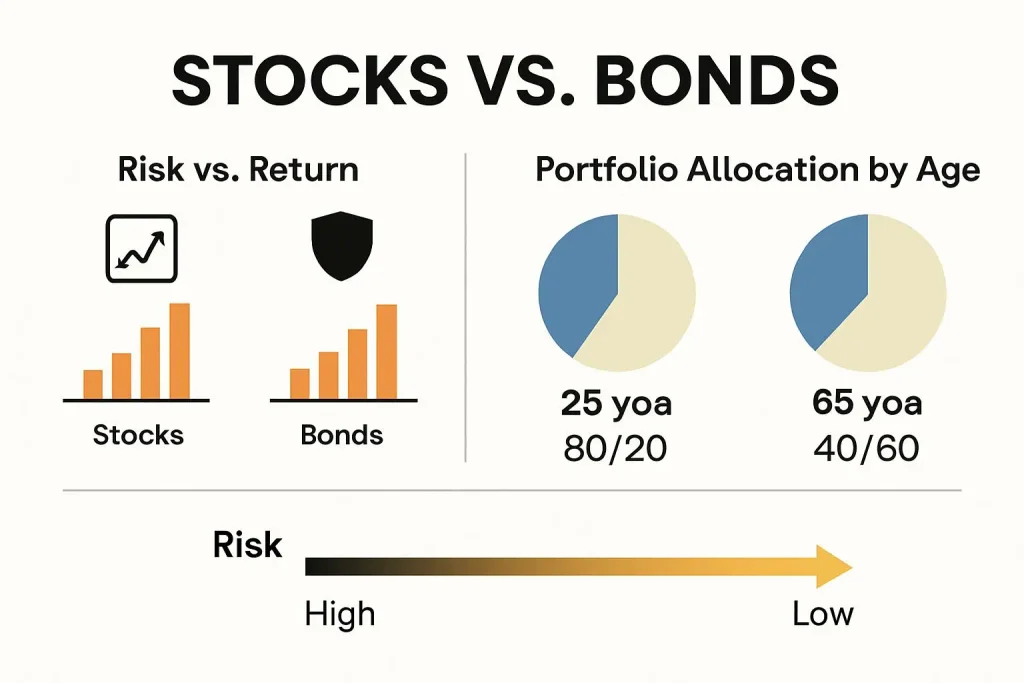
Financial decisions therefore involve evaluating both potential benefits and possible losses. A lender considers the probability that a borrower will repay. An investor considers the potential return of an asset alongside its volatility and other risks. A business considers whether the expected benefit of borrowing or investing justifies the associated financial exposure.
Risk management does not mean eliminating all risk. Instead, it involves identifying, measuring, and managing risks according to an individual’s or organization’s objectives and ability to absorb losses.
This relationship between risk, return, time, and uncertainty is one of the central mechanisms connecting different parts of finance.
How Does Finance Support the Economy?
Finance supports economic activity by helping direct capital toward households, businesses, governments, and projects that need funding. It allows people to save for the future, businesses to obtain financing, investors to allocate capital, and governments to fund public activities.
Consider a small business that receives a loan to purchase equipment. The financing allows the company to increase production without waiting until it has accumulated enough cash to purchase the equipment outright. If the investment succeeds, the business may generate additional revenue, hire employees, purchase more supplies, and repay its lenders.
Financial markets can support larger projects as well. Companies can raise capital by issuing stocks or bonds, while governments can borrow through debt markets to finance public spending.
Finance also supports economic activity through payment systems. Businesses need reliable ways to receive customer payments and pay suppliers and employees. Households need mechanisms for receiving income, paying bills, saving money, and transferring funds.
However, finance does not automatically guarantee economic growth. Poor lending decisions, excessive leverage, weak risk management, fraud, or financial instability can produce significant economic costs.
A well-functioning financial system can therefore help allocate capital, facilitate transactions, manage risk, and support productive economic activity, while effective regulation and risk management help limit the consequences of financial failures.
What Happens When the Financial System Does Not Work Properly?
When the financial system stops functioning effectively, the flow of money and credit between households, businesses, banks, investors, and governments can become disrupted. The consequences can extend beyond financial markets into employment, business activity, investment, and household finances.
For example, if banks experience major losses or become concerned about their ability to meet obligations, they may become more cautious about lending. Businesses that depend on credit can then find it harder to finance operations or expansion, while households may face tighter lending conditions.

The 2008 global financial crisis demonstrated how problems in one part of the financial system can spread through interconnected institutions and markets. Severe losses associated with the U.S. housing and mortgage markets contributed to major stress across financial institutions, a sharp reduction in credit availability, and a broader economic downturn.
Other forms of disruption include bank runs, in which many depositors attempt to withdraw their money at the same time, and market crashes, in which asset prices decline rapidly. Liquidity shortages can also make it difficult for institutions or investors to sell assets or obtain funding when needed.
Financial regulation, supervision, capital requirements, liquidity rules, deposit-protection arrangements, and central-bank facilities are among the mechanisms used in different jurisdictions to reduce financial-system risks.
Understanding these failure points provides another way to understand how finance operates. The financial system depends heavily on trust, liquidity, functioning institutions, accurate information, and effective risk management. When those foundations weaken, problems can spread quickly across interconnected parts of the economy.
Conclusion
Finance works as a connected system that moves and manages money between people, businesses, financial institutions, investors, and governments. From everyday payments and savings to business loans, investments, and financial markets, each activity plays a role in determining where money goes and how it is used.
The process is not simply about moving cash from one account to another. Finance helps allocate capital, provide access to credit, manage risk, facilitate payments, and transfer financial resources across time. Banks and other financial institutions connect participants, while financial markets allow investors and organizations to exchange capital and financial assets.
Understanding these connections makes everyday financial decisions easier to put into context. Saving, borrowing, investing, and managing risk are not isolated activities; they are parts of a much larger system that influences businesses and the wider economy.
Ultimately, understanding how does finance work means understanding the flow of money, the institutions that support it, the risks involved, and the decisions that determine how capital is used. Once you understand these basic mechanisms, financial concepts that may initially seem complicated become much easier to follow.
Frequently Asked Questions
How does finance work in simple terms?
Finance works by helping money move between people and organizations that have funds available and those that need them. Banks, financial markets, lenders, investors, and payment systems help transfer, manage, and allocate money while accounting for factors such as interest, risk, time, and expected returns.
How does money move through the financial system?
Money moves through the financial system through payments, bank transfers, lending, investing, and financial-market transactions. For example, a customer pays a business, the business receives the funds through a payment system, and the money may later be used to pay employees, suppliers, lenders, or investors.
How do banks make money?
Banks generally earn revenue from activities such as lending, fees, and other financial services. A major source is the difference between the interest banks earn on loans and the interest they pay on certain deposits and other funding sources. Their profitability also depends on operating costs, credit losses, market conditions, and regulatory requirements.
Why are interest rates important in finance?
Interest rates influence how expensive it is to borrow money and how much return savers and lenders may receive. Changes in interest rates can affect mortgages, business loans, savings, bonds, investment decisions, consumer spending, and broader economic activity.
What is the main purpose of the financial system?
The financial system helps move and allocate capital, facilitate payments, provide credit, manage financial risks, and connect savers with borrowers and investors with organizations seeking funding. It allows financial resources to be transferred across people, businesses, institutions, and different points in time.