

Search engines have become one of the most important ways people discover businesses, products, services, and information online. Whenever someone wants to learn something, compare products, or find a service, they often begin with Google or another search engine. For businesses, this creates an opportunity to reach potential customers who are already looking for relevant information.
This is where SEO in digital marketing plays an important role.
Search Engine Optimization (SEO) helps websites improve their visibility in organic search results. By creating useful content, optimizing webpages, improving website performance, and making information easier for search engines to understand, businesses can attract relevant visitors without paying for every organic click.
However, SEO is not simply about adding keywords to an article. It involves understanding search intent, creating valuable content, optimizing website structure, improving technical performance, and building a trustworthy online presence.
In this guide, you will learn how SEO works in digital marketing, how Google discovers and ranks webpages, the different types of SEO, and the practical strategies businesses can use to improve their search visibility.
Why Is SEO Important in Digital Marketing?
SEO is important because it connects businesses with people who are already interested in their products, services, or information.
A well-planned SEO strategy can help businesses:
- Increase organic traffic by attracting visitors from relevant search queries.
- Improve online visibility by making important webpages easier to discover.
- Build credibility through useful, accurate, and informative content.
- Generate qualified leads from people searching for specific services.
- Support sales by helping customers research products before purchasing.
- Improve website usability through better navigation, content organization, and performance.
- Build long-term marketing value by developing a stronger organic presence over time.
For example, a digital marketing agency that publishes helpful articles about SEO, content marketing, and social media marketing may attract people who are researching these topics. Some readers may later become potential clients.
SEO therefore supports more than website traffic. When implemented effectively, it can contribute to brand awareness, customer acquisition, and business growth.
How Does SEO Work in Digital Marketing?
SEO works by helping search engines discover webpages, understand their content, and determine whether they are relevant to users’ searches.
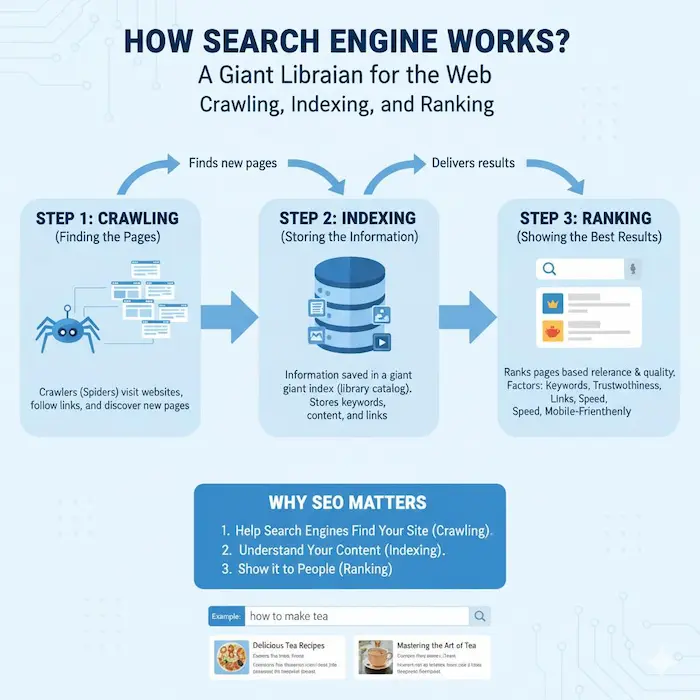
Google explains its search process through three main stages: crawling, indexing, and serving search results. Understanding these stages makes it easier to see where SEO improvements can help.
1. Crawling: How Search Engines Discover Websites
Crawling is the process through which search engines discover webpages and retrieve their content.
Search engines use automated programs called crawlers or bots. Google uses a crawler commonly known as Googlebot to explore accessible webpages and discover new or updated content.
Crawlers can find URLs through links, XML sitemaps, and previously discovered pages. When they visit a webpage, they attempt to retrieve information that helps the search engine understand the page.
For example, suppose you publish an article about email marketing on your website. If another relevant article links to it, Google may discover the new URL through that internal link.
To support crawling, website owners should:
- Create an XML sitemap containing important URLs.
- Add relevant internal links to new articles.
- Ensure important pages return appropriate HTTP status codes.
- Avoid accidentally blocking important content in
robots.txt. - Maintain reliable website hosting.
- Check crawling issues using Google Search Console.
Crawling does not guarantee indexing. Google may discover a URL but decide not to index it, or technical problems may prevent the page from being accessed.
You can learn more in Google’s official guide to how Google Search discovers and crawls webpages.
2. Indexing: How Google Understands Your Content
After crawling a webpage, Google analyzes its content and determines whether it should be included in its search index.
Indexing involves processing and storing information about webpages so that they can potentially appear in search results.
Search engines may analyze several elements, including:
- Main page content and headings.
- Page titles and descriptive information.
- Images and their contextual information.
- Links to and from other webpages.
- Canonical URLs and duplicate content signals.
- Language and other contextual details.
- Technical directives affecting indexing.
For example, an article titled “How to Start a Blog” should clearly explain blogging rather than provide unrelated information about online shopping.
Clear headings, relevant content, descriptive titles, and logical page organization help communicate a webpage’s purpose.
Technical settings are equally important. If an important page contains a noindex directive, Google may exclude it from its index. Incorrect canonical tags, duplicate URLs, and inaccessible content can also affect indexing.
To improve indexing readiness:
- Make sure the page is accessible to Googlebot.
- Check that it does not have an unintended
noindexdirective. - Provide useful and original information.
- Add appropriate internal links.
- Include the URL in your XML sitemap when suitable.
- Inspect the URL using Google Search Console.
Remember that Google does not guarantee that every discovered or crawled page will be indexed.
3. Ranking: How Google Selects Search Results
When someone searches for a particular topic, Google identifies pages that may satisfy the query and orders the results using automated ranking systems.
This is the stage most people associate with SEO.
For example, someone searching for “how does SEO work in digital marketing” is probably looking for an educational guide. A useful article explaining crawling, indexing, keyword research, and ranking may be more relevant to that search than a product checkout page.
Google considers many signals and systems when determining which results are useful. These can include the relevance of content, the meaning of the query, information quality, context, and other factors.
There is no single trick that guarantees a particular ranking.
Businesses can improve their chances of appearing for relevant searches by:
- Creating helpful, accurate, and original content.
- Matching the search intent behind target keywords.
- Writing clear titles and headings.
- Building logical internal links.
- Improving mobile usability and page performance.
- Resolving technical SEO problems.
- Earning relevant backlinks naturally.
- Keeping important information accurate and up to date.
The main objective is not simply to rank for a keyword. It is to provide a useful answer to the person performing the search.
What Are the Main Types of SEO?
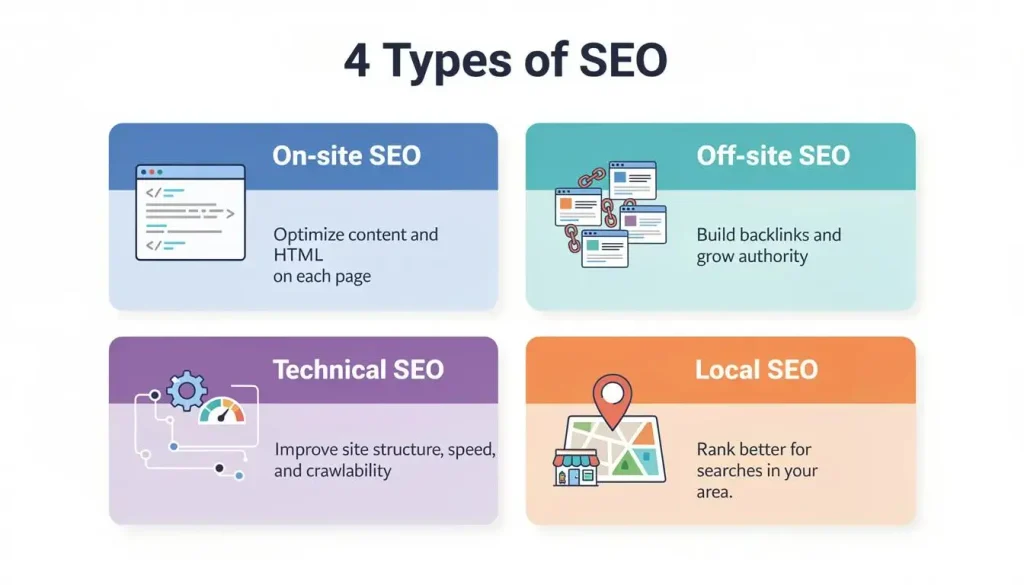
SEO is commonly divided into four major categories: on-page SEO, off-page SEO, technical SEO, and local SEO.
Each category addresses a different aspect of improving a website’s organic search visibility.
1. On-Page SEO
On-page SEO involves optimizing individual webpages to help search engines and visitors understand their content.
It includes keyword research, title tags, headings, content quality, internal linking, image optimization, and URL structure.
For example, if you publish an article about email marketing, the page should explain the topic clearly, answer relevant questions, and organize information into useful sections.
Important on-page SEO practices include:
- Keyword optimization: Use relevant search terms naturally where they help describe the topic.
- Title tags: Write descriptive titles that communicate the main subject.
- Headings: Organize content using a logical H1, H2, and H3 structure.
- Meta descriptions: Summarize the page to help users understand its value before clicking.
- Internal links: Connect related pages using descriptive anchor text.
- Image optimization: Use appropriate image sizes and meaningful alt text when images convey information.
- Content quality: Provide accurate, useful, and sufficiently detailed answers.
For example, an article targeting “how does SEO work in digital marketing” should explain how SEO works rather than repeatedly insert the exact phrase into every paragraph.
Natural language, relevant examples, and a clear structure generally provide a better reading experience than keyword repetition.
For more practical guidance, read Google’s SEO Starter Guide.
2. Off-Page SEO
Off-page SEO refers to activities outside your website that can support its reputation, visibility, and authority.
One important part of off-page SEO is earning backlinks, which are links from other websites to your webpages.
For example, a marketing publication might link to your article because it provides a useful explanation of keyword research. That link can introduce your website to new readers and help search engines understand the relationships between webpages.
Useful off-page SEO activities include:
- Publishing original research and useful resources.
- Building relationships with relevant publishers.
- Earning editorial backlinks from credible websites.
- Sharing valuable content with interested audiences.
- Participating in relevant industry communities.
- Developing a recognizable and trustworthy brand.
Not all backlinks have the same value. Relevant links earned through genuine editorial decisions are generally more desirable than links created primarily to manipulate rankings.
Avoid purchasing manipulative links, participating in link schemes, or generating large numbers of irrelevant backlinks.
The goal of off-page SEO is to build a legitimate online reputation rather than simply collect links.
3. Technical SEO
Technical SEO focuses on improving the technical aspects of a website so search engines can access, process, and understand its content.
Even a well-written article may struggle to appear in search results if Google cannot access the page or if indexing settings prevent it from being included in the index.
Important technical SEO elements include:
- Crawlability: Make sure search engines can access important pages.
- Indexability: Check that pages intended for search results are not unintentionally blocked or marked noindex.
- XML sitemaps: Help search engines discover important URLs.
- Canonical tags: Identify preferred URLs when duplicate or similar pages exist.
- Mobile usability: Make content readable and navigation usable on mobile devices.
- Page performance: Reduce unnecessary scripts and oversized resources.
- HTTPS: Secure the website’s connection.
- Structured data: Use supported schema markup when it accurately describes the content.
- URL structure: Use clear, descriptive URLs where practical.
Technical SEO should prioritize problems that prevent search engines from accessing content or prevent visitors from using the website effectively.
For WordPress websites, tools such as Google Search Console and SEO plugins can help identify relevant issues. However, installing an SEO plugin alone does not guarantee that every technical SEO requirement is satisfied.
4. Local SEO
Local SEO helps businesses improve their visibility in searches connected to a particular location.
For example, someone searching for “digital marketing agency in Lahore” may want to hire a provider in that city rather than read a general educational article.
Local SEO is particularly useful for businesses serving customers in specific geographical areas.
Important local SEO activities include:
- Creating and maintaining an eligible Google Business Profile.
- Keeping business details accurate.
- Choosing relevant business categories.
- Providing clear information about services and locations.
- Encouraging genuine customer reviews.
- Publishing useful location-specific content when appropriate.
- Earning relevant local mentions and links.
Local search visibility can depend on relevance, distance, prominence, and other factors.
Although businesses cannot control every ranking factor, accurate information and a trustworthy local presence can improve their chances of appearing in relevant searches.
How Does Keyword Research Work in SEO?
Keyword research is the process of identifying the words and phrases people use when searching for information, products, or services.
It helps marketers understand what their audience needs and which topics their websites should cover.
For example, people interested in SEO might search for:
- What is SEO?
- How does SEO work in digital marketing?
- On-page SEO techniques.
- Technical SEO checklist.
- Best SEO tools for beginners.
- SEO services for small businesses.
These searches relate to the same general subject, but they do not all express the same intent.
Someone searching “what is SEO?” probably wants a definition. Someone searching “SEO services for small businesses” may be comparing agencies or considering hiring a professional.
Understanding Search Intent
Search intent describes the reason behind a user’s search.
There are four commonly used categories:
1. Informational intent: The user wants to learn something.
Example: “How does SEO work?”
2. Navigational intent: The user wants to find a particular website or page.
Example: “Google Search Console login.”
3. Commercial investigation: The user is comparing products or services before deciding.
Example: “Best SEO tools for small businesses.”
4. Transactional intent: The user wants to complete an action, such as making a purchase or requesting a service.
Example: “Hire an SEO consultant.”
Understanding intent helps you create the most appropriate type of content. An informational query may require a detailed guide, while a transactional query may be better served by a service page with clear benefits and a contact form.
How to Find the Right Keywords
A practical keyword research process involves several steps:
- Identify your website’s main topics.
- List questions your target audience may ask.
- Research relevant keywords and variations.
- Review search results to understand intent.
- Evaluate relevance, competition, and potential business value.
- Group closely related keywords into topic clusters.
- Create or improve the most appropriate page.
- Review performance and update your strategy.
Tools such as Google Search Console, Google Keyword Planner, and other keyword research platforms can help identify opportunities.
Avoid creating a separate article for every keyword variation. When several searches express the same intent, one comprehensive article may serve readers better than multiple repetitive pages.
How Does Content Marketing Support SEO?
Content marketing and SEO work together because useful content helps search engines understand a website’s subject and helps users find answers to their questions.
Content marketing involves creating and distributing valuable information to attract and engage an audience. SEO helps that content become discoverable through organic search.
Common forms of SEO content include:
- Blog articles and educational guides.
- Product descriptions and category pages.
- Service pages and landing pages.
- Case studies and original research.
- Tutorials and step-by-step instructions.
- Videos, diagrams, and visual resources.
- Frequently asked questions.
For example, a digital marketing website might publish a comprehensive SEO guide, a separate tutorial about keyword research, and a service page explaining its SEO services.
Each page serves a different purpose while supporting the website’s overall subject.
Create Helpful, People-First Content
Effective SEO content should answer the reader’s question rather than simply repeat keywords.
Before publishing an article, consider whether it:
- Answers the main question clearly.
- Provides accurate and reliable information.
- Explains the topic sufficiently.
- Includes useful examples and practical advice.
- Uses clear headings and readable paragraphs.
- Adds original value rather than repeating generic information.
- Links to relevant resources when they support the explanation.
Google recommends creating helpful, reliable, people-first content rather than content designed primarily to manipulate rankings. You can read its guidance on creating helpful, reliable, people-first content.
Longer articles can be useful for complex subjects, but word count alone does not determine ranking. A focused 1,000-word article may be more helpful than a repetitive 3,000-word article.
The ideal length depends on the subject, search intent, and information readers need.
How Does Link Building Help SEO?
Link building involves earning or acquiring links from other websites to your own content.
Backlinks can help readers discover your website and provide search engines with additional information about how webpages are connected.
For example, if a respected marketing website references your original research about website traffic, its readers may follow the link to explore your findings.
Effective Link-Building Strategies
Publish original research. Surveys, studies, and useful statistics may give other publishers a reason to reference your website.
Create valuable resources. Develop detailed guides, checklists, calculators, or tutorials that solve real problems.
Build professional relationships. Connect with relevant publishers, writers, and businesses in your industry.
Share expert insights. Contribute useful information to relevant publications when it genuinely benefits their audiences.
Promote your content. Share valuable resources with people who may find them useful.
Avoid spam comments, automated link schemes, and paid links designed to manipulate rankings.
A strong backlink profile is not simply a large collection of links. Relevance, context, and legitimate link acquisition practices matter.
How Does User Experience Affect SEO?
User experience describes how easily visitors can access, understand, and interact with a website.
A useful website should make it easy for readers to find information without unnecessary distractions or confusion.
Important user experience considerations include:
- Readable text and clear headings.
- Simple navigation.
- Responsive mobile design.
- Fast and stable page loading.
- Accessible links and buttons.
- Limited intrusive pop-ups.
- Clear calls to action.
- Useful and relevant content.
Google also considers page experience signals and systems, but no single page experience score guarantees higher rankings.
Core Web Vitals measure aspects of loading performance, responsiveness, and visual stability. These metrics can help website owners identify opportunities to improve the browsing experience.
A better user experience can also support business objectives. For example, a service page that loads reliably and clearly explains its benefits may make it easier for a potential customer to submit an inquiry.
The goal is to create a website that works well for both visitors and search engines.
How Long Does SEO Take to Show Results?
SEO is a long-term marketing strategy because search engines need time to discover, process, and evaluate webpages and their changes.
The timeline depends on factors such as website history, competition, content quality, technical health, search demand, and existing online reputation.
Some technical changes may be reflected relatively quickly, while meaningful improvements for competitive keywords can take months or longer.
There is no universal timeline for SEO success.
For example, a website with an indexing problem may benefit from correcting an unintended noindex directive. However, resolving the issue does not guarantee immediate rankings or traffic because Google must still process the change and evaluate the page.
The best approach is to implement improvements consistently, monitor results, and avoid unrealistic promises about guaranteed rankings.

How to Measure SEO Performance
SEO requires ongoing measurement so businesses can understand which pages perform well and which need improvement.
Two useful tools are Google Search Console and Google Analytics.
Google Search Console
Google Search Console helps website owners understand how their pages perform in Google Search.
It provides information about:
- Organic search clicks and impressions.
- Search queries.
- Average search position and click-through rate.
- Indexing status.
- Sitemap processing.
- Crawling and technical issues.
- Search appearance performance.
For example, if an article receives many impressions but relatively few clicks, review whether its title and search snippet clearly explain the value of the content.
If an important article is not indexed, inspect the URL using the URL Inspection tool and investigate any reported issues.
Google Analytics
Google Analytics helps website owners understand what visitors do after arriving on their websites.
Depending on your configuration, you can measure:
- Organic search sessions.
- Engaged sessions.
- Important page views.
- Lead form submissions.
- Purchases and revenue.
- Other conversion events.
Search Console and Analytics serve different purposes. Search Console helps explain performance in Google Search, while Analytics helps you understand what visitors do on your website.
Important SEO Metrics to Track
| SEO metric | What it measures |
|---|---|
| Organic clicks | Clicks from organic search results |
| Impressions | How often pages appear in search results |
| Click-through rate (CTR) | The proportion of impressions that result in clicks |
| Average position | The average position of a result across recorded searches |
| Indexed pages | Pages Google has included in its index |
| Organic conversions | Leads, purchases, or other goals attributed to organic traffic |
| Engagement | How visitors interact with your website according to your analytics setup |
Do not judge SEO success through rankings alone. Relevant traffic, qualified leads, sales, and other business outcomes can provide a more meaningful picture of performance.
What Is the Difference Between SEO and Paid Advertising?
SEO and paid search advertising both help businesses reach people through search engines, but their methods differ.
| Feature | SEO | Paid search advertising |
|---|---|---|
| Search placement | Organic results | Sponsored placements |
| Payment | No payment per organic click to the search engine | Often pay per click or another advertising model |
| Time to visibility | Usually gradual | Campaign visibility can begin after launch and approval |
| Long-term presence | Can build sustained organic visibility | Depends on continued campaign funding |
| Main activities | Content, technical improvements, website structure, backlinks | Ad targeting, bids, budgets, landing pages |
| Primary benefit | Organic discovery over time | Targeted paid exposure |
SEO is not completely free because it requires time, expertise, content creation, and website maintenance.
Paid advertising also requires careful planning because spending money does not automatically produce profitable results.
Many businesses use both approaches. Paid search can support immediate campaign goals, while SEO develops organic visibility over the longer term.
Common SEO Mistakes to Avoid
Even a well-designed website can struggle when its SEO strategy includes avoidable mistakes.
1. Keyword Stuffing
Keyword stuffing means repeating keywords unnaturally to influence rankings.
Instead of repeating “SEO digital marketing” throughout every paragraph, explain the topic naturally and use relevant terminology where it makes sense.
2. Publishing Duplicate or Thin Content
Pages that provide little original value or repeat information across multiple URLs may offer a poor user experience.
Create content that serves a clear purpose and adds meaningful information.
3. Ignoring Technical SEO
Incorrect noindex directives, broken internal links, server errors, and blocked pages can interfere with crawling or indexing.
Review important URLs and resolve technical problems that prevent search engines from accessing the content.
4. Buying Manipulative Backlinks
Links created primarily to manipulate rankings can violate Google’s spam policies.
Focus on useful resources, genuine relationships, and legitimate editorial references.
5. Neglecting Mobile Users
A website that is difficult to navigate on a phone can frustrate visitors.
Test pages across different screen sizes and ensure important information is easy to access.
6. Expecting Instant Results
SEO changes may take time to influence search performance.
Monitor progress over an appropriate period and avoid making major decisions based only on short-term fluctuations.
7. Writing Only for Search Engines
Content that repeats keywords but fails to answer readers’ questions is unlikely to provide lasting value.
Prioritize usefulness, accuracy, originality, and a satisfying reading experience.
A Step-by-Step SEO Strategy for Beginners
If you are new to SEO, start with the fundamentals rather than trying to implement every technique at once.
Step 1: Set clear goals. Decide whether you want more organic traffic, qualified leads, online sales, or local inquiries.
Step 2: Research your audience. Identify the questions, problems, and needs of your potential customers.
Step 3: Perform keyword research. Find relevant search queries and determine their intent.
Step 4: Check technical SEO. Review important URLs, indexing settings, internal links, mobile usability, and page performance.
Step 5: Optimize existing pages. Improve titles, headings, content, internal links, and calls to action.
Step 6: Publish helpful content. Create original articles and resources that answer genuine questions.
Step 7: Strengthen internal linking. Connect related articles and service pages using descriptive anchor text.
Step 8: Earn relevant backlinks. Promote valuable resources and build relationships with credible publishers.
Step 9: Measure performance. Use Google Search Console and Google Analytics to evaluate visibility, traffic, and conversions.
Step 10: Improve consistently. Update outdated information, resolve technical issues, and refine pages based on performance data.
SEO works best as an ongoing process rather than a one-time adjustment.
Conclusion
SEO is an essential part of digital marketing because it helps businesses connect their websites with people searching for relevant information, products, and services.
It works through several connected activities: search engines discover webpages through crawling, analyze their content during indexing, and evaluate relevant pages when generating search results. Website owners can support this process through useful content, keyword research, on-page optimization, technical improvements, internal linking, and legitimate link building.
However, successful SEO is not simply about reaching the top of Google. It also involves attracting the right audience, providing a positive user experience, and turning relevant visitors into meaningful business outcomes.
If you are beginning your SEO journey, focus on the fundamentals. Make sure your important pages are accessible, understand what your audience searches for, publish helpful content, and measure your progress using reliable tools.
With consistent effort and a well-planned strategy, SEO can become a valuable part of your digital marketing activities and help your website build a stronger organic presence over time.
Frequently Asked Questions About SEO in Digital Marketing
What does SEO mean in digital marketing?
SEO means Search Engine Optimization. It is the process of improving a website’s accessibility, relevance, and quality to help its pages appear in relevant organic search results.
2. How does SEO work step by step?
SEO involves researching keywords, understanding search intent, creating useful content, optimizing webpages, improving technical accessibility, earning relevant links, and measuring performance. Search engines then discover, crawl, index, and potentially rank eligible webpages.
3. Is SEO free?
Organic search clicks do not require payment to the search engine. However, SEO can involve costs for content creation, technical development, professional services, research tools, and website maintenance.
4. How long does SEO take to work?
The timeline varies according to competition, website health, content quality, and other factors. Some improvements may be reflected quickly, while meaningful organic growth can take months or longer. No provider can reliably guarantee a particular ranking for every website.
5. What are the four main types of SEO?
The four commonly discussed types are on-page SEO, off-page SEO, technical SEO, and local SEO. Together, they address page content, external reputation, website infrastructure, and location-based visibility.