

Corporate finance is the area of finance that focuses on how companies raise money, invest it, and manage financial resources to achieve their business goals. It helps organizations decide where to obtain funding, which projects deserve investment, and how to use available cash efficiently. These decisions affect a company’s profitability, financial stability, and long-term growth.
From purchasing new equipment to expanding into another market, businesses need a clear financial strategy to make informed decisions. Corporate finance helps managers compare investment opportunities, evaluate financial risks, and choose suitable funding sources, such as loans, equity, or retained earnings.
In this guide, you will learn what corporate finance means, its main areas and functions, why it matters, and how it works through practical examples. You will also explore financing methods, career opportunities, and the difference between corporate finance and accounting.
What Is Corporate Finance?
Corporate finance is the branch of finance concerned with how businesses raise capital, make investment decisions, manage cash flow, and allocate financial resources. Its primary objective is to increase the long-term value of a business while maintaining an appropriate balance between risk, profitability, and financial stability.

Corporate finance applies to businesses of different sizes, from startups and family-owned companies to multinational corporations. Although their financial needs may differ, all businesses must decide how to obtain money, where to invest it, and how to manage their financial obligations.
Simple Definition of Corporate Finance
In simple terms, corporate finance is how a business manages its money to operate, grow, and create value.
It answers three fundamental questions:
- Where will the money come from? A company may use loans, issue shares, or reinvest profits.
- Where should the money go? Management evaluates projects, equipment purchases, technology, and expansion opportunities.
- How should financial resources be managed? The company monitors cash flow, expenses, debt, and financial performance.
For example, a furniture manufacturer planning to open a second factory must estimate construction costs, forecast future sales, and compare financing options. Corporate finance helps the company determine whether the investment is financially worthwhile and how to fund it.
What Is the Main Purpose of Corporate Finance?
The main purpose of corporate finance is to support decisions that increase business value over time. This involves selecting worthwhile investments, managing financing costs, and ensuring the company can meet its financial obligations.
A business must also balance immediate needs with future opportunities. Spending too much on expansion can create cash shortages, while avoiding all financial risk may prevent the company from growing.
Corporate finance provides a framework for making these trade-offs based on financial analysis rather than guesswork.
How Does Corporate Finance Work?
Corporate finance works through a continuous process of financial planning, funding, investment, and performance monitoring. Companies use this process to determine their financial needs, choose appropriate funding sources, and evaluate whether their decisions deliver the expected results.

1. Identify Financial Needs
The first step is determining how much money the company needs and what it will be used for. Financial needs may arise from purchasing equipment, hiring employees, developing products, or expanding operations.
Budgets and forecasts help estimate the required amount and when the funds will be needed.
2. Evaluate Financing Options
Next, the company compares available funding sources. These may include bank loans, bonds, issuing shares, or using internally generated cash.
Each option has different costs and risks. Debt requires repayment and usually involves interest, while equity financing may reduce existing owners’ percentage of ownership.
3. Make Investment Decisions
Once funding requirements are understood, the company evaluates where its money should be invested. Finance teams estimate future cash flows, compare expected returns, and assess potential risks.
Tools such as net present value (NPV) and internal rate of return (IRR) can help evaluate long-term projects.
4. Monitor Financial Performance
After an investment is made, the company compares actual results with its original forecasts. It reviews revenue, expenses, cash flow, and other financial measures to determine whether the project is performing as expected.
For example, a software company might invest in developing a new product. If sales fall below forecasts, management may adjust its budget, revise pricing, or reconsider its marketing strategy.
What Are the Main Areas of Corporate Finance?
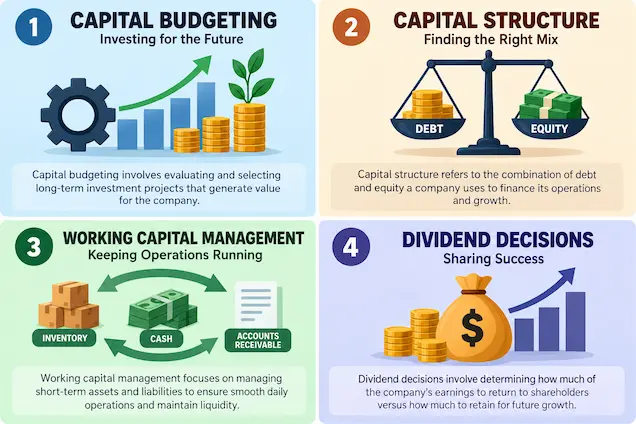
Corporate finance includes several interconnected areas that guide a company’s investment, funding, and day-to-day financial decisions. Four commonly discussed areas are capital budgeting, capital structure, working capital management, and dividend decisions.
Capital Budgeting
Capital budgeting is the process of evaluating long-term investments to determine which projects or assets a company should fund.
Examples include building a factory, purchasing machinery, launching a new product, or acquiring another business. Because these investments may require substantial resources, companies assess their expected costs, future cash flows, and potential risks before deciding.
Common evaluation methods include NPV, IRR, and the payback period. These tools help management compare investment opportunities and understand their financial implications.
Capital Structure
Capital structure refers to the mix of debt and equity a company uses to finance its operations and investments.
Debt financing includes borrowing through loans or bonds, while equity financing generally involves raising money in exchange for an ownership interest. Debt can allow existing owners to retain control, but repayment obligations increase financial pressure. Equity does not usually require scheduled principal repayment, but it can dilute ownership.
Companies evaluate these trade-offs to determine a funding structure that suits their financial position, strategy, and risk tolerance. For more detail, see this guide to capital structure and financing decisions.
Working Capital Management
Working capital management focuses on the short-term assets and liabilities needed to keep a business operating smoothly.
Net working capital is calculated by subtracting current liabilities from current assets. These items may include cash, inventory, customer receivables, and supplier payables.
Effective working capital management helps a company pay employees and suppliers on time, collect customer payments efficiently, and maintain appropriate inventory levels.
For example, a retailer may negotiate better payment terms with suppliers while improving the collection of overdue customer invoices. These actions can improve cash availability without requiring additional long-term financing.
Dividend Decisions
Dividend decisions determine how much of a company’s profits should be distributed to shareholders and how much should be retained for future use.
A mature business with predictable cash flows may distribute a portion of its profits as dividends. A growing company may retain more earnings to fund expansion, research, or new equipment.
The appropriate decision depends on profitability, available cash, investment opportunities, financial obligations, and shareholder expectations.
What Are the Main Functions of Corporate Finance?
The main functions of corporate finance involve planning financial activities, analysing investments, selecting funding sources, managing cash flow, and assessing financial risks. Together, these functions help a business use its resources effectively.

Financial Planning and Forecasting
Financial planning establishes targets for revenue, expenses, profitability, and investment. Forecasting estimates future financial performance using historical results, current conditions, and expected business changes.
These activities help managers prepare budgets, anticipate funding requirements, and make better-informed decisions.
Investment Analysis
Investment analysis evaluates whether proposed projects or assets are likely to deliver sufficient financial benefits.
Finance teams compare costs, forecast cash flows, assess uncertainty, and consider how each investment supports the company’s broader strategy.
Financing Decisions
Financing decisions determine how a company obtains the money required for its operations and growth.
Finance teams compare debt, equity, and internal funding, considering their costs, risks, repayment requirements, and effects on ownership.
Cash Flow Management
Cash flow management tracks the movement of money into and out of a business. It helps companies maintain enough cash to meet expenses, pay suppliers, and service debt.
A company can report an accounting profit and still face financial difficulties if customers pay late or large payments become due before sufficient cash is available.
Risk Assessment
Risk assessment identifies financial threats that could affect business performance. These may include changing interest rates, currency fluctuations, rising costs, declining demand, or customer defaults.
Companies can respond through forecasting, appropriate insurance, hedging where suitable, diversification, and maintaining sufficient financial reserves.
What Are the Goals of Corporate Finance?
Corporate finance supports several related goals that help a company maintain financial health and create long-term value.
Maximizing Shareholder Value
For shareholder-owned businesses, an important objective is increasing the long-term value of shareholders’ ownership interests. Management evaluates investments and financial decisions based on their expected contribution to business value, while considering associated risks.
Improving Profitability
Profitability measures how effectively a company generates earnings from its revenue and resources. Finance teams analyse costs, margins, pricing, and asset utilization to identify opportunities for improvement.
Maintaining Financial Stability
Financial stability means having the resources to meet financial obligations and withstand unexpected difficulties. Companies support stability by managing liquidity, monitoring debt, and planning for changes in revenue or expenses.
Balancing Risk and Return
Investment opportunities differ in their expected returns and uncertainty. Corporate finance helps businesses evaluate whether a potential return justifies the financial and operational risks involved.
Why Is Corporate Finance Important?
Corporate finance is important because financial decisions influence almost every part of a business. Effective financial management helps organizations fund growth, control costs, allocate resources, and respond to changing market conditions.
Its main benefits include:
- Supporting business growth: Financial planning helps companies fund expansion, launch products, and enter new markets.
- Using resources efficiently: Investment analysis helps direct limited funds toward projects that support business objectives.
- Improving decision-making: Budgets, forecasts, and financial models provide a structured basis for evaluating alternatives.
- Managing financial risk: Companies can identify potential cash shortages, excessive debt, and other threats before they become more serious.
- Maintaining liquidity: Cash flow planning helps ensure that money is available when payments are due.
- Supporting long-term sustainability: A balanced financial strategy helps businesses pursue growth without ignoring financial stability.
For example, a restaurant chain considering expansion may compare the expected sales, operating costs, rental expenses, and funding requirements of several locations. Corporate finance helps management decide whether opening a new branch is likely to create sufficient value.
What Are the Main Sources of Corporate Financing?
Companies obtain funding from different sources depending on their financial needs, ownership preferences, repayment capacity, and investment plans. Three important sources are equity financing, debt financing, and internal financing.
Equity Financing
Equity financing involves raising capital by selling an ownership interest in a business. A company may issue shares or obtain investment from venture capital firms and other investors.
The company generally does not have to repay equity capital according to a fixed loan schedule. However, existing owners may experience ownership dilution, and new investors may gain certain rights.
Debt Financing
Debt financing involves borrowing money that must be repaid according to agreed terms. Common examples include bank loans, credit facilities, and corporate bonds.
Debt allows owners to raise funds without necessarily giving up ownership. However, interest and repayment obligations can place pressure on cash flow. Interest may also receive tax-deductible treatment where applicable rules and circumstances permit it.
Internal Financing
Internal financing uses funds generated within the business, particularly retained earnings and available operating cash.
Using internal funds can reduce dependence on external lenders and investors. However, the company must consider whether using those funds for a particular project is better than keeping them available for other needs.
Short-Term and Long-Term Financing
Financing can also be classified by its duration.
- Short-term financing generally supports immediate or near-term needs, such as inventory purchases and working capital requirements.
- Long-term financing typically supports larger investments, such as facilities, machinery, acquisitions, and expansion projects.
The appropriate option depends on the purpose of the funding, the expected timing of cash flows, and the company’s ability to meet its obligations.
What Are Some Examples of Corporate Finance?
Corporate finance decisions arise whenever a business needs to raise money, invest resources, or manage financial obligations.

Investing in a New Project
A food manufacturer considers purchasing a new production line. Its finance team estimates the initial cost, forecasts additional sales, and evaluates operating expenses before recommending whether to proceed.
Raising Capital for Expansion
A technology company wants to develop a new product. It compares a bank loan with an equity investment, considering borrowing costs, repayment obligations, ownership dilution, and expected future revenue.
Managing Working Capital
A retailer experiences cash shortages because customers pay slowly. The company improves its collection process, reviews inventory levels, and negotiates suitable supplier payment terms to improve liquidity.
Deciding Whether to Pay Dividends
A profitable company must decide whether to distribute earnings to shareholders or retain the funds for expansion. Corporate finance helps management compare shareholder distributions with the potential benefits of reinvestment.
Evaluating a Business Acquisition
A company considers purchasing a competitor to enter a new market. Its finance team evaluates the purchase price, expected cash flows, financing requirements, integration costs, and potential risks before making a recommendation.
What Do Corporate Finance Departments Do?
Corporate finance departments help businesses plan their financial activities and evaluate important strategic decisions. Their responsibilities vary by organization, but commonly include budgeting, financial analysis, funding decisions, cash management, and performance monitoring.
Typical responsibilities include:
- Preparing budgets and forecasts: Estimating future revenue, expenses, cash requirements, and financial results.
- Evaluating investments: Assessing proposed projects, acquisitions, and expansion plans.
- Managing financing: Analysing funding options and monitoring the company’s debt and equity structure.
- Monitoring performance: Comparing actual results with budgets and investigating significant differences.
- Supporting strategic decisions: Providing financial analysis for pricing, product launches, cost management, and business expansion.
In larger organizations, these activities may be divided among specialist teams such as financial planning and analysis (FP&A), treasury, and corporate development. In smaller businesses, one finance manager may handle several of these responsibilities.
What Is the Difference Between Corporate Finance and Accounting?
Corporate finance and accounting are closely related, but they serve different purposes. Corporate finance primarily supports financial planning and decisions, while accounting records transactions and prepares financial reports.
Purpose of Corporate Finance
Corporate finance uses financial information to evaluate future opportunities, determine funding needs, manage cash, and support business decisions.
Purpose of Accounting
Accounting records and organizes financial transactions and prepares reports such as income statements, balance sheets, and cash flow statements. It also helps businesses meet relevant reporting and compliance requirements.
Key Differences
- Primary focus: Corporate finance emphasizes financial decisions and planning; accounting emphasizes recording, reporting, and interpreting financial transactions.
- Typical tasks: Corporate finance includes forecasting, investment analysis, and financing decisions. Accounting includes bookkeeping, reconciliations, financial statements, and compliance.
- Main output: Corporate finance provides analyses and recommendations. Accounting provides structured financial information and reports.
How They Work Together
Corporate finance depends on accurate accounting information to prepare budgets and evaluate investment opportunities. Accounting, in turn, records the financial effects of loans, investments, and other business decisions.
For example, accounting records a company’s historical sales and expenses. The finance team uses those records to forecast future cash flow and determine whether the company can afford to open another location.
What Is the Difference Between Corporate Finance and Investment Banking?
Corporate finance and investment banking are related fields, but their responsibilities differ. In-house corporate finance focuses on managing an organization’s own financial resources, while investment banking often advises businesses on transactions and capital raising.

Corporate Finance Responsibilities
Corporate finance professionals may prepare budgets, analyse investments, manage cash flow, evaluate funding options, and advise company leaders on financial strategy.
Their work generally supports the ongoing financial needs and long-term objectives of their organization.
Investment Banking Responsibilities
Investment bankers commonly advise companies on mergers and acquisitions, assist with issuing shares or bonds, and help structure major financial transactions.
They generally work for investment banks or financial advisory firms and serve business clients.
Key Difference
Corporate finance teams help a business decide what it should do with its financial resources. Investment bankers may help that business execute a transaction, raise external capital, or acquire another company.
For example, a manufacturer’s finance team may determine that issuing bonds is an appropriate way to fund expansion. An investment bank could help structure and arrange the bond offering.
What Challenges Do Corporate Finance Teams Face?
Corporate finance teams must make decisions under uncertainty while balancing profitability, liquidity, investment needs, and financial risk.

Common challenges include:
- Managing cash flow: Late customer payments or seasonal sales can create shortages even when a business is profitable.
- Controlling financing costs: Changes in interest rates can increase borrowing expenses and affect investment decisions.
- Evaluating investment risks: Actual project results may differ from forecasts because of changing costs, demand, or competition.
- Handling economic uncertainty: Inflation, currency fluctuations, and market changes can affect revenue and expenses.
- Balancing growth and profitability: Investing in expansion may reduce short-term earnings, while excessive cost-cutting can restrict future growth.
Accurate forecasting, regular performance reviews, and flexible financial plans help organizations respond to these challenges.
What Are the Career Opportunities in Corporate Finance?
Corporate finance offers career opportunities in companies across industries, from entry-level analytical positions to senior financial leadership roles.
Common Corporate Finance Jobs
Typical roles include:
- Financial analyst
- Financial planning and analysis (FP&A) analyst
- FP&A manager
- Treasury analyst or treasurer
- Corporate finance manager
- Corporate development analyst
- Finance director
- Chief financial officer (CFO)
Responsibilities depend on the employer, industry, and seniority of the role.
What Qualifications Do You Need for Corporate Finance?
Many entry-level positions require a bachelor’s degree in finance, accounting, economics, or business. Some employers prefer postgraduate qualifications or professional credentials relevant to the position.
Examples include the CFA designation, ACCA qualification, or CPA credential, depending on the role and jurisdiction. Requirements vary by employer and country, so candidates should check the qualifications listed in relevant job descriptions.
What Skills Are Needed in Corporate Finance?
Important skills include:
- Financial modelling and spreadsheet proficiency
- Understanding financial statements
- Analytical thinking and problem-solving
- Budgeting and forecasting
- Investment analysis and valuation
- Communication and presentation
- Attention to detail and professional judgment
Practical experience with financial models and business analysis can help candidates develop these skills.
Is Corporate Finance a Difficult Career?
Corporate finance can be demanding because it involves analytical work, deadlines, financial uncertainty, and decisions that affect business performance.
However, the difficulty depends on the role and the individual’s experience. A strong foundation in accounting, financial analysis, spreadsheets, and business fundamentals can make the work more manageable.

Conclusion
Corporate finance helps businesses raise funds, evaluate investments, manage cash flow, and allocate financial resources effectively. Its main areas include capital budgeting, capital structure, working capital management, and dividend decisions.
By combining financial planning with investment analysis and risk assessment, companies can make more informed decisions about growth, funding, and profitability. Whether a business is a startup planning its first expansion or an established corporation managing complex investments, corporate finance plays an important role in its long-term financial health and success.
Frequently Asked Questions About Corporate Finance
What Are the Three Main Areas of Corporate Finance?
Three widely recognized areas are capital budgeting, capital structure, and working capital management. Dividend policy is also an important corporate finance decision area.
What Is the Main Goal of Corporate Finance?
The main goal is generally to increase the long-term value of the business while managing financial risk and maintaining the ability to meet its obligations.
What Is an Example of Corporate Finance?
A company deciding whether to borrow money to build a new factory is an example. Its finance team evaluates the investment cost, financing terms, expected cash flows, and potential risks before recommending a decision.
What Is the Scope of Corporate Finance?
Corporate finance covers financial planning, investment decisions, capital structure, funding, working capital management, dividend decisions, and financial risk assessment. These activities apply to businesses of different sizes and industries.
What Is the Difference Between Corporate Finance and Accounting?
Corporate finance focuses on planning, funding, and investment decisions, while accounting records transactions and prepares financial reports. Both functions work together to support informed business decisions.