

Every time you take a loan to buy a car, save money in a bank, pay for insurance, or hear that “the stock market fell today,” you are touching financial markets. They sit quietly behind many of the things we use every day. Your salary may come from a company that raised money by selling shares. Your savings may earn interest because a government borrowed money by selling bonds. The price of the petrol you buy, the value of your currency, and even the cost of your home loan are all shaped by markets you may never see.
So, what are financial markets, and why do they matter so much? In simple words, they are places (physical or online) where people and organizations buy and sell money-related assets such as shares, bonds, currencies, and commodities. They connect people who have extra money with people who need money.
In this beginner-friendly guide, you will learn how financial markets work, their main types and functions, who takes part in them, the tools traded in them, and how you can start taking part safely. No financial background is needed.
What is a Financial Markets?
Financial markets are marketplaces where buyers and sellers trade financial assets such as stocks, bonds, currencies, derivatives, and commodities. Just as a vegetable market connects farmers with shoppers, a financial market connects those who have money with those who need it.
A financial asset is something that has value because of a legal claim, not because of its physical form. A share of a company is a good example. You cannot touch it like a chair or a phone, but it gives you a claim on part of the company’s profits.
Financial markets can be:
- Physical, such as a trading floor in a stock exchange building.
- Digital, where trades happen through computers and mobile apps.
- Over-the-counter (OTC), where two parties trade directly with each other instead of through a central exchange.
Today, most trading happens electronically. You can buy a share of a company on the other side of the world from your phone in a few seconds.
A simple example: Imagine a bakery that wants to open ten new branches but needs money. Instead of asking one bank, it can sell small ownership pieces (shares) to thousands of investors. The investors give the bakery money, and in return they hope to earn a profit as the business grows. The place where this exchange happens is a financial market.
How Do Financial Markets Work?
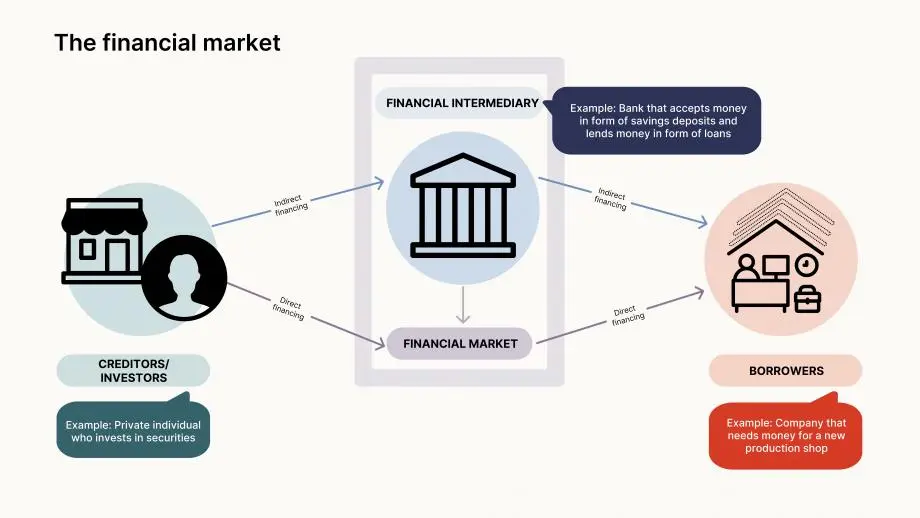
At the heart of every financial market is a simple idea: people with extra money (savers and investors) provide it to people who need money (businesses, governments, and individuals), and both sides benefit.
The basic flow of money
- Savers and investors have money they do not need right now.
- Borrowers and issuers, such as companies and governments, need money to grow, build, or operate.
- The financial market brings them together. Money flows from savers to borrowers, and in return savers get a financial asset (a share, a bond, or a loan agreement) and the promise of future returns.
How prices are decided
Prices in financial markets are mostly decided by supply and demand.
- If many people want to buy a share (high demand) and few want to sell (low supply), the price goes up.
- If many people want to sell and few want to buy, the price goes down.
Prices also change because of news and expectations. Strong company profits, a change in interest rates, a new government policy, or even a global event can make investors more or less eager to buy.
Primary and secondary markets
Financial markets work at two levels:
- Primary market: This is where new assets are created and sold for the first time. When a company launches an Initial Public Offering (IPO), it sells its shares to the public for the first time. The money goes directly to the company.
- Secondary market: This is where investors trade existing assets with each other. When you buy a share from another investor on a stock exchange, the money goes to that investor, not to the company.
The secondary market is important because it gives investors a way to sell their investments when they need cash. Without it, people would be afraid to invest in the first place.
The role of intermediaries
Most people do not trade directly. They use intermediaries such as brokers, banks, and exchanges. A broker places your buy and sell orders. An exchange provides the platform where trades are matched. Clearing organizations make sure that the buyer gets the asset and the seller gets paid.
What Are the Different Types of Financial Markets?
There are several types of financial markets. Each one deals with a different kind of asset and serves a different purpose.
1. Stock market (equity market)
The stock market is where shares of companies are bought and sold. When you buy a share, you become a part-owner of that company. If the company grows and earns profits, your share may rise in value, and you may also receive dividends (a share of the profits).
Example: Buying shares of a well-known company on a stock exchange.
2. Bond market (debt market)
The bond market is where governments and companies borrow money by selling bonds. A bond is like an IOU. You lend money, and the issuer promises to pay you regular interest and return your original amount on a fixed date.
Example: A government sells treasury bonds to fund roads, schools, or hospitals.
3. Money market
The money market deals with very short-term borrowing and lending, usually for a year or less. It involves low-risk tools like treasury bills and short-term deposits. Banks and large institutions use it to manage their day-to-day cash needs.
4. Foreign exchange (forex) market
The forex market is where currencies are traded. If you travel abroad and swap your local currency for another, you are using this market on a small scale. Forex is the largest financial market in the world by trading volume, because international trade and travel need currency exchange all the time.
5. Commodity market
The commodity market is where raw materials are traded. These include gold, silver, crude oil, natural gas, wheat, cotton, and coffee. Farmers, manufacturers, and investors use this market to buy, sell, or protect themselves from price changes.
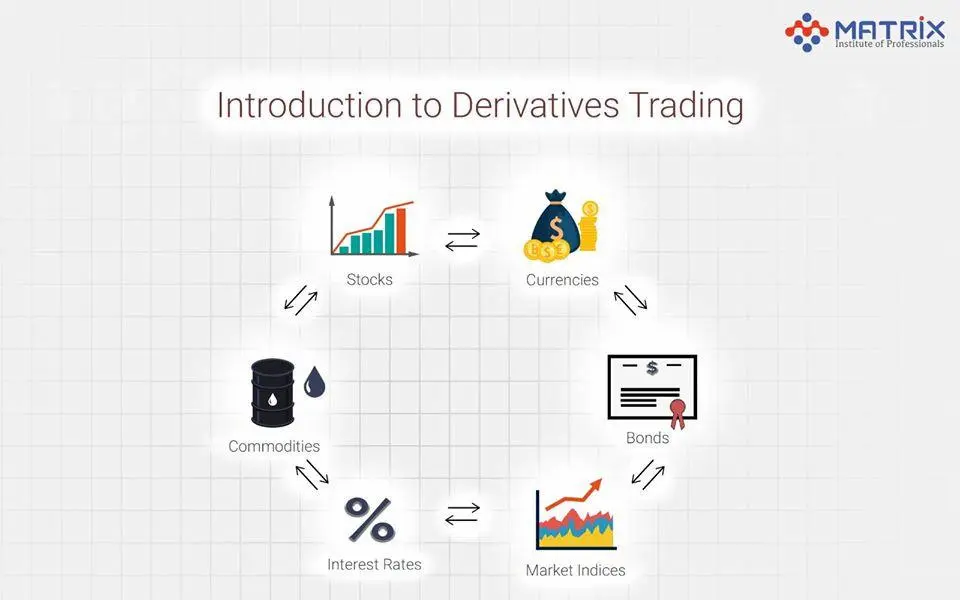
6. Derivatives market
The derivatives market deals with contracts whose value comes from another asset, such as a stock, a currency, or a commodity. Common derivatives include futures and options. They are often used to reduce risk, but they can also be used for speculation, and they can be complicated and risky for beginners.
7. Other types
- Cryptocurrency market: Digital currencies such as Bitcoin are traded on online platforms. This market is newer, less regulated in many countries, and highly volatile.
- Insurance market: Risk is transferred from individuals and businesses to insurance companies.
Quick comparison table
| Market Type | What Is Traded | Typical Time Frame | Risk Level (General) |
| Stock market | Company shares | Medium to long term | Medium to high |
| Bond market | Government and company bonds | Medium to long term | Low to medium |
| Money market | Short-term loans, treasury bills | Less than 1 year | Low |
| Forex market | Currencies | Short to long term | Medium to high |
| Commodity market | Gold, oil, wheat, etc. | Short to long term | Medium to high |
| Derivatives market | Futures, options | Usually short term | High |
Other ways to classify markets
Financial markets can also be grouped by how they operate:
- Capital markets deal with long-term funds (stocks and bonds), while money markets deal with short-term funds.
- Primary markets sell new assets, while secondary markets trade existing ones.
- Exchange-traded markets work through a formal exchange, while over-the-counter (OTC) markets work through direct deals between parties.
What Are the Main Functions of Financial Markets?
Financial markets do much more than let people trade. They perform several important jobs for the economy.
1. Mobilizing savings
Financial markets turn idle savings into productive investment. Instead of keeping money at home, people can put it into shares, bonds, or funds, where it helps businesses grow and earns returns for the saver.
2. Allocating capital efficiently
Money is limited, so it should go where it is used best. Markets guide money toward the companies and projects that investors believe will perform well. Businesses with strong ideas and good results usually find it easier to raise money.
3. Price discovery
Markets help decide the fair price of assets. Thousands of buyers and sellers share their views through their trades, and the result is a price that reflects current information. This process is called price discovery.
4. Providing liquidity
Liquidity means how easily you can turn an asset into cash. A house is not very liquid because selling it can take months. A share of a large listed company is highly liquid because you can usually sell it within seconds. Financial markets give investors this flexibility.
5. Reducing risk
Markets allow people and businesses to protect themselves from price changes. For example, an airline can use futures contracts to lock in a fuel price in advance, so a sudden jump in oil prices does not ruin its budget. Investors also reduce risk by diversifying, which means spreading money across different assets.
6. Lowering transaction costs
Because markets bring many buyers and sellers into one place, it is faster, cheaper, and easier to find a trading partner. Without them, you would have to search for someone who wants to buy what you sell, and negotiate everything yourself.
7. Sharing information
Companies listed on stock exchanges must publish regular financial reports. This gives investors and the public useful information, and encourages transparency.
Who Are the Main Participants in Financial Markets?
Many different players take part in financial markets. Each has a different goal.
| Participant | Role | Example |
| Individual investors | Invest personal savings to build wealth | A salaried employee buying shares for retirement |
| Institutional investors | Manage large pools of money for others | Pension funds, mutual funds, insurance companies |
| Companies (issuers) | Raise money by selling shares or bonds | A business launching an IPO |
| Governments | Borrow money by issuing bonds | Treasury bonds to fund public projects |
| Banks | Lend, accept deposits, and trade in markets | Commercial and investment banks |
| Brokers and dealers | Help buyers and sellers complete trades | Online trading platforms |
| Central banks | Control money supply and interest rates | The central bank of a country |
| Regulators | Make and enforce rules to protect investors | Securities commissions |
A closer look at a few key players
- Institutional investors are very powerful because they invest huge amounts. Their buying and selling can move prices.
- Central banks do not trade for profit. Instead, they set policies, such as interest rates, which affect all financial markets. When interest rates rise, borrowing becomes more costly and bond yields usually change, which affects share prices as well.
- Regulators act like referees. They create rules to stop fraud, insider trading, and unfair practices, so that ordinary investors are treated fairly.
People also use the word speculators for those who try to profit from short-term price movements, and hedgers for those who use markets to reduce risk. Both are part of the market, but their goals are very different.
What Are Financial Market Instruments?
Financial instruments are the actual products traded in financial markets. They are legal documents or contracts that represent money or value. Here are the most common ones.
Equity instruments
Shares (stocks) represent ownership in a company. Shareholders may earn money in two ways: through capital gains (when the share price rises) and dividends (a part of company profits paid to shareholders).
Debt instruments
Debt instruments are based on lending money.
- Bonds: Long-term loans to governments or companies that pay regular interest.
- Treasury bills: Short-term government securities, usually seen as very safe.
- Certificates of deposit: Fixed-term deposits offered by banks.
- Commercial paper: Short-term borrowing by large companies.
Derivative instruments
- Futures: An agreement to buy or sell something at a fixed price on a future date.
- Options: A contract that gives you the right, but not the duty, to buy or sell at a set price.
- Swaps: Agreements to exchange payment streams, often used to manage interest rate or currency risk.
Pooled investment instruments
These let many people invest together.
- Mutual funds: A professional manager invests the pooled money of many investors in a mix of assets.
- Exchange-traded funds (ETFs): Funds that trade on a stock exchange like a share and often track an index, such as a group of the biggest companies in a country.
Foreign exchange and commodity instruments
These include currency pairs (like the US dollar against the euro), spot and forward contracts, and commodity contracts for items like gold or oil.
Equity vs. debt: a simple comparison
| Feature | Equity (Shares) | Debt (Bonds) |
| What you get | Ownership in a company | A loan agreement |
| Returns | Dividends and price growth | Fixed interest payments |
| Risk | Higher | Usually lower |
| Claim if company fails | After lenders are paid | Before shareholders |
Why Are Financial Markets Important?
Financial markets are the engine of a modern economy. Here is why they matter.

They support economic growth
Businesses need money to hire people, build factories, and develop new products. By helping them raise money, financial markets create jobs and increase production.
They help people build wealth
Ordinary people can invest small amounts and take part in the growth of large companies. Over long periods, investing in markets has helped many people grow their savings faster than leaving money idle. This is not guaranteed, but it is one of the main ways people build long-term wealth.
They make borrowing possible
Governments use bond markets to fund infrastructure like roads, bridges, and hospitals. Companies use them to expand. Individuals benefit too, because lending in the broader economy depends on how well these markets work.
They give a picture of the economy
Stock market indexes, bond yields, and currency rates are often watched as signs of economic health. For example, a steady rise in a major stock index may suggest investor confidence, while sharp falls may signal worry.
They support trade and business stability
Importers and exporters use the forex market to exchange currencies. Farmers and manufacturers use commodity markets to manage price risk.
They affect your daily life
Even if you never buy a single share, financial markets affect you. Your pension fund may be invested in them. Interest rates on loans, the cost of imported goods, and the value of your currency are all influenced by what happens in these markets.
What Is the Difference Between Financial Markets and Capital Markets?
People often mix up these two terms, but the difference is simple.
Financial markets are the broad category. They include every market where financial assets are traded, whether short-term or long-term.
Capital markets are one part of financial markets. They focus on long-term funding, usually for more than a year, through stocks and bonds.
Think of it this way: all capital markets are financial markets, but not all financial markets are capital markets.
| Feature | Financial Markets | Capital Markets |
| Scope | Broad; covers all financial trading | Narrower; a part of financial markets |
| Time period | Short-term and long-term | Long-term (over one year) |
| Includes | Money, forex, commodity, derivatives, stock, and bond markets | Mainly stock and bond markets |
| Main purpose | Trading all kinds of financial assets | Raising long-term funds for growth |
| Example | Forex trading, treasury bills, stocks | Buying company shares, corporate bonds |
So, when a company sells shares to build a new factory, that is a capital market activity. When a bank borrows money overnight from another bank, that is a money market activity. Both fall under financial markets.
What Are the Advantages and Disadvantages of Financial Markets?
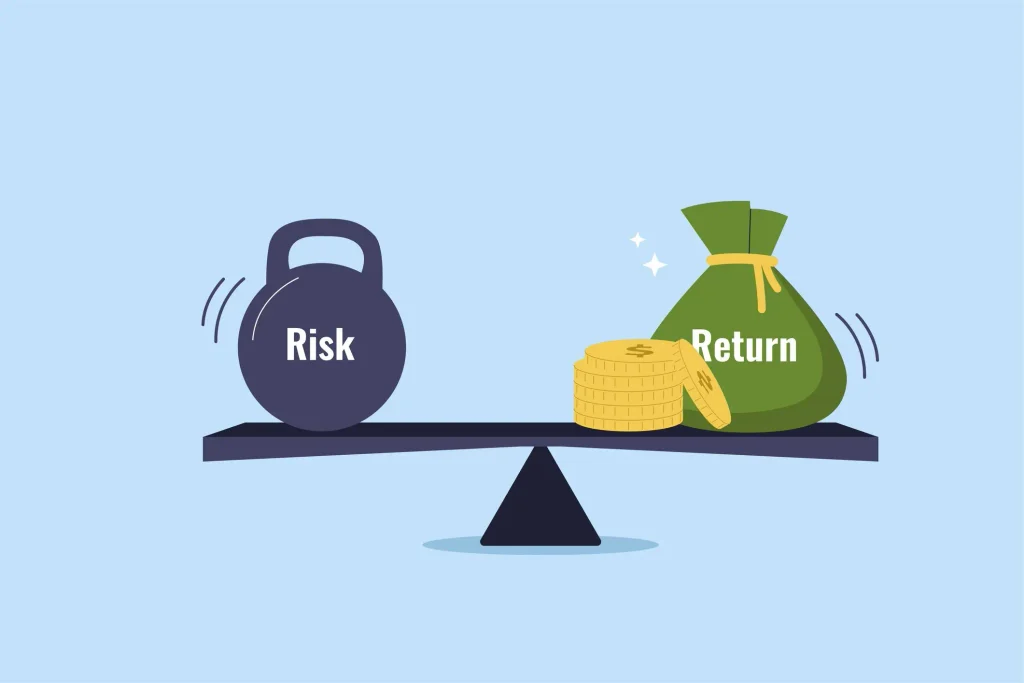
Like most things, financial markets have both benefits and drawbacks. Understanding both helps you make smarter decisions.
Advantages
- Easy access to funds: Businesses and governments can raise money quickly.
- Wealth-building opportunities: Investors can earn returns over time.
- Liquidity: Many assets can be sold quickly when cash is needed.
- Fair price discovery: Prices reflect public information and market demand.
- Diversification: Investors can spread money across many assets to reduce risk.
- Transparency: Listed companies must share financial information.
- Economic growth: Money flows to productive uses, creating jobs and innovation.
Disadvantages
- Risk of loss: Prices can fall, and you may lose part or all of your investment.
- Volatility: Prices can change quickly, sometimes without a clear reason.
- Speculation and bubbles: When prices rise far above real value because of hype, a sudden crash can follow.
- Complexity: Some products, especially derivatives, are hard to understand.
- Fraud and scams: Fake investment schemes target beginners.
- Inequality: People with more money and knowledge often benefit more.
- Economic shocks: A crisis in one market can spread to others and to the wider economy.
A well-known example is the 2008 global financial crisis, which began with problems in the housing and mortgage markets in the United States and spread worldwide. It showed how closely connected markets are, and why good rules and risk management matter.
Examples of Financial Markets Around the World
Here are some of the best-known financial markets and exchanges.

New York Stock Exchange (NYSE) and Nasdaq (United States)
These are among the largest stock exchanges in the world by value. Many globally famous companies are listed on them. Indexes like the S&P 500 and the Dow Jones Industrial Average track groups of leading U.S. companies.
London Stock Exchange (United Kingdom)
One of the oldest exchanges in the world, it lists companies from many countries. The FTSE 100 index follows the largest companies listed there.
Tokyo Stock Exchange (Japan)
The main exchange of Japan, with the Nikkei 225 index as a popular benchmark.
Shanghai and Shenzhen Stock Exchanges (China)
These are key exchanges for China’s fast-growing economy.
National Stock Exchange and Bombay Stock Exchange (India)
India has two major exchanges. The Bombay Stock Exchange is one of the oldest in Asia, and the NSE is one of the largest by number of trades.
Pakistan Stock Exchange (Pakistan)
The Pakistan Stock Exchange (PSX) is the country’s main stock market, where local companies in banking, energy, cement, and other sectors are listed. Its main benchmark is the KSE-100 Index.
Global markets that are not stock exchanges
- Foreign exchange market: A global network of banks and traders working across time zones, almost 24 hours a day on weekdays.
- Commodity exchanges: Places like the Chicago Mercantile Exchange, where futures for oil, gold, and grain are traded.
- Government bond markets: The market for U.S. Treasury securities is among the biggest and most closely watched in the world.
Quick summary table
| Market or Exchange | Country | Famous Index |
| NYSE / Nasdaq | United States | S&P 500, Dow Jones, Nasdaq Composite |
| London Stock Exchange | United Kingdom | FTSE 100 |
| Tokyo Stock Exchange | Japan | Nikkei 225 |
| Shanghai Stock Exchange | China | SSE Composite |
| NSE / BSE | India | Nifty 50, Sensex |
| Pakistan Stock Exchange | Pakistan | KSE-100 |
If you want to understand how global financial stability is monitored, the International Monetary Fund (IMF) publishes regular reports and explainers on the world economy and financial systems.
How Can Beginners Start Investing in Financial Markets?
Starting out can feel scary, but a step-by-step approach makes it easier. Here is a simple path for beginners.

Step 1: Set clear financial goals
Ask yourself why you want to invest. Is it to build an emergency fund, buy a home, pay for education, or save for retirement? Your goal decides how much risk you can take and how long you can stay invested.
Step 2: Build an emergency fund first
Before investing, keep some savings aside for unexpected costs, such as medical bills or job loss. Many experts suggest saving enough to cover several months of expenses. This stops you from being forced to sell investments at a bad time.
Step 3: Learn the basics
Understand key ideas such as risk and return, diversification, inflation, and compounding. Free educational resources from regulators are a great place to begin. For example, Investor.gov, run by the U.S. Securities and Exchange Commission, offers beginner-friendly guides on investing basics and how to avoid fraud.
Step 4: Understand your risk tolerance
Risk tolerance means how much price fluctuation you can handle without panic. If a 20% fall would keep you awake at night, you may prefer lower-risk options like bonds or money market funds.
Step 5: Choose a regulated broker or platform
Only use licensed and regulated brokers in your country. Check their registration with your local securities regulator before sending money. Compare fees, ease of use, and customer support.
Step 6: Start small and diversify
You do not need a large amount to begin. Many people start with small, regular amounts. Instead of putting everything in one company, spread your money across different assets. Index funds and ETFs are popular beginner options because one purchase gives you exposure to many companies at once.
Step 7: Invest regularly and think long term
A method called dollar-cost averaging means investing a fixed amount at regular times, such as monthly. This reduces the stress of trying to guess the perfect time to buy.
Step 8: Avoid common beginner mistakes
- Investing money you cannot afford to lose.
- Chasing “hot tips” from social media or friends.
- Buying something you do not understand.
- Panic selling when prices fall.
- Falling for promises of guaranteed high returns. If it sounds too good to be true, it usually is.
- Putting all your money in one stock or one asset.
Step 9: Review your investments occasionally
Check your portfolio once or twice a year to make sure it still matches your goals. Avoid checking prices every hour, as it can lead to emotional decisions.
Conclusion
So, what are financial markets? They are the organized spaces, both physical and digital, where money, shares, bonds, currencies, and commodities are traded. They connect savers with borrowers, help businesses grow, give governments a way to fund public needs, and offer ordinary people a path to build wealth.
In this guide, we looked at how financial markets work through supply and demand, the difference between primary and secondary markets, and the main types: stock, bond, money, forex, commodity, and derivatives markets. We also covered their key functions, such as mobilizing savings, price discovery, liquidity, and risk reduction. We saw who takes part, the instruments traded, how financial markets differ from capital markets, and the real advantages and risks they bring.
The most important lesson for beginners is that financial markets offer opportunity, but they reward patience, learning, and caution. Start with clear goals, learn the basics, use regulated platforms, diversify, and stay away from get-rich-quick promises. With time and good habits, understanding financial markets can help you make smarter decisions about your money and your future.
Frequently Asked Questions
What are financial markets in simple words?
Financial markets are places where people buy and sell financial assets like shares, bonds, currencies, and commodities. They connect people who have extra money with those who need to borrow or raise funds.
What is the main purpose of financial markets?
The main purpose is to move money from savers to those who can use it productively. This helps businesses grow, governments fund projects, and investors earn returns, while also deciding fair prices and providing liquidity.
Are financial markets safe for beginners?
Financial markets carry risk, so no investment is completely safe. However, beginners can lower risk by learning the basics, using regulated platforms, diversifying, investing only money they can afford to set aside, and thinking long term.
How do financial markets affect the economy?
They help businesses raise money, support jobs, guide interest rates, and shape currency values. A strong, well-regulated market usually supports economic growth, while a market crash can reduce spending, lending, and confidence.
What is the difference between a stock market and a financial market?
The stock market is just one type of financial market. A financial market is a much wider term that includes stocks, bonds, money markets, currencies, commodities, and derivatives.
Can the central bank affect financial markets?
Yes. When a central bank changes its interest rate, it affects borrowing costs, bond yields, share prices, and currency values. You can learn more about how this works from resources like the Federal Reserve, which explains monetary policy and its effects on the economy.