

Most people know the feeling of checking their bank balance and wondering where their money went. Individuals juggle rent, bills, and savings goals, while business owners face a similar challenge on a larger scale: paying suppliers, covering salaries, managing expenses, and deciding when to invest in growth. Without a clear financial plan, even a steady income can be difficult to manage.
So, what is financial management? In simple terms, it is the process of planning, organizing, directing, and controlling financial resources to achieve specific goals. It applies to everyday household budgeting just as much as it does to managing the finances of a growing business.
Effective financial management helps businesses maintain stability, control costs, handle unexpected challenges, and identify opportunities for growth. For individuals, it makes it easier to manage expenses, build savings, reduce financial stress, and plan for the future.
In this guide, you will learn what financial management means, its main objectives, key functions, and importance. We will also explore its different types, scope, and practical examples to help you understand how financial management works in real-life situations.
Whether you are a student, beginner, or business owner, understanding financial management can help you make smarter financial decisions and use money more effectively.
What Is Financial Management?
Financial management is the process of planning, organizing, directing, and controlling an individual’s or organization’s financial resources to achieve specific objectives. It involves deciding how much money is needed, where to obtain it, how to allocate it, and how to monitor its use.
In simple words, financial management helps people and businesses make informed decisions about their money instead of spending or investing without a clear plan.
The concept applies to different situations. An individual managing a monthly salary, a small business owner controlling operating expenses, and a large company planning a new investment are all practicing financial management. Although their financial needs differ, they share the same purpose: using money efficiently to achieve their goals.

Financial management involves several important activities:
- Budgeting and forecasting: Estimating future income, expenses, and financial requirements.
- Cash flow management: Monitoring the money coming into and going out of an individual’s or business’s accounts.
- Investment decisions: Choosing suitable opportunities to generate future returns.
- Financing decisions: Determining how to obtain the money needed for operations and investments.
- Risk management: Identifying financial threats and taking steps to reduce potential losses.
For example, imagine someone owns a small clothing store. They must decide how much inventory to purchase, how much money to reserve for rent and salaries, when to pay suppliers, and whether taking a loan to open another branch is a good decision. Each choice affects the store’s financial position.
Financial management is also closely related to accounting, but the two are not the same. Accounting focuses on recording, organizing, and reporting financial transactions. Financial management uses that information to make future decisions, prepare budgets, control spending, and plan investments.
According to OpenStax’s introduction to the role of finance and financial managers, financial management plays an important role in business operations, investment decisions, and the effective use of company resources.
Ultimately, financial management provides a framework for making better financial choices, maintaining stability, and working toward long-term objectives.
What Are the Main Objectives of Financial Management?
The main objectives of financial management are to use financial resources efficiently, maintain financial stability, control costs, and increase long-term value. These objectives help individuals and organizations decide how to manage their money and achieve their financial goals.

Some of the most important objectives include:
1. Profit Maximization
Profit maximization means increasing the difference between a business’s revenue and expenses. Companies aim to generate higher profits by improving sales, controlling operating costs, and using resources effectively.
However, focusing only on short-term profits can sometimes lead to poor decisions. For example, reducing product quality may lower expenses temporarily but damage customer trust over time.
2. Wealth Maximization
Wealth maximization focuses on increasing the long-term value of a business for its owners or shareholders. It considers expected returns, financial risks, and the timing of future cash flows.
Unlike simply increasing immediate profits, wealth maximization encourages businesses to make decisions that support sustainable growth and long-term value.
3. Maintaining Financial Stability
Financial stability means having enough financial resources to meet current obligations and handle unexpected expenses. Businesses need sufficient funds to pay employees, suppliers, rent, and other operating costs.
Individuals also need financial stability to manage household expenses, repay debts, and prepare for emergencies.
4. Ensuring Liquidity
Liquidity refers to the ability to access cash or quickly convert assets into cash to meet short-term financial obligations.
For example, a business may own valuable machinery and property but still struggle to pay its monthly bills if it does not have enough available cash. Financial management helps maintain an appropriate level of liquidity.
5. Controlling Financial Costs
Another important objective is reducing unnecessary expenses without affecting business performance. Companies regularly review operating costs, compare supplier prices, and identify areas where resources are being wasted.
Effective cost control helps businesses protect their profits and use available funds more productively.
6. Managing Financial Risks
Every financial decision involves some level of risk. Businesses may face rising interest rates, changing market conditions, currency fluctuations, or customers who fail to pay their bills.
Financial management helps identify these risks and develop strategies to reduce their possible impact.
7. Supporting Long-Term Growth
Financial management also aims to provide the resources needed for future development. Businesses may invest in new equipment, technology, employees, or additional locations to expand their operations.
The right financial decisions help organizations grow without putting unnecessary pressure on their finances.
Together, these objectives help businesses balance profitability, liquidity, risk, and long-term value rather than focusing on just one financial target.
What Are the Key Functions of Financial Management?
The functions of financial management are the activities involved in planning, obtaining, allocating, monitoring, and protecting financial resources. These functions help businesses maintain smooth operations and make informed decisions about their money.

The seven important functions are explained below.
1. Financial Planning
Financial planning involves estimating how much money an individual or business will need in the future. It includes setting financial goals, preparing budgets, forecasting income, and estimating expenses.
For example, a manufacturing company planning to increase production must calculate the cost of machinery, raw materials, employees, and other resources before starting the project.
2. Raising Funds
Businesses need money to start operations, purchase equipment, pay employees, and finance expansion. Raising funds involves identifying suitable sources of finance.
Common sources include bank loans, investments from shareholders, retained earnings, and other forms of business financing.
The goal is to obtain the required funds at a reasonable cost without creating unnecessary financial pressure.
3. Allocating Funds
After obtaining money, businesses must decide how to use it effectively. This function involves distributing financial resources among different activities and investment opportunities.
For example, a company may allocate funds to purchase new machinery, improve its marketing, hire additional employees, or expand its production facilities.
Proper fund allocation helps businesses prioritize activities that support their objectives.
4. Working Capital Management
Working capital management focuses on handling the money required for everyday business operations.
Working capital generally refers to the difference between current assets and current liabilities. Current assets include cash, inventory, and money customers owe, while current liabilities include short-term debts and unpaid bills.
For example, a retail store needs enough working capital to purchase inventory, pay employees, and cover rent while waiting for customers to make payments.
5. Dividend Decisions
Dividend decisions involve determining how much of a company’s profit should be distributed to shareholders and how much should remain in the business.
A growing company may retain a larger portion of its earnings to finance expansion, while an established company may distribute more profits as dividends.
The right decision depends on the company’s financial position, investment opportunities, and shareholder expectations.
6. Financial Control and Reporting
Financial control involves monitoring financial activities and comparing actual results with planned budgets and targets.
Businesses use financial statements, reports, and performance measurements to identify problems and improve financial performance.
For example, if a company’s monthly expenses are higher than expected, management can investigate the reason and take corrective action.
7. Risk Management
Risk management involves identifying potential financial problems and taking appropriate steps to reduce their impact.
Businesses may face credit risk, market risk, interest rate risk, currency risk, and operational risks.
They can manage these risks through insurance, financial planning, diversification, careful lending policies, and regular financial monitoring.
All seven functions work together. Financial planning identifies what a business needs, raising funds provides the money, allocation puts it to work, and financial control and risk management help protect it.
Why Is Financial Management Important?
Financial management is important because it helps individuals and businesses control their money, make better decisions, reduce financial risks, and achieve long-term objectives. Without proper financial planning, even organizations with strong sales or individuals with regular incomes can experience financial difficulties.

Here are some major reasons why financial management matters.
1. Helps Control Cash Flow
Cash flow is the movement of money into and out of an individual’s or business’s accounts. Managing it properly ensures that enough money is available to cover regular expenses and financial obligations.
A business may generate good sales but still experience cash shortages when customers delay payments. Monitoring cash flow helps identify these problems before they become serious.
2. Improves Financial Decision-Making
Financial management provides useful information for making important decisions. Businesses can evaluate whether to hire employees, purchase equipment, open new locations, or invest in technology.
Instead of relying on assumptions, managers can use budgets, financial reports, and forecasts to compare available options.
3. Supports Business Growth
Businesses need financial resources to expand their operations, introduce new products, enter new markets, and improve their services.
Effective financial management helps determine whether an investment is affordable and whether its expected benefits justify the cost.
4. Reduces Financial Risks
Unexpected expenses, economic changes, rising costs, and declining sales can affect financial stability.
A good financial management process helps identify potential problems early and prepare appropriate responses. This allows businesses and individuals to handle unexpected situations more effectively.
5. Helps Improve Profitability
Managing expenses and allocating resources properly can improve a company’s financial performance.
For example, a business that reviews its operating costs may discover unnecessary expenses or negotiate better prices with suppliers. These improvements can increase the amount of revenue retained as profit.
6. Builds Trust With Investors and Lenders
Investors, banks, and other financial institutions often review an organization’s financial position before providing funding.
Accurate financial records, realistic budgets, and responsible financial decisions help demonstrate that a business understands its financial responsibilities.
This can improve its ability to obtain financing and build stronger financial relationships.
7. Helps Achieve Long-Term Financial Goals
Financial management supports long-term planning by helping people and organizations prepare for future needs.
Individuals can use it to build savings, repay debt, purchase property, or plan for retirement. Businesses can use it to strengthen their financial position and invest in sustainable growth.
Overall, financial management creates a stronger foundation for financial stability. It helps people understand their current financial position and make decisions that support their future goals.
What Are the Three Main Types of Financial Management?
The three broad types of financial management are personal, corporate, and public financial management. Each type focuses on managing financial resources for a different purpose, but all involve planning, budgeting, controlling expenses, and making informed financial decisions.
1. Personal Financial Management
Personal financial management focuses on how individuals and families manage their income, expenses, savings, investments, and debts.
It includes preparing monthly budgets, paying bills, building emergency funds, managing loans, purchasing insurance, and planning for retirement.
For example, a young professional earning a monthly salary may divide their income between household expenses, savings, debt repayments, and investments.
The main objective is to achieve financial security while meeting current and future personal needs.
2. Corporate Financial Management
Corporate financial management deals with how businesses obtain, allocate, and control their financial resources.
It includes investment planning, financing decisions, working capital management, financial reporting, and dividend decisions.
For example, a retail company planning to open five new stores must estimate the required investment, compare financing options, forecast expected revenue, and determine whether the expansion is financially practical.
Its main objective is to increase business value while maintaining financial stability and managing risk.
3. Public Financial Management
Public financial management focuses on how governments and public institutions collect, allocate, spend, and monitor public funds.
It involves tax revenue, government budgets, public expenditure, debt management, procurement, and financial accountability.
For example, a government may prepare an annual budget to distribute public funds among education, healthcare, transportation, and infrastructure projects.
The main purpose is to ensure that public resources are managed responsibly, transparently, and efficiently.
The World Bank explains the role of sound public financial management in improving accountability and the effective use of public resources in its financial management overview.
The following table summarizes the three types:
| Type | Who manages the money? | Main purpose |
| Personal | Individuals and families | Financial security and personal goals |
| Corporate | Businesses and companies | Business value and sustainable growth |
| Public | Governments and public institutions | Responsible use of public funds |
Although these types operate at different levels, they share the same basic principles of financial planning, resource allocation, monitoring, and control.
What Is the Scope of Financial Management?
The scope of financial management refers to the different activities and decisions involved in managing financial resources. It covers much more than simply obtaining money. It also includes deciding where to invest funds, choosing suitable financing methods, managing daily expenses, and monitoring financial performance.
The scope has expanded over time. Traditionally, financial management focused mainly on obtaining funds. The modern approach includes both raising money and making decisions about how those funds should be used.
The main areas within its scope include:
1. Investment Decisions
Investment decisions involve selecting assets, projects, and opportunities where financial resources should be used.
For example, a company may compare the expected returns from purchasing new machinery with the benefits of opening another branch.
These decisions help determine how money can generate future value.
2. Financing Decisions
Financing decisions determine where a business should obtain the money required for its activities.
Common financing sources include loans, shares, retained earnings, and other forms of capital.
Businesses must consider borrowing costs, repayment obligations, ownership dilution, and financial risk when selecting financing options.
3. Dividend Decisions
Dividend decisions focus on how much profit should be distributed to shareholders and how much should be retained for future business activities.
A company must balance shareholder expectations with its need for future investment.
4. Working Capital Management
Working capital management deals with short-term financial requirements, including cash, inventory, accounts receivable, and accounts payable.
Its purpose is to ensure that daily operations continue without unnecessary cash shortages.
5. Financial Planning and Forecasting
Financial planning involves estimating future financial needs and preparing budgets to meet them.
Forecasting helps businesses estimate future sales, expenses, cash requirements, and investment needs.
6. Financial Analysis and Control
Financial analysis involves reviewing financial statements, calculating financial ratios, and evaluating business performance.
Financial control ensures that actual financial results remain aligned with planned objectives.
7. Risk and Tax Management
Financial management also includes identifying financial risks and considering tax obligations when making business decisions.
Companies must understand how interest rates, currency changes, taxation, and market conditions may affect their financial position.
The three major corporate finance decisions—investment, financing, and dividends—are closely connected. A useful explanation of these principles is available in NYU Professor Aswath Damodaran’s introduction to corporate finance.
Together, these areas show that financial management is a broad business function that influences nearly every major organizational decision.
How Does Financial Management Work?
Financial management works through a continuous process of setting financial goals, reviewing available resources, preparing plans, allocating money, monitoring results, and making adjustments when necessary.
It is not a one-time activity. Individuals and businesses must regularly review their financial position to ensure their decisions remain effective.
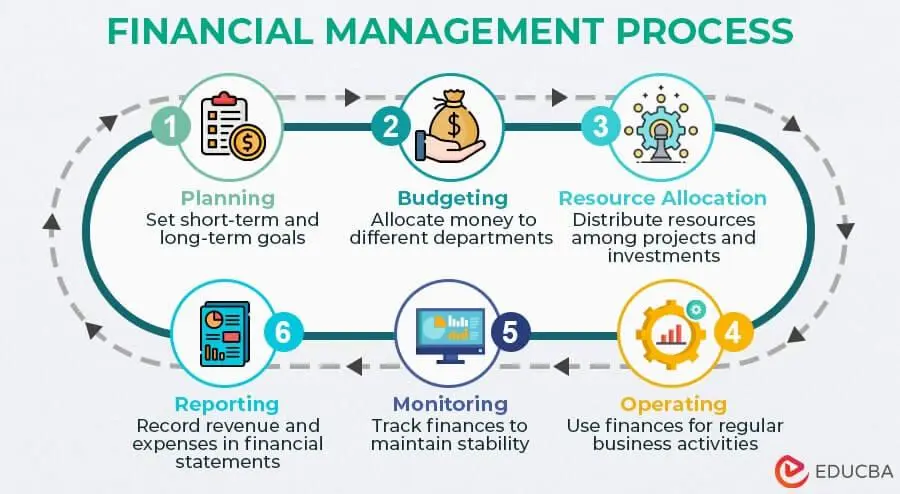
Here are six basic steps involved in the process.
Step 1: Set Financial Goals
The first step is identifying what you want to achieve.
An individual may want to save for a house, repay debt, or build an emergency fund. A business may want to increase revenue, purchase equipment, or expand into another market.
Clear goals provide direction for financial decisions.
Step 2: Analyze Your Current Financial Position
The next step is understanding how much money is available and what financial obligations exist.
Businesses review their income statements, balance sheets, and cash flow statements. Individuals can review their monthly income, expenses, savings, assets, and debts.
This analysis provides a starting point for financial planning.
Step 3: Prepare a Financial Plan
After reviewing the current financial position, the next step is preparing a plan.
A financial plan estimates future income, expenses, funding requirements, and savings or investment targets.
A realistic budget helps ensure that available resources are distributed according to priorities.
Step 4: Arrange and Allocate Funds
Once the plan is ready, the required money must be obtained and allocated appropriately.
Businesses may use their profits, loans, or investments to finance operations. Individuals may distribute their salaries between essential expenses, savings, debt repayments, and other needs.
The purpose is to use available resources where they provide the greatest benefit.
Step 5: Monitor Financial Performance
Financial performance should be reviewed regularly to identify differences between planned and actual results.
Businesses may monitor sales, expenses, profitability, cash flow, and financial ratios. Individuals can review their monthly budgets and savings progress.
Regular monitoring helps identify problems early.
Step 6: Review and Adjust the Plan
Financial plans may need to change when income, expenses, business conditions, or personal goals change.
For example, if a business experiences higher operating costs than expected, it may need to reduce unnecessary spending or adjust its prices.
This continuous review process helps keep financial decisions aligned with changing circumstances.
Consider a small online store that wants to double its orders within one year. The owner reviews previous sales, prepares a marketing budget, invests in additional inventory, and monitors monthly expenses. After noticing that shipping costs are reducing profits, the owner compares delivery providers and chooses a more cost-effective option.
This example shows how financial management works in practice: plan, act, monitor, and improve.
What Is a Financial Management System?
A financial management system (FMS) is a combination of processes, tools, and software used to record, organize, monitor, and manage financial activities.
It helps businesses maintain accurate financial information, prepare reports, track expenses, manage payments, and make informed financial decisions.
Instead of managing financial records through disconnected spreadsheets and paper documents, an organization can use a financial management system to bring important information together.

Most financial management systems include the following features:
1. General Ledger
The general ledger is the central record of a company’s financial transactions. It organizes financial information into accounts and supports the preparation of financial statements.
2. Accounts Payable and Receivable
Accounts payable tracks money a business owes to suppliers and other parties. Accounts receivable tracks money customers owe the business.
These functions help organizations monitor incoming and outgoing payments.
3. Budgeting and Forecasting
These tools help businesses prepare budgets, estimate future income and expenses, and compare actual performance with financial targets.
4. Cash Management
Cash management features help organizations monitor bank balances, incoming payments, outgoing expenses, and available funds.
5. Financial Reporting and Analytics
Reporting tools create financial statements, summaries, and dashboards that help managers understand business performance.
6. Internal Controls
Internal controls include approval processes, transaction permissions, and audit trails that help reduce errors, unauthorized activities, and potential fraud.
Financial management systems are available in different forms depending on an organization’s size and requirements. Small businesses may use cloud-based platforms such as QuickBooks or Xero, while larger organizations may use enterprise systems such as SAP or Oracle NetSuite.
For example, a growing distribution company may previously have tracked customer invoices using spreadsheets. After adopting a financial management system, it can monitor unpaid invoices, record payments, prepare reports, and review its cash position from one platform.
A financial management system does not replace professional judgment. Instead, it provides organized information that supports better financial decisions.
What Are Some Examples of Financial Management?
Financial management can be seen in everyday activities, from managing household expenses to making investment decisions in large corporations. Practical examples help explain how financial planning and control work in different situations.

1. Personal Financial Management Example
Imagine a person earning $2,000 per month. They need to pay rent, purchase groceries, cover transportation costs, repay debt, and save for future needs.
By preparing a monthly budget, they can divide their income between essential expenses, savings, and other financial priorities.
They may also build an emergency fund to cover unexpected expenses, such as medical bills or car repairs.
This is an example of personal financial management because the individual is planning and controlling available income.
2. Small Business Financial Management Example
Consider a café owner who earns revenue from daily customer sales.
The owner must manage rent, employee salaries, food supplies, electricity bills, and other operating expenses. They also need to reserve enough money to pay suppliers on time.
When ingredient prices increase, the owner reviews expenses and considers adjusting menu prices or finding alternative suppliers.
These decisions help maintain profitability and control cash flow.
3. Corporate Financial Management Example
A manufacturing company wants to purchase new machinery to increase production.
Before making the investment, its financial managers estimate the equipment cost, expected revenue, operating expenses, and potential risks.
They also compare financing options, such as using retained earnings or obtaining a bank loan.
This is an example of corporate financial management because the company evaluates an investment and decides how to finance it.
4. Public Financial Management Example
A city government receives revenue through taxes, fees, and other sources.
It prepares an annual budget to allocate public funds to schools, hospitals, roads, transportation, and other services.
Government departments must monitor spending and report how public resources are used.
This demonstrates public financial management because government institutions are planning, allocating, and controlling public funds.
5. Nonprofit Financial Management Example
A charitable organization receives donations to support education programs.
It must prepare a budget, monitor donations, pay program expenses, and ensure that restricted contributions are used for their intended purposes.
Accurate financial records help the organization demonstrate accountability to donors.
These examples show that financial management is not limited to large companies. It is a practical process used whenever people or organizations make decisions about money.
How to Start a Career in Financial Management?
Starting a career in financial management usually requires a combination of education, financial knowledge, technical skills, and practical experience.
Professionals in this field work in banks, corporations, accounting firms, government departments, investment companies, and nonprofit organizations.

Here are some important steps to begin a career in financial management.
1. Get a Relevant Education
A bachelor’s degree in finance, accounting, economics, or business administration can provide a strong foundation.
These programs introduce students to financial reporting, investment analysis, corporate finance, budgeting, and business management.
Some entry-level opportunities may also be available to candidates with relevant diplomas or professional training.
2. Develop Essential Financial Skills
Financial management requires both technical and analytical abilities.
Some important skills include:
- Financial analysis and reporting
- Budgeting and forecasting
- Accounting principles
- Financial modeling
- Microsoft Excel
- Data analysis
- Problem-solving
- Communication and decision-making
These skills help professionals interpret financial information and explain their recommendations.
3. Consider Professional Certifications
Professional qualifications can improve your knowledge and support career development.
Some recognized options include:
- CFA (Chartered Financial Analyst): Focuses on investment analysis, portfolio management, and financial markets.
- ACCA (Association of Chartered Certified Accountants): Covers accounting, financial management, auditing, and business.
- CPA (Certified Public Accountant): Focuses on accounting, auditing, taxation, and financial reporting, particularly within relevant licensing jurisdictions.
- CMA (Certified Management Accountant): Emphasizes management accounting, financial planning, performance management, and business decision-making.
The most suitable qualification depends on your career interests, location, and professional requirements.
4. Gain Practical Experience
Practical experience helps turn financial knowledge into professional skills.
Students can apply for internships at banks, accounting firms, financial departments, and businesses.
Entry-level positions such as finance assistant, junior accountant, and financial analyst trainee can also provide valuable experience.
5. Build Professional Connections
Networking can help you learn about job opportunities and understand the expectations of employers.
Connecting with finance professionals, attending industry events, and joining relevant professional organizations can support career development.
6. Continue Learning
Financial regulations, technology, business practices, and financial markets continue to change.
Professionals should keep improving their knowledge through courses, certifications, industry publications, and practical training.
A career in financial management develops over time. Starting with an entry-level position, gaining experience, and developing specialized skills can create opportunities to move into senior financial and management roles.
What Are the Top Careers in Financial Management?
Financial management offers different career opportunities across banking, business, government, investment firms, consulting companies, and nonprofit organizations.
Each position has different responsibilities, qualifications, and areas of specialization.
Here are some common careers in the field.
1. Financial Analyst
A financial analyst reviews financial information, studies business performance, prepares forecasts, and evaluates investment opportunities.
They help companies and investors make informed financial decisions.
2. Financial Manager
A financial manager oversees budgeting, financial reporting, investment planning, and financial performance.
They help organizations manage resources and achieve financial objectives.
3. Financial Controller
A financial controller supervises accounting operations, financial statements, internal controls, and reporting procedures.
Their work helps maintain accurate financial records and compliance with applicable requirements.
4. Chief Financial Officer (CFO)
A CFO is a senior executive responsible for an organization’s overall financial strategy.
They oversee financial planning, funding decisions, risk management, reporting, and financial performance.
5. Budget Analyst
A budget analyst prepares and reviews budgets to ensure that financial resources are allocated appropriately.
They may work for businesses, government departments, universities, and nonprofit organizations.
6. Treasurer
A treasurer manages cash, banking relationships, borrowing, liquidity, and financial investments.
Their main responsibility is to ensure that an organization has sufficient funds to meet its financial obligations.
7. Risk Manager
A risk manager identifies and evaluates financial threats that could affect an organization.
They develop strategies to reduce exposure to risks such as market changes, credit losses, and currency fluctuations.
8. Investment Analyst
An investment analyst researches financial markets, companies, securities, and investment opportunities.
They provide information and recommendations to support investment decisions.
9. Internal Auditor
An internal auditor reviews financial processes, internal controls, and organizational procedures.
Their work helps identify errors, weaknesses, and potential fraud.
10. Personal Financial Planner
A personal financial planner helps individuals manage their money, develop savings strategies, evaluate investments, and prepare for future financial needs.
The right career depends on your interests and strengths. People who enjoy analyzing data may prefer financial analysis, while those interested in leadership may work toward financial management or CFO positions.
As financial technology and data analytics continue to develop, professionals with both financial knowledge and technical skills may also find opportunities in emerging areas of finance.
Conclusion
Financial management is the process of planning, organizing, directing, and controlling financial resources to achieve specific goals. It helps individuals, businesses, and governments make informed decisions about earning, spending, saving, borrowing, and investing money.
Throughout this guide, we explored the main objectives, functions, types, and scope of financial management. We also discussed how financial management works, the role of financial management systems, practical examples, and career opportunities in the field.
The most important takeaway is that effective financial management is not just about increasing profits or reducing expenses. It is about using available resources wisely, maintaining financial stability, managing risks, and preparing for future opportunities.
Whether you are managing a household budget, starting a small business, or working toward a career in finance, developing strong financial management skills can help you make better decisions.
Start by understanding your financial position, setting realistic goals, preparing a budget, and reviewing your progress regularly. Small but consistent financial decisions can make a meaningful difference over time.
Frequently Asked Questions (FAQs)
What Is Financial Management in Simple Words?
Financial management is the process of planning, organizing, and controlling money to use it effectively. It involves deciding how much money is needed, where it will come from, how it should be spent, and how to monitor its use. Whether managing personal finances or running a business, the goal is to make informed financial decisions, avoid unnecessary expenses, and achieve financial goals.
What Are the Seven Functions of Financial Management?
The seven key functions of financial management are:
Financial planning: Estimating future financial needs and preparing budgets.
Raising funds: Obtaining money through loans, shares, or retained earnings.
Allocating funds: Directing financial resources toward suitable investments and business activities.
Working capital management: Managing short-term assets and liabilities to maintain daily operations.
Dividend decisions: Deciding whether to distribute profits to shareholders or reinvest them.
Financial control: Monitoring financial performance and comparing actual results with planned targets.
Risk management: Identifying and reducing potential financial losses.
Together, these functions help individuals and organizatio
What Are the Three Types of Financial Management?
The three broad types of financial management are personal, corporate, and public financial management. Personal financial management focuses on individual and household finances, including budgeting, saving, and debt management. Corporate financial management deals with business finances, such as raising capital, managing cash flow, and making investment decisions. Public financial management involves government revenue, budgeting, public spending, and debt management. Each type serves a different purpose but follows similar financial planning principles.
Why Is Financial Management Important?
Financial management is important because it helps individuals and businesses use money wisely and make better financial decisions. It supports effective budgeting, controls expenses, prevents cash flow problems, and helps manage financial risks. For businesses, it encourages profitability, stability, and sustainable growth. For individuals, it makes saving money, managing debt, and achieving long-term financial goals easier.
What Is the Main Objective of Financial Management?
The main objective of financial management is to use financial resources efficiently while maintaining financial stability and increasing long-term value. For businesses, this generally means maximizing shareholder wealth through sound investment, financing, and dividend decisions. For individuals, it means managing income, controlling expenses, building savings, and achieving financial security.