
Deep learning is one of the most important technologies behind modern artificial intelligence. From facial recognition and voice assistants to self-driving cars and generative AI tools, deep learning allows computers to perform tasks that once required human intelligence. It helps machines recognize images, understand language, identify patterns, and make predictions by learning from large amounts of data.
Unlike traditional programming, where developers write specific instructions for every task, deep learning systems learn patterns through artificial neural networks. These networks contain multiple layers that process information and gradually improve their ability to produce accurate results.
As artificial intelligence continues to develop, deep learning is becoming increasingly important across industries such as healthcare, finance, transportation, education, and technology.
But what exactly is deep learning, how does it work, and why is it so important?
In this guide, you’ll learn what deep learning means, how neural networks process information, the different types of deep learning models, their real-world applications, benefits, challenges, and how deep learning differs from machine learning and generative AI.
Definition of Deep Learning
In technical terms, deep learning is a machine learning approach that uses deep artificial neural networks to automatically learn representations from data.
These networks consist of interconnected artificial neurons organized into layers. Each neuron receives information, performs mathematical calculations, and passes the results to other neurons.
The learning process involves adjusting the network’s internal parameters, particularly weights and biases, to reduce the difference between its predictions and the correct answers.
Deep learning can work with different types of data, including:
- Images: Photographs, medical scans, satellite images, and videos.
- Text: Documents, conversations, articles, and written instructions.
- Audio: Speech recordings, music, and environmental sounds.
- Numerical data: Financial transactions, measurements, and sensor readings.
- Time-series data: Stock prices, weather measurements, and equipment performance records.
One of the most important characteristics of deep learning is its ability to perform automatic feature extraction. This means the model can discover useful characteristics in raw data without requiring developers to manually define every feature.
Deep Learning in Artificial Intelligence (AI)
Deep learning is an important part of artificial intelligence, but the three terms artificial intelligence, machine learning, and deep learning do not mean exactly the same thing.
Artificial intelligence (AI) is the broader field of creating computer systems that can perform tasks associated with human intelligence, such as reasoning, problem-solving, understanding language, and recognizing patterns.
Machine learning (ML) is a subset of AI that allows computers to learn from data and improve their performance without being explicitly programmed with every rule.
Deep learning is a specialized approach within machine learning that uses neural networks with multiple layers to learn complex patterns.
Think of these technologies as three nested circles:
- Artificial intelligence represents the broadest field.
- Machine learning is one approach within artificial intelligence.
- Deep learning is a specialized method within machine learning.
Many modern AI technologies, including advanced image recognition, speech processing, and large language models, use deep learning.
How Deep Learning Mimics the Human Brain
Deep learning takes inspiration from the way biological neurons communicate in the human brain.
The human brain contains billions of neurons connected through complex networks. These neurons receive signals, process information, and communicate with other neurons.
Artificial neural networks use a simplified mathematical concept inspired by this structure.
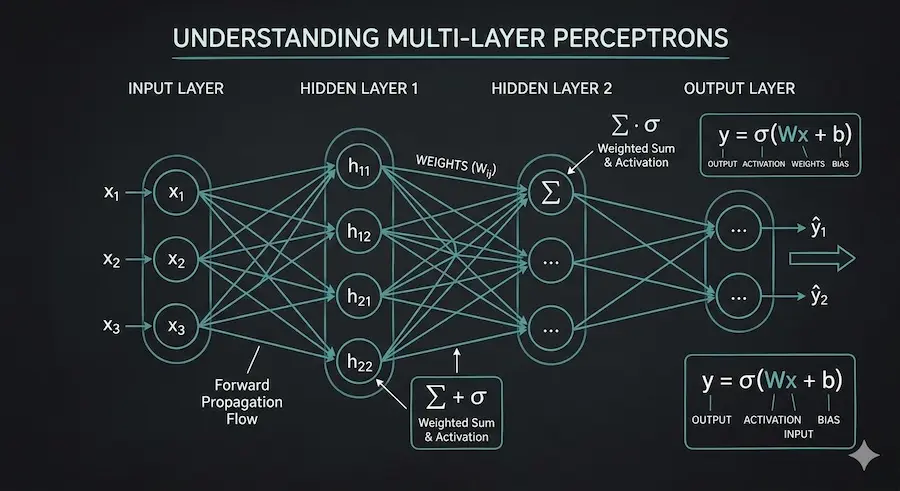
An artificial neuron receives numerical inputs, multiplies them by weights, adds a bias, and passes the result through an activation function. The output is then sent to other neurons in the network.
For example, when a deep learning model analyzes an image:
- The first layers may recognize simple patterns such as edges and colors.
- Middle layers combine these patterns into shapes and textures.
- Deeper layers identify more complex features, such as eyes, ears, and faces.
- The final layers use these features to recognize the object.
However, artificial neural networks do not work exactly like biological brains. They are mathematical systems loosely inspired by the idea of interconnected neurons and learning through experience.
Simple Real-World Example of Deep Learning
Consider a smartphone’s facial recognition system.
When you unlock your phone using your face, the device uses image-processing and recognition technologies to analyze facial characteristics.
A deep learning model can learn patterns associated with facial features, such as the position of the eyes, the shape of the nose, and the distance between different facial landmarks.
During training, the model learns from many examples of faces. Once trained, it can analyze a new facial image and determine whether it matches the enrolled user.
Other familiar examples include:
- Email spam filters identifying suspicious messages.
- Photo applications recognizing and grouping faces.
- Voice assistants understanding spoken commands.
- Online platforms recommending videos and products.
- Translation applications converting text between languages.
These examples demonstrate how deep learning helps computers identify complex patterns and perform useful tasks automatically.
How Does Deep Learning Work?
Deep learning works by processing information through multiple layers of an artificial neural network. During training, the network makes predictions, measures its errors, and adjusts its internal parameters to improve its performance.
This process happens repeatedly until the model learns useful patterns from its training data.
Let’s understand the process step by step.
Deep Neural Network Structure
A deep neural network is made up of interconnected artificial neurons arranged in multiple layers.
These layers work together to transform raw information into meaningful predictions or outputs.
A typical deep neural network contains three main types of layers:
- Input layer: Receives the original data.
- Hidden layers: Process information and identify patterns.
- Output layer: Produces the final prediction or result.
The number of hidden layers and neurons depends on the model’s architecture and the complexity of the problem it needs to solve.
For example, a simple image classification model might identify whether an image contains a cat or a dog, while a more advanced model may identify hundreds or thousands of different objects.
Input Layer
The input layer is the first part of a neural network. It receives the information that the model needs to analyze.
The format of the input depends on the task.
For example:
- An image recognition model receives numerical pixel values.
- A language model receives numerical representations of text tokens.
- A speech recognition model receives audio features or other numerical representations of sound.
- A forecasting model receives historical numerical measurements.
The input layer passes this information to the hidden layers for further processing.
Hidden Layers
Hidden layers are where most of the processing takes place.
Each hidden layer transforms the information it receives and extracts useful features that help the model understand the data.
For example, when analyzing an image of a vehicle:
- Early layers may identify lines, edges, and colors.
- Intermediate layers may recognize wheels, windows, and headlights.
- Deeper layers may combine these features to recognize a complete vehicle.
Each layer builds on information learned by previous layers.
Deep neural networks can contain many hidden layers, allowing them to learn complicated relationships that may be difficult for traditional machine learning algorithms to identify.
Output Layer
The output layer produces the model’s final result.
The output depends on the problem the model is designed to solve.
For example:
- An image classification model may predict whether an image contains a cat, dog, or bird.
- A spam detection model may classify an email as spam or legitimate.
- A forecasting model may predict future sales.
- A language model may generate the next token in a sequence.
The output layer converts the processed information into a result that can be interpreted by the application.
How Deep Learning Models Learn From Data
A deep learning model learns through a repeated training process that involves making predictions, calculating errors, and updating network parameters.
The main stages include:
1. Data collection: Developers gather relevant training data, such as images, text, audio, or numerical information.
2. Data preparation: The data is cleaned, organized, and converted into a format suitable for the neural network.
3. Forward propagation: Information moves through the network from the input layer to the output layer.
4. Loss calculation: A loss function compares the model’s prediction with the expected answer and measures how inaccurate the prediction is.
5. Backpropagation: The model calculates how much different network parameters contributed to the error.
6. Parameter updates: An optimizer adjusts the weights and biases to reduce the loss.
7. Repeated training: The process continues over multiple batches and training epochs until the model learns useful patterns.
After training, developers evaluate the model using separate data that was not used to train it. This helps determine whether the model can generalize to new examples.
When a trained model makes predictions on new data, that process is called inference.
Backpropagation
Backpropagation is an important algorithm used to train neural networks.
It works by calculating how much each parameter in a neural network contributes to the prediction error. The model then uses these calculations to determine how its weights should change.
For example, imagine a model that predicts whether an image contains a dog. If it incorrectly identifies a cat as a dog, backpropagation helps calculate how the network’s parameters contributed to that incorrect prediction.
The calculated gradients are passed to an optimization algorithm, which updates the parameters to reduce future errors.
Without backpropagation, training large neural networks would be significantly more difficult.
Gradient Descent
Gradient descent is an optimization algorithm used to minimize the loss function during neural network training.
It works by adjusting the model’s parameters in a direction that reduces the prediction error.
The learning rate determines how large each update should be.
- A learning rate that is too high may cause the model to miss the optimal solution.
- A learning rate that is too low may make training unnecessarily slow.
- An appropriate learning rate helps the model learn more efficiently.
Several optimization methods are commonly used in deep learning, including stochastic gradient descent (SGD), Adam, and AdamW.
What Are the Different Levels of Deep Learning?
The term “levels of deep learning” can refer to the layers within a neural network or the overall complexity of a model.
Understanding these levels helps explain how neural networks transform simple information into more complex representations.
Levels of Layers in a Neural Network
Different neural network layers learn different types of features.
For example, when a deep learning model analyzes a photograph:
- Low-level features: The network identifies edges, lines, colors, and basic patterns.
- Intermediate features: It combines simple patterns into shapes, textures, and objects.
- High-level features: It identifies more complex structures, such as faces, animals, and vehicles.
- Final representations: The model uses these features to make a classification or prediction.
This layered learning process allows deep neural networks to understand complex data.
Shallow Neural Networks
Shallow neural networks contain a relatively small number of hidden layers.
They can work well for simpler problems where the relationships between inputs and outputs are not extremely complex.
However, they may struggle with tasks that require learning multiple levels of abstract features.
Deep Neural Networks
Deep neural networks contain multiple hidden layers and can learn more complicated patterns.
They are commonly used in:
- Image and video recognition.
- Natural language processing.
- Speech recognition.
- Medical image analysis.
- Generative AI.
The additional layers allow these models to learn increasingly complex representations of data.
Large-Scale Deep Learning Models
Some modern deep learning models contain billions of parameters and require substantial computing resources.
Large language models are an example of this category.
These models are trained on extensive datasets and can perform tasks such as answering questions, summarizing documents, translating languages, and generating code.
However, increasing the number of layers or parameters does not automatically make a model better. Performance also depends on architecture, training data, optimization, and evaluation.
What Are the Different Types of Deep Learning?
Deep learning includes several neural network architectures designed to solve different types of problems.
Some architectures are especially useful for image recognition, while others are designed for sequential information, language processing, content generation, or complex relationships between connected objects.
Here are some of the most widely used deep learning architectures and approaches.
Convolutional Neural Networks (CNNs)
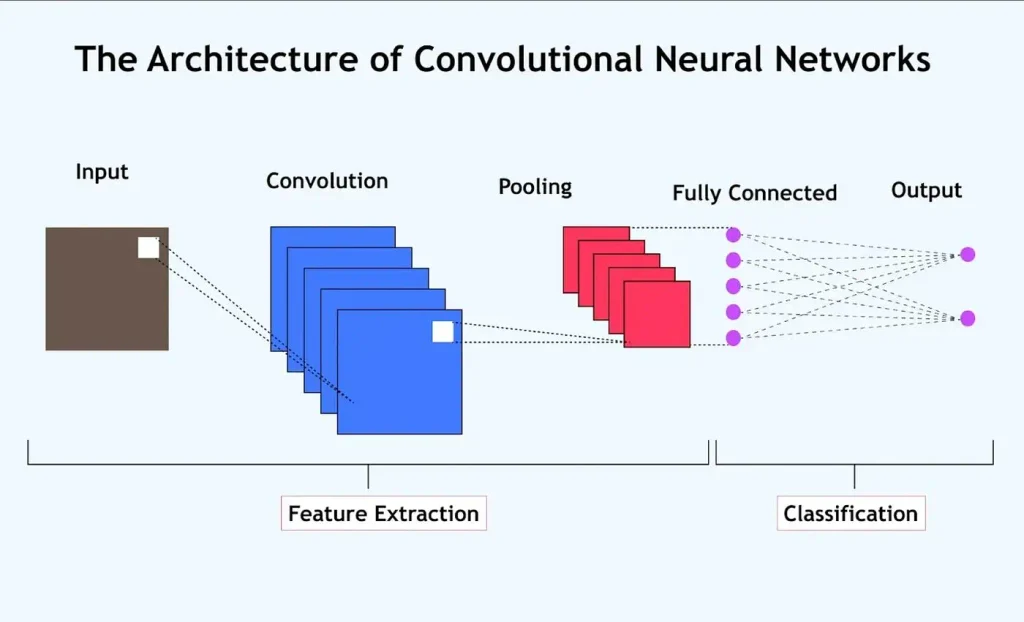
Convolutional neural networks are deep learning architectures primarily designed for processing grid-like data, especially images.
CNNs use mathematical operations called convolutions to identify important patterns within an image.
Their filters can detect features such as edges, textures, shapes, and object parts.
As information moves through the network, these features are combined to recognize more complex objects.
Common applications include:
- Facial recognition.
- Medical image analysis.
- Object detection.
- Self-driving vehicle vision systems.
- Satellite image processing.
For example, a CNN trained on medical images may help identify suspicious patterns in X-rays or MRI scans. Its predictions can support medical professionals in evaluating images.
Recurrent Neural Networks (RNNs)
Recurrent neural networks are designed to process sequential information, where the order of data matters.
Unlike traditional feedforward neural networks, RNNs maintain a hidden state that carries information from previous steps in a sequence.
This makes them useful for tasks involving:
- Speech recognition.
- Time-series forecasting.
- Language modeling.
- Sequential data analysis.
However, traditional RNNs can struggle to remember information over long sequences because of problems such as vanishing gradients.
Two popular variations are:
- Long Short-Term Memory (LSTM): Uses gates to control what information is stored, forgotten, and passed forward.
- Gated Recurrent Unit (GRU): Uses a simpler gating mechanism to manage information in sequential data.
Although transformers have replaced RNNs in many modern language applications, RNN-based models remain useful in certain sequence-processing tasks.
Transformer Models
Transformers are deep learning architectures that have become central to modern natural language processing and generative AI.
They were introduced in the 2017 research paper Attention Is All You Need.
The most important feature of transformers is the attention mechanism, which allows a model to identify relationships between different parts of an input sequence.
For example, when processing a sentence, a transformer can consider how different words relate to one another, helping it understand context.
Transformers are widely used in:
- Text generation.
- Language translation.
- Question answering.
- Document summarization.
- Code generation.
- Multimodal AI applications.
Many modern large language models use transformer-based architectures.
Autoencoders
Autoencoders are neural networks designed to learn compact representations of data and reconstruct the original input.
They typically contain two main components:
- Encoder: Compresses the input into a smaller representation.
- Decoder: Reconstructs the original information from that representation.
For example, an autoencoder trained on images may learn to represent important visual features in a compressed form.
Autoencoders are commonly used for:
- Image denoising.
- Data compression.
- Anomaly detection.
- Feature learning.
- Data reconstruction.
They can also help identify unusual patterns in industrial equipment or financial transactions.
Generative Adversarial Networks (GANs)
Generative Adversarial Networks use two neural networks that compete with each other during training.
These networks are called the generator and discriminator.
The generator creates synthetic data, such as artificial images.
The discriminator attempts to determine whether the generated data is real or artificially created.
As training continues, the generator improves its ability to produce realistic outputs, while the discriminator becomes better at identifying generated examples.
GANs have been used for:
- Synthetic image generation.
- Image-to-image translation.
- Image enhancement.
- Data augmentation.
- Research involving synthetic datasets.
For example, a GAN can learn patterns from a collection of human face images and generate new artificial faces.
Diffusion Models
Diffusion models are generative deep learning models that create new data by learning to reverse a gradual noise-removal process.
During training, noise is progressively added to data, such as images. The model learns how to reverse this process and reconstruct meaningful information from noisy inputs.
During generation, a trained diffusion model typically begins with random noise and gradually transforms it into a new image.
These models are widely used in modern image-generation systems and other generative applications.
Common applications include:
- AI image generation.
- Image editing.
- Image restoration.
- Audio generation.
- Scientific research.
Diffusion models have become an important part of modern generative AI because they can produce detailed and diverse outputs.
Graph Neural Networks (GNNs)
Graph neural networks are designed to process graph-structured data.
A graph consists of nodes and edges. Nodes represent individual entities, while edges describe the relationships between them.
For example, in a social network:
- People are represented as nodes.
- Connections between people are represented as edges.
GNNs learn from both the characteristics of individual nodes and their relationships with neighboring nodes.
They are useful for:
- Social network analysis.
- Fraud detection.
- Recommendation systems.
- Molecular property prediction.
- Traffic network analysis.
For example, financial institutions may use graph-based machine learning systems to identify suspicious relationships between accounts and transactions.
Mamba Models
Mamba is a newer neural network architecture based on selective state-space models.
It was introduced as an alternative approach to processing long sequences of information efficiently.
Traditional attention-based transformers can become computationally expensive when processing very long sequences. Mamba uses a selective mechanism to decide which information should be retained and processed.
This approach can offer computational advantages for certain long-sequence tasks.
Potential applications include:
- Long-document processing.
- Time-series analysis.
- Audio processing.
- Biological sequence modeling.
- Long-context machine learning.
Mamba is an evolving area of deep learning research, and its effectiveness depends on the specific task and implementation.
Comparison of Deep Learning Models
| Model | Main purpose | Common application |
| CNN | Image feature extraction | Facial recognition |
| RNN | Sequential data processing | Time-series analysis |
| Transformer | Context and sequence modeling | Language models |
| Autoencoder | Data compression and reconstruction | Anomaly detection |
| GAN | Synthetic data generation | Image creation |
| Diffusion model | Iterative data generation | AI image generation |
| GNN | Graph relationship learning | Fraud detection |
| Mamba | Efficient sequence modeling | Long-sequence processing |
What Tools and Frameworks Are Used in Deep Learning?
Developing deep learning models requires programming tools, libraries, frameworks, and computing resources.
A deep learning framework provides ready-made components for building neural networks, preparing data, training models, and evaluating results.
These tools reduce the amount of code developers need to write and make it easier to experiment with different architectures.
TensorFlow
TensorFlow is an open-source machine learning framework developed by Google.
It provides tools for building, training, and deploying machine learning and deep learning models.
TensorFlow supports different types of neural networks and can run on CPUs, GPUs, and specialized hardware.
It is commonly used for:
- Image classification.
- Natural language processing.
- Predictive modeling.
- Production machine learning applications.
PyTorch
PyTorch is an open-source machine learning framework originally developed by Meta’s AI research team.
It is widely used in artificial intelligence research and commercial development because of its flexible programming model and strong GPU support.
PyTorch provides tools for creating neural networks, calculating gradients, training models, and experimenting with different architectures.
It is particularly popular among researchers and developers working with advanced deep learning models.
Keras
Keras is a high-level deep learning API designed to make neural network development easier.
It allows developers to create models using relatively simple and readable code.
Keras is suitable for beginners who want to understand how neural networks work without writing every low-level mathematical operation themselves.
It can be used for:
- Classification.
- Regression.
- Image recognition.
- Neural network experimentation.
JAX
JAX is a Python library developed by Google for high-performance numerical computing and machine learning research.
It supports automatic differentiation, accelerated numerical operations, and compilation.
Researchers use JAX to experiment with advanced mathematical models and build computationally intensive machine learning systems.
NVIDIA CUDA
CUDA is a parallel computing platform and programming model developed by NVIDIA.
It allows software developers to use NVIDIA GPUs for computationally intensive tasks.
Deep learning training involves large numbers of mathematical operations, which GPUs can perform efficiently in parallel.
CUDA helps frameworks such as PyTorch and TensorFlow take advantage of NVIDIA GPU hardware.
Other Useful Deep Learning Tools
Several additional tools support deep learning development:
- Hugging Face Transformers: Provides access to pre-trained transformer models and tools for natural language processing and other AI tasks.
- ONNX: An open format for representing machine learning models and supporting interoperability between frameworks.
- NumPy: Helps with numerical computing and array operations.
- Pandas: Provides tools for working with structured datasets.
- Jupyter Notebook: Allows developers to experiment with Python code interactively.
- Google Colab: Provides a cloud-based environment for running Python and experimenting with machine learning.
For beginners, Python, PyTorch or Keras, and Google Colab provide a practical starting point.
What Are the Applications of Deep Learning?
Deep learning is used in many industries because it can identify complex patterns in large amounts of data.
It powers technologies that help computers recognize images, understand spoken language, analyse documents, make predictions, and generate new content.
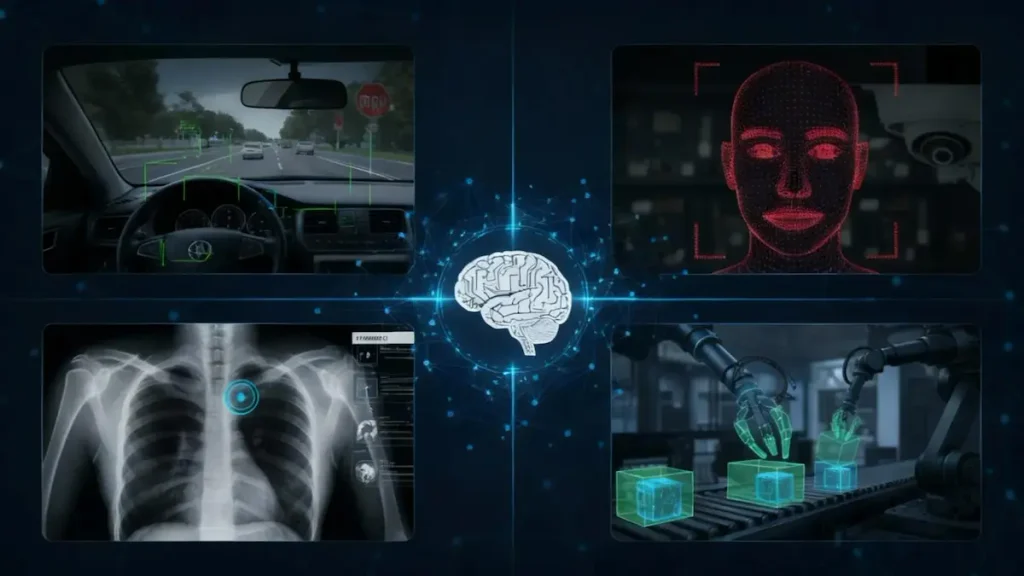
Here are some important real-world applications.
Computer Vision and Image Recognition
Computer vision is a field of artificial intelligence that allows computers to interpret and analyse visual information.
Deep learning models, particularly CNNs and vision transformers, are used to identify objects, recognize faces, classify images, and understand visual scenes.
For example, a security system can use facial recognition to compare a person’s face with previously registered images.
Other applications include:
- Object detection in photographs and videos.
- Quality inspection in manufacturing.
- Medical image analysis.
- Traffic monitoring.
- Satellite image interpretation.
These systems can analyses large volumes of visual information and help automate tasks that previously required manual inspection.
Speech Recognition
Speech recognition uses AI to convert spoken language into text or commands.
Deep learning models analyse audio signals and identify patterns associated with spoken words.
For example, when you speak to a voice assistant, the system processes your speech and converts it into information that software can understand.
Common applications include:
- Voice assistants.
- Automatic subtitles.
- Speech-to-text applications.
- Voice-controlled devices.
- Real-time transcription.
Deep learning has significantly improved the ability of speech recognition systems to handle different accents, speaking styles, and noisy environments.
Natural Language Processing (NLP)
Natural language processing focuses on helping computers understand, interpret, and generate human language.
Deep learning models, especially transformers, have improved many NLP applications.
These include:
- Language translation.
- Text summarization.
- Sentiment analysis.
- Question answering.
- Chatbots.
- Document classification.
For example, a customer service chatbot can analyse a user’s question and generate a relevant response based on its training and available context.
Large language models also use deep learning to generate and process human-like text.
Healthcare and Medical Diagnosis
Healthcare is one of the most promising areas for deep learning applications.
Medical professionals work with large amounts of information, including medical images, laboratory results, electronic health records, and patient monitoring data.
Deep learning can help analyse this information and identify patterns that may be difficult to detect manually.
Applications include:
- Detecting suspicious patterns in X-rays.
- Analysing MRI and CT scans.
- Identifying abnormalities in retinal images.
- Supporting disease prediction research.
- Analysing medical and biological datasets.
- Drug discovery research.
For example, a trained deep learning model may identify patterns associated with a particular condition in a medical scan.
However, these systems are decision-support tools. Medical diagnosis and treatment decisions require appropriate clinical expertise and validation.
Recommendation Systems
Recommendation systems analyse user behaviour and preferences to suggest relevant products, videos, music, and other content.
Deep learning models can process information such as viewing history, clicks, purchases, ratings, and user interactions.
For example, a streaming platform may analyse which videos you watch, how long you watch them, and what content you interact with.
It can use this information to recommend other videos that may interest you.
Recommendation systems are commonly used by:
- Online shopping platforms.
- Video streaming services.
- Music applications.
- Social media platforms.
- Digital content services.
Autonomous Vehicles
Self-driving vehicles use several AI technologies to understand their surroundings and make driving decisions.
Deep learning helps these systems analyse information collected from cameras and other sensors.
Applications include:
- Recognizing pedestrians.
- Detecting vehicles.
- Identifying traffic signs.
- Recognizing lane markings.
- Understanding road conditions.
- Tracking objects around the vehicle.
For example, a computer vision model can identify a pedestrian crossing the road and provide information to the vehicle’s decision-making system.
Autonomous driving requires multiple technologies working together, including perception, localization, planning, and control.
Fraud Detection and Cybersecurity
Financial institutions and cybersecurity organizations use machine learning and deep learning to analyse large amounts of activity and identify suspicious patterns.
Deep learning models can learn relationships between transactions, accounts, devices, and user behaviour.
Applications include:
- Detecting unusual financial transactions.
- Identifying suspicious account activity.
- Analysing network traffic.
- Detecting malicious software patterns.
- Supporting identity verification.
For example, if a payment differs significantly from a customer’s usual activity, a fraud detection system may flag it for additional review.
Generative AI and Content Creation
Generative AI is one of the most visible applications of modern deep learning.
Generative models can create new content based on patterns learned during training.
They can generate:
- Written articles and summaries.
- Computer code.
- Images and illustrations.
- Music and audio.
- Video content.
- Synthetic datasets.
Large language models use deep learning to generate text and respond to instructions, while diffusion models are widely used in image generation.
This technology is changing how people approach content creation, software development, research, and creative work.
What Are the Benefits of Deep Learning?
Deep learning provides several advantages over traditional approaches to solving complex data problems.
Its ability to learn patterns automatically and process different types of information makes it valuable in modern AI applications.
Automatic Feature Extraction
One of the biggest advantages of deep learning is its ability to automatically identify useful features from raw data.
Traditional machine learning often requires domain experts to select and prepare relevant features manually.
Deep learning models can learn these representations through multiple layers.
For example, an image recognition model can learn to identify edges, shapes, and object parts without developers manually defining every visual feature.
High Accuracy and Performance
Deep learning has achieved strong results in tasks such as image classification, speech recognition, and natural language processing.
Its ability to learn complex patterns can make it particularly effective when sufficient high-quality data and computing resources are available.
A well-known example is Alex Net, a deep convolutional neural network that achieved a breakthrough in the 2012 ImageNet image recognition competition.
Processing Complex and Unstructured Data
Deep learning can process different forms of unstructured data, including:
- Images.
- Audio recordings.
- Video.
- Text documents.
- Speech.
This is important because much of the information generated by people and organizations is not stored in simple structured tables.
Deep learning provides methods for extracting useful information from these complex data sources.
Discovering Hidden Patterns
Deep learning models can identify relationships and patterns that may be difficult to describe using traditional programming rules.
For example, a model analysing financial transactions may identify unusual combinations of activities that indicate possible fraud.
These capabilities make deep learning useful in research, business intelligence, healthcare, and cybersecurity.
Scalability
Deep learning models can be trained on increasingly large datasets using powerful computing hardware and distributed systems.
Some architectures can also be adapted to new tasks through techniques such as transfer learning and fine-tuning.
This allows organizations to reuse existing models rather than building every system from scratch.
Automation and Productivity
Deep learning can automate repetitive and data-intensive tasks.
For example, businesses can use AI systems to classify documents, analyse customer messages, detect defects, and process large volumes of information.
Automation can reduce manual workloads and help employees focus on more complex responsibilities.
However, the benefits depend on how accurately and responsibly the technology is implemented.
What Are the Challenges of Deep Learning?
Although deep learning has many advantages, it also comes with important technical, financial, and ethical challenges.
Understanding these limitations is necessary when designing and deploying reliable AI systems.
Large Amounts of High-Quality Data
Deep learning models often require substantial amounts of training data to learn useful patterns.
For supervised learning, the data may also need accurate labels.
Collecting, cleaning, organizing, and labelling datasets can be expensive and time-consuming.
Poor-quality or unrepresentative training data can reduce model accuracy and lead to unreliable predictions.
High Computational Costs
Training deep neural networks requires significant computing resources, especially for large models.
Developers often use GPUs or specialized AI accelerators to perform the large number of mathematical operations required during training.
These resources can increase development costs through:
- Hardware expenses.
- Cloud computing charges.
- Electricity consumption.
- Infrastructure maintenance.
Large-scale models may require substantial computing resources even after training, particularly during inference.
Long Training Times
Training complex neural networks can take considerable time.
The duration depends on the model architecture, dataset size, hardware, optimization methods, and training configuration.
Developers may need to run multiple experiments to find suitable model parameters and improve performance.
This can make deep learning development slower and more expensive.
Overfitting
Overfitting occurs when a model learns the training data too closely, including noise and irrelevant details.
As a result, it may perform very well on training examples but poorly on new, unseen data.
Developers use several techniques to reduce overfitting:
- Regularization.
- Dropout.
- Data augmentation.
- Early stopping.
- Cross-validation.
- Increasing training data diversity.
The objective is to build a model that learns general patterns rather than simply memorizing examples.
Lack of Interpretability
Many deep learning models are difficult to interpret.
Although they can produce accurate predictions, understanding exactly why a particular prediction was made can be challenging.
This is often called the black-box problem.
It is especially important in areas such as healthcare, finance, insurance, and other high-impact applications where people need understandable explanations for automated decisions.
Researchers use explainable AI techniques to make model behaviour easier to analyse.
Data Bias and Privacy
Deep learning models learn from their training data. If the data contains bias, the model may reproduce or even amplify that bias.
For example, a facial recognition system trained on an unrepresentative dataset may perform differently across demographic groups.
Privacy is another important concern, especially when models are trained using personal information, medical records, or sensitive business data.
Organizations should use appropriate data protection, access controls, evaluation procedures, and responsible AI practices.
Adversarial Attacks
Some deep learning models can be fooled by carefully designed inputs known as adversarial examples.
These inputs may contain small changes that are difficult for humans to notice but can cause a model to make an incorrect prediction.
For example, carefully modified images may cause an image recognition model to misclassify an object.
This makes security testing and robustness evaluation important when deploying deep learning systems in sensitive applications.
Deep Learning vs. Machine Learning vs. Artificial Intelligence
Artificial intelligence, machine learning, and deep learning are closely related concepts, but they describe different areas of computing.
Understanding their differences makes it easier to understand how modern intelligent systems are developed.
What Is Artificial Intelligence?
Artificial intelligence is the broad field of developing computer systems that can perform tasks associated with human intelligence.
These tasks include:
- Reasoning.
- Problem-solving.
- Language understanding.
- Pattern recognition.
- Decision-making.
- Planning.
AI systems can use different approaches, including rule-based systems, search algorithms, machine learning, and deep learning.
For example, a traditional chess program may use programmed rules and search algorithms to select moves without using deep learning.
What Is Machine Learning?
Machine learning is a subset of artificial intelligence that allows computer systems to learn patterns from data.
Instead of manually programming every possible rule, developers train algorithms using examples.
Common machine learning methods include:
- Decision trees.
- Random forests.
- Support vector machines.
- Linear regression.
- K-nearest neighbours.
- Neural networks.
For example, a machine learning algorithm can analyse historical customer information to predict which customers may cancel a subscription.
What Is Deep Learning?
Deep learning is a specialized subset of machine learning that uses neural networks with multiple layers.
It is particularly useful for complex tasks involving images, audio, text, and other forms of unstructured information.
Deep learning models can automatically learn increasingly complex features from training data.
Examples include image recognition systems, speech assistants, and large language models.
Key Differences Between AI, Machine Learning, and Deep Learning
| Feature | Artificial Intelligence | Machine Learning | Deep Learning |
| Meaning | Broad field of intelligent systems | Learning from data | Learning through deep neural networks |
| Relationship | Broadest category | Subset of AI | Subset of ML |
| Approach | Rules, search, learning, and reasoning | Statistical learning algorithms | Multi-layer neural networks |
| Data requirements | Depends on the approach | Varies by algorithm | Often requires substantial data |
| Feature extraction | Depends on the method | Often requires manual feature engineering | Can learn features automatically |
| Computing resources | Varies | Often moderate | Can be computationally intensive |
| Example | Rule-based chess system | Decision-tree spam classifier | CNN-based image recognition |
The simplest way to understand the relationship is:
Artificial intelligence is the broader concept, machine learning is one approach within AI, and deep learning is a specialized approach within machine learning.
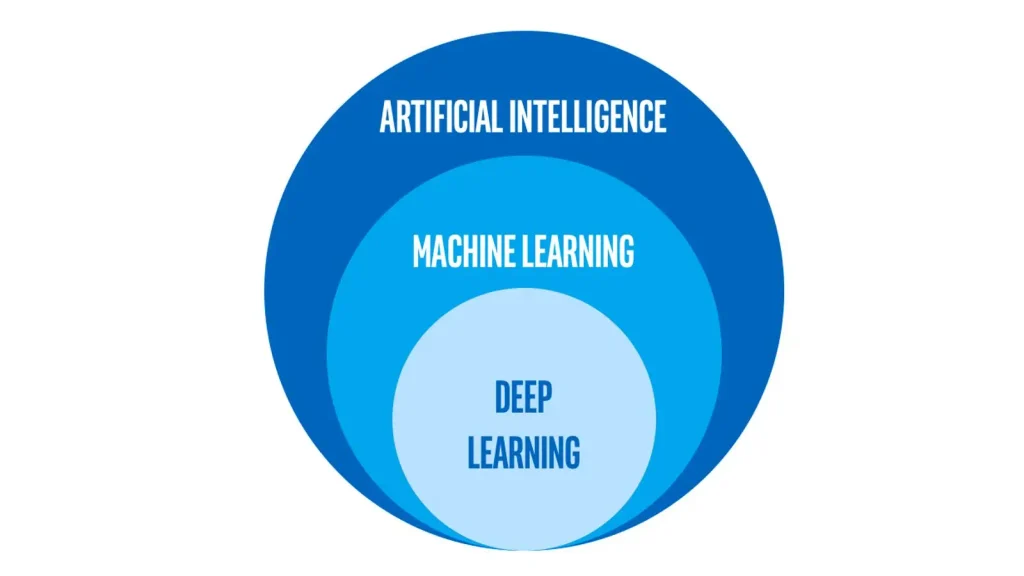
All deep learning is machine learning, and all machine learning is part of artificial intelligence, but not all AI systems use machine learning or deep learning.
Deep Learning vs. Generative AI: What’s the Difference?
Deep learning and generative AI are closely connected, but they describe different things.
Deep learning is a method for training neural networks, while generative AI refers to AI systems designed to create new content.
Generative AI can produce text, images, audio, video, and computer code by learning patterns from training data.
Many modern generative AI systems use deep learning architectures.
For example, large language models use transformer-based neural networks to process and generate text. Image-generation systems often use diffusion models or other generative architectures.
However, not every deep learning application is generative.
A deep learning system that detects tumors in medical images or identifies fraudulent transactions is performing a prediction or classification task rather than creating new content.
Key Differences Between Deep Learning and Generative AI
| Feature | Deep Learning | Generative AI |
| Meaning | Machine learning technique using deep neural networks | AI focused on generating new content |
| Main purpose | Learn patterns and make predictions | Create new content |
| Common tasks | Classification, prediction, detection | Text, image, audio, and video generation |
| Technology | CNNs, RNNs, transformers, and other networks | Transformers, diffusion models, GANs, and others |
| Example | Detecting objects in images | Generating images from text prompts |
In simple terms, deep learning provides many of the underlying technologies that make modern generative AI possible.
What Is the Future of Deep Learning?
Deep learning continues to develop as researchers discover new architectures, improve training techniques, and find ways to make AI systems more efficient.
Its future will likely involve more capable models, improved reasoning, better handling of different data types, and broader adoption across industries.
Advancements in Generative AI
Generative AI is one of the fastest-developing areas built on deep learning.
Modern models can generate text, images, audio, video, and code.
Future improvements may make these systems more reliable, context-aware, and useful for professional applications.
Businesses may increasingly use generative AI for customer support, software development, content production, research, and workflow automation.
Multimodal AI Models
Traditional AI systems were often designed to work with a single type of data, such as text or images.
Multimodal AI models can process multiple types of information together.
For example, a multimodal model may analyse an image, understand a spoken question about it, and generate a written response.
This capability creates opportunities for more natural human-computer interaction.
Deep Learning in Healthcare and Robotics
Healthcare and robotics are two important areas where deep learning may have a significant impact.
In healthcare, deep learning can support medical image analysis, drug discovery, medical research, and patient monitoring.
In robotics, neural networks can help machines understand their environments, recognize objects, and perform complex tasks.
As these technologies improve, they may support more advanced medical tools, industrial automation, and intelligent robotic systems.
More Efficient and Smaller AI Models
Large deep learning models can require substantial computing resources.
Researchers are therefore developing techniques to make models smaller, faster, and more efficient.
Some important approaches include:
- Model quantization: Reducing the numerical precision used to represent model parameters.
- Pruning: Removing less important connections or parameters.
- Knowledge distillation: Training a smaller model to reproduce the behaviour of a larger model.
- Efficient architectures: Designing neural networks that require fewer computational resources.
These improvements can make deep learning more practical for smartphones, embedded devices, and applications with limited computing power.
Conclusion
Deep learning is an important branch of machine learning that allows computers to learn complex patterns through artificial neural networks with multiple layers. It has transformed how machines process images, understand speech, analyse text, recognize objects, and generate new content.
From convolutional neural networks and transformers to diffusion models and graph neural networks, different deep learning architectures solve different types of problems. These technologies are already being used in healthcare, finance, transportation, cybersecurity, recommendation systems, and generative AI.
However, deep learning also comes with challenges, including high computing costs, large data requirements, overfitting, privacy concerns, and limited interpretability.
As research continues, more efficient architectures and improved training techniques will make deep learning increasingly accessible and useful.
Understanding deep learning is a valuable starting point for anyone interested in artificial intelligence, machine learning, and the future of modern technology.
Frequently Asked Question
Is ChatGPT deep learning?
Yes, ChatGPT is powered by deep learning technology. It uses large language models (LLMs) based on deep neural networks, particularly transformer architectures, to understand and generate human-like text.
2. What is the difference between AI, ML, and DL?
Artificial intelligence (AI) is the broad field of creating machines that perform tasks requiring human-like intelligence. Machine learning (ML) is a subset of AI that enables computers to learn from data. Deep learning (DL) is a subset of machine learning that uses multi-layered artificial neural networks to identify complex patterns.
3. What is deep learning in simple words?
Deep learning is a type of artificial intelligence that teaches computers to learn from examples and recognize patterns using artificial neural networks. For example, it allows computers to recognize faces, understand speech, identify objects, and process human language without manually programming every rule.
4. Is ChatGPT machine learning or deep learning?
ChatGPT uses both machine learning and deep learning. More specifically, it is powered by deep learning models, which are a specialized form of machine learning. Its transformer-based neural networks are trained on large amounts of data to understand and generate text.
5. What are the three types of AI?
Artificial intelligence is commonly categorized into three theoretical types based on capability:
Artificial Narrow Intelligence (ANI): AI designed to perform specific tasks, such as facial recognition, voice assistants, and recommendation systems.
Artificial General Intelligence (AGI): A theoretical form of AI that could understand, learn, and perform a wide range of intellectual tasks at a human-like level.
Artificial Superintelligence (ASI): A hypothetical form of AI that would surpass human intelligence across virtually all intellectual activities.