
Introduction
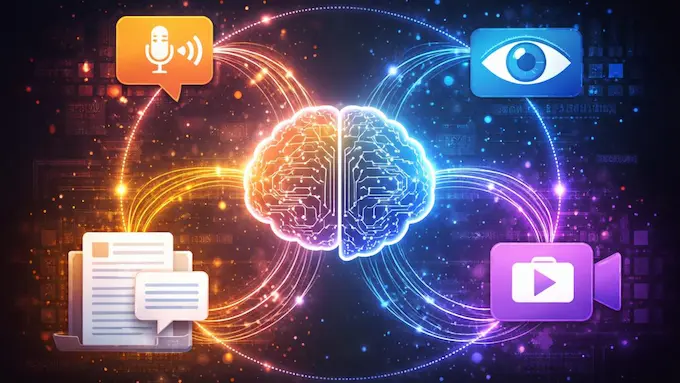
Generative artificial intelligence (AI) is a type of artificial intelligence that can create new content, including text, images, audio, video, and computer code. Unlike systems designed primarily to classify information or make predictions, generative AI produces outputs based on patterns learned from training data.
Tools such as ChatGPT, Google Gemini, Claude, and AI image generators have made this technology accessible to students, professionals, businesses, and everyday users. People can use generative AI to draft articles, explore ideas, summarize documents, develop software, create visual concepts, and perform many other tasks.
However, generative AI is not perfect. It can produce inaccurate information, reflect biases, raise privacy and copyright concerns, and generate convincing but misleading content.
Understanding what generative AI is, how it works, and where its limitations lie helps people use it more effectively. This guide explores the technology’s main types, practical applications, popular tools, benefits, risks, and future developments.
What Is Generative AI?
Generative AI is a category of artificial intelligence that uses trained models to generate new content. Depending on the model, this content may include written language, illustrations, photographs, music, speech, video, or software code.
In simple terms, generative AI learns patterns and relationships from examples and uses those learned patterns to produce outputs in response to prompts or other inputs.
For example, a user can ask an AI assistant to write a product description, explain a scientific concept, summarize a lengthy document, or suggest ideas for a marketing campaign. The system processes the request and generates a response based on its training, available context, and design.
The underlying technology is more complex than simply copying and pasting information. Many generative models learn statistical structures in data and use them to construct outputs. Nevertheless, generated content can sometimes resemble existing material, and its originality and accuracy should not be assumed.
Generative AI also does not operate exactly like a human. A model can produce convincing explanations without necessarily having reliable knowledge of whether its statements are true. This is why verification remains important.
What Can Generative AI Do?
Generative AI supports several types of content creation:
- Text generation: Writing articles, emails, summaries, translations, explanations, and creative stories.
- Image generation: Producing illustrations, product concepts, digital artwork, and visual mock-ups.
- Audio generation: Creating synthetic speech, music, sound effects, and other audio.
- Video generation: Generating or modifying video from text prompts, images, or existing clips.
- Code generation: Suggesting software code, explaining functions, generating tests, and assisting with debugging.
- Multimodal generation: Processing or generating combinations of text, images, audio, and other information.
The available capabilities depend on the specific model and product. Not every generative AI tool can perform every task.
A Simple Example of Generative AI
Imagine a small business that sells handmade notebooks. The owner wants a product description for an online store but does not know how to write persuasive marketing copy.
The owner enters the following prompt:
“Write a friendly, 100-word product description for a handmade notebook with recycled paper, a linen cover, and a minimalist design. Highlight its suitability for journaling and everyday planning.”
The AI generates a draft that the owner can review, edit, and improve. The owner might then request a shorter version or ask for a more professional tone.
This example demonstrates how generative AI can support content creation. However, the business owner must check that the description accurately represents the notebook and does not introduce unsupported claims.
How Does Generative AI Work?
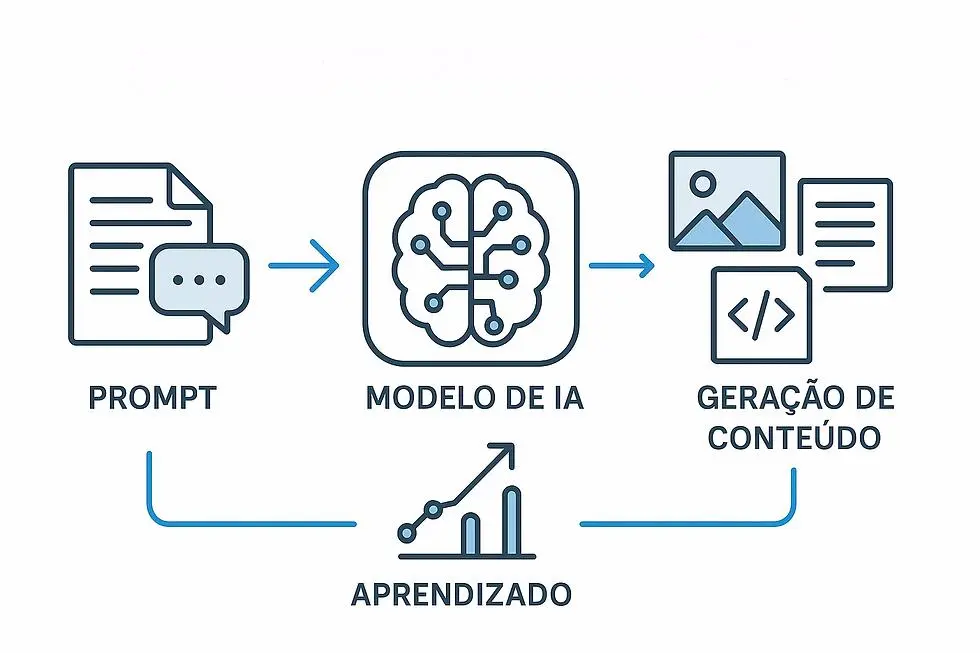
Generative AI systems use different architectures and training methods. Although no single process describes every model, most generative systems involve learning patterns from data and using a trained model to generate outputs.
1. Data Collection and Preparation
AI developers collect and prepare data relevant to a model’s intended purpose. Depending on the application, this data may include text, images, audio, video, code, or combinations of different formats.
Data preparation can involve filtering low-quality material, removing duplicates, standardizing formats, and identifying information that should not be included in training.
The quality and composition of training data influence what a model learns. Incomplete, inaccurate, or biased data can contribute to unreliable results.
Data collection practices also differ across developers. Licensing, privacy, consent, and the handling of personal information are important considerations throughout this process.
2. Model Training
During training, a model adjusts its internal parameters to improve performance on a specific learning objective.
For example, many large language models learn by predicting the next token in a sequence. A token may represent a word, part of a word, punctuation, or another unit of text.
During training, the model encounters many examples and learns statistical relationships that help it predict plausible continuations.
Image-generation models use different approaches. Some learn relationships between images and text, while diffusion models commonly learn to generate images by reversing a noise-based process.
Training methods vary, so these examples should not be treated as a universal description of every generative AI system.
3. Learning Patterns and Representations
As training progresses, the model develops internal representations that help it perform its task.
A language model may learn patterns involving grammar, word relationships, context, and common forms of explanation. An image model may learn patterns involving shapes, textures, colours, and visual compositions.
These learned representations are encoded in the model’s parameters. They are not simply a searchable library of complete answers.
This distinction helps explain why generative AI can produce new combinations of learned patterns. However, generating a different combination does not guarantee that an output is accurate, original, or free from similarities to existing content.
4. Prompt Processing and Content Generation
After training, a model can be used to respond to prompts or other inputs. This stage is often called inference.
A user provides an instruction, question, image, or another supported input. The model processes it and generates an output based on its architecture, instructions, settings, and available context.
For example, a user might ask an AI assistant to explain photosynthesis to a ten-year-old. The model can generate a simpler explanation with familiar examples.
The user can then request changes, ask follow-up questions, or provide additional context.
Output quality depends on the model’s capabilities, the clarity of the prompt, the information available, and the complexity of the task.
5. Fine-Tuning and Human Feedback
Some models receive additional training after their initial training. This can include fine-tuning on selected examples or preference-based methods that help the model respond more appropriately to instructions.
Human feedback may contribute to these processes by helping developers compare outputs and improve model behaviour.
These methods can make systems more useful, but they cannot eliminate all errors, bias, or safety concerns.
The central idea is that generative AI combines learned patterns, a trained model, and user input to produce content. The precise mechanism differs among language models, image generators, audio systems, and multimodal tools.
For a deeper technical introduction to generative models, see OpenAI’s explanation of generative models.
What Are the Main Types of Generative AI?
Generative AI can be classified according to the content it produces. These categories often overlap because a single model may support several types of input and output.

1. Text-Generating AI
Text-generating AI creates written language from prompts or other inputs. Many systems use large language models (LLMs), which learn statistical patterns in language from training data.
Common applications include writing assistance, summarization, translation, brainstorming, question answering, and document analysis.
For example, a student might ask an AI assistant to explain a difficult scientific concept, while a business professional might use one to draft a report.
Text generation can save time, but generated content may include inaccurate facts, fabricated references, or misleading explanations. Important claims should be checked against reliable sources.
2. Image-Generating AI
Image-generating AI creates or edits visual content using text prompts, reference images, or other inputs.
Some systems use diffusion models, which learn to generate images through a process involving the gradual removal of noise. Other generative approaches use different architectures and objectives.
Designers can use image generators to explore visual concepts, create illustrations, develop product mock-ups, and experiment with advertising ideas.
For example, a furniture designer might generate several concepts for a modern chair before creating a detailed prototype.
Potential problems include visual inconsistencies, inaccurate representations, copyright questions, and misleading imagery.
3. Audio and Speech-Generating AI
Audio-generating systems can produce synthetic speech, music, sound effects, and other audio content.
Text-to-speech technology converts written text into spoken language. Other systems can generate music or reproduce vocal characteristics.
These capabilities may support accessibility, language learning, narration, entertainment, and media production.
Voice generation also requires care. Unauthorized voice imitation can facilitate impersonation, fraud, and other forms of misuse.
4. Video-Generating AI
Video-generating AI creates or transforms moving images using text prompts, images, video clips, or other inputs.
Potential applications include storyboarding, advertising concepts, educational content, and creative experimentation.
For example, a marketing team might generate a short visual concept to explore how a product advertisement could look before arranging a full production.
Generated video can contain inconsistencies in motion, object appearance, and physical details. It can also be used to create deceptive media, making verification and context important.
5. Code-Generating AI
Code-generating AI assists with software development by suggesting code, explaining functions, drafting documentation, generating tests, and helping investigate errors.
A developer might ask an AI coding assistant to write a function, explain an unfamiliar programming concept, or suggest a solution to a bug.
These tools can reduce repetitive work, but generated code may contain defects, insecure practices, or incorrect assumptions. Developers must review and test it before using it in production.
6. Multimodal Generative AI
Multimodal AI systems can process or generate more than one type of information, such as text and images or text and audio.
For example, a user might provide a photograph of a machine and ask an AI assistant to describe its visible components. Another system might accept spoken instructions and respond with generated speech.
Multimodal capabilities vary between products. A system that can process several types of information does not necessarily interpret every input correctly.
Generative AI vs. Traditional AI
Artificial intelligence is a broad field that includes systems designed for many different tasks. Generative AI is one category within that field.
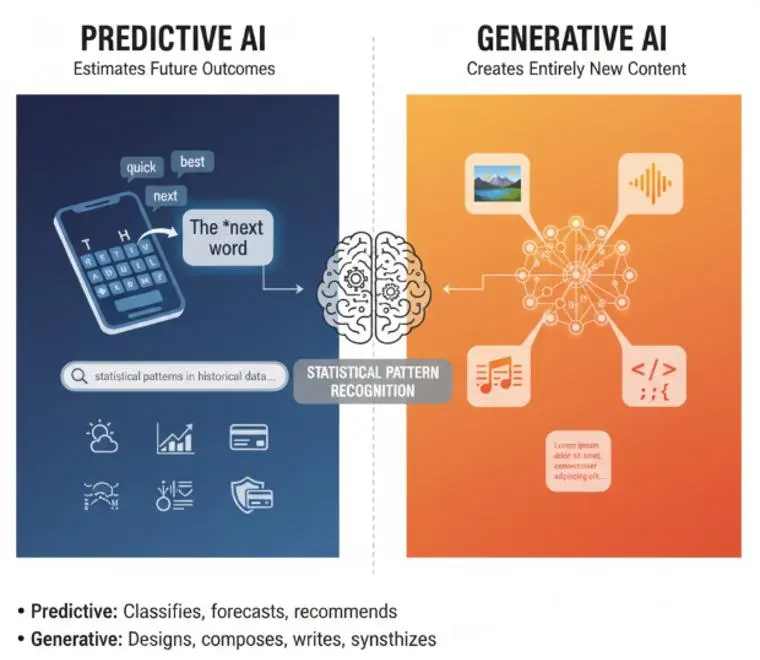
Traditional or predictive AI systems are often used to classify information, identify patterns, estimate probabilities, detect anomalies, or make predictions. Generative AI focuses on producing content, although the two approaches can overlap.
| Feature | Generative AI | Traditional or predictive AI |
| Primary purpose | Generate content | Classify, predict, detect, or recommend |
| Typical output | Text, images, audio, video, or code | Labels, scores, forecasts, or recommendations |
| Example | Generate a product description | Predict whether a transaction is fraudulent |
| Common application | Content creation and synthesis | Forecasting and pattern recognition |
| Evaluation | Quality, relevance, factuality, and task-specific measures | Accuracy, precision, recall, calibration, and task-specific measures |
These are general distinctions rather than strict technical boundaries. Generative models can perform classification tasks, and modern AI products may combine predictive and generative components.
Generative AI vs. Machine Learning vs. Deep Learning
These terms describe related but different concepts:
- Artificial intelligence (AI): The broad field of developing systems that perform tasks associated with intelligence.
- Machine learning (ML): Techniques that allow systems to learn patterns from data.
- Deep learning: A branch of machine learning that uses multilayer neural networks.
- Generative AI: AI systems designed to generate new content, often using machine learning and deep learning techniques.
Generative AI is not separate from the wider AI research field. It builds on methods developed across machine learning, neural networks, and other areas of computer science.
Popular Generative AI Tools and Examples
A variety of tools make generative AI accessible for personal and professional tasks. Each product has different capabilities, limitations, and terms of use.
ChatGPT
ChatGPT is an AI assistant that can support writing, explanations, brainstorming, summarization, coding, and supported multimodal tasks. Its available features depend on the model, product configuration, and access level.
Google Gemini
Google Gemini provides AI assistance for language-related tasks and, in supported versions, other types of information. Its features and integrations vary across products.
Claude
Claude is an AI assistant used for writing, analysis, document-related tasks, and programming assistance. Its capabilities depend on the model and product configuration.
Adobe Firefly
Adobe Firefly provides generative AI capabilities for creative workflows, including supported image-generation and editing tasks. Users should check the relevant licensing terms before using generated assets commercially.
GitHub Copilot
GitHub Copilot is an AI coding assistant that suggests code and supports software development workflows. Developers should review suggestions, test the resulting software, and follow applicable security practices.
These examples illustrate different uses of generative AI rather than representing every available tool. Features, pricing, licensing, and availability may change, so consult each provider’s current documentation before deciding.
Real-World Applications of Generative AI
Generative AI is being used in education, business, marketing, software development, research, and creative industries. Its suitability depends on the task, the quality of the output, and the safeguards in place.

1. Education and Learning
Students and educators can use generative AI to explain difficult topics, create practice questions, draft lesson plans, and summarize learning materials.
For example, a student studying physics might ask an AI assistant to explain Newton’s laws through everyday examples.
Teachers may also use these tools to develop alternative explanations for students with different learning needs.
However, AI-generated educational content can contain mistakes. Students should verify important information, follow academic integrity rules, and use AI to support learning rather than misrepresent their work.
2. Business and Customer Service
Businesses can use generative AI to draft customer responses, summarize support conversations, organize internal knowledge, and assist employees with information retrieval.
A customer service team might use AI to prepare a response to a frequently asked question, which an employee reviews before sending.
Organizations should consider confidentiality, data protection, reliability, and escalation procedures. Sensitive cases may require direct human assistance rather than automated responses.
3. Marketing and Content Creation
Marketing teams can use generative AI to brainstorm campaign ideas, create outlines, draft product descriptions, and explore alternative messaging.
For example, a small business could generate several versions of a product announcement for different audiences and then edit the most suitable version.
Human review remains essential. Teams should verify claims, avoid misleading advertising, check usage rights, and ensure that published content accurately represents the product and brand.
4. Healthcare and Scientific Research
Generative AI may support administrative work, literature exploration, document drafting, and research planning.
Researchers can use it to organize information, explore possible explanations, or generate ideas for further investigation.
However, AI-generated scientific summaries are not automatically validated. Medical diagnoses, treatment decisions, and research conclusions require appropriate evidence and qualified professional judgment.
5. Software Development
Developers can use generative AI for code suggestions, explanations, test generation, documentation, and debugging assistance.
For instance, an engineer might ask a coding assistant to create a sample function and then adapt it to the application’s requirements.
The engineer remains responsible for testing, security, performance, maintainability, and compatibility with the existing system.
6. Design, Media, and Entertainment
Creative professionals can use generative AI to explore visual concepts, develop storyboards, create synthetic audio, and experiment with different design directions.
An independent filmmaker might generate rough scene concepts before planning a production.
These applications can make experimentation faster, but they also raise questions about consent, attribution, copyright, authenticity, and the impact of automation on creative work.
Across these industries, generative AI is best understood as a tool that can support human work. Its value depends on how well it fits the workflow and how carefully its outputs are reviewed.
What Are the Benefits of Generative AI?
Generative AI offers several potential benefits, although the actual results depend on the task and implementation.
Increased Productivity
Generative AI can help users create first drafts, summarize information, generate alternatives, and automate parts of repetitive content-related work.
For example, an employee may use AI to prepare an initial report outline before adding verified data and analysis.
These tools can reduce time spent on certain tasks, but the total benefit depends on the amount of review, correction, and integration required.
Creativity and Idea Generation
Generative AI can suggest alternative approaches and help users explore ideas they might not have considered initially.
Writers can experiment with different story directions, while designers can generate visual concepts for further development.
AI-generated suggestions do not replace human judgment, originality, or creative decision-making. Their value often comes from helping people explore possibilities.
Personalization and Accessibility
Some generative AI systems can adapt explanations to different reading levels, support language learning, produce alternative formats, or assist with speech and text accessibility.
For example, a user may request a plain-language explanation of a complicated topic or convert written material into spoken output.
Effectiveness depends on the system’s capabilities and the user’s needs.
Faster Prototyping and Experimentation
Businesses and developers can use generative AI to explore ideas, create preliminary mock-ups, and test different approaches before investing in a complete solution.
This can make early experimentation more accessible, especially when producing an initial draft or concept would otherwise require substantial effort.
However, a prototype is not necessarily a finished or reliable product. Outputs must be tested and refined before practical deployment.
Limitations and Risks of Generative AI
Generative AI can be useful, but its limitations need to be understood before it is used in important decisions or professional workflows.

The NIST Generative AI Risk Management Profile provides guidance for identifying and managing risks associated with generative AI systems.
1. Hallucinations and Incorrect Information
Generative AI can produce statements that sound convincing but are factually wrong. These errors are commonly called hallucinations.
A model might invent a citation, misstate a scientific finding, or provide an inaccurate explanation. The fluency of an answer does not establish its reliability.
Users should verify important claims against trustworthy sources, especially when the information affects consequential decisions.
2. Bias and Fairness
Models can reproduce or amplify biases in training data, evaluation methods, or deployment practices.
For example, a system might generate stereotypical descriptions of occupations or perform unevenly across different groups.
Developers and organizations should test for relevant biases, monitor system performance, and implement appropriate mitigation measures.
3. Privacy and Data Security
The way an AI tool handles user-provided text, documents, images, and other information depends on its product, settings, contracts, and policies.
Uploading confidential business information, personal details, passwords, or sensitive records to an unapproved system can create privacy and security risks.
Users should understand relevant data-handling practices and follow organizational policies before submitting sensitive information.
4. Copyright and Intellectual Property
Generative AI raises questions about copyrighted training data, similarities between generated outputs and existing works, ownership, attribution, and commercial use.
Legal rules and outcomes vary by jurisdiction and circumstances. A product’s terms of service do not necessarily settle every legal question.
Before publishing or commercializing generated content, users should check applicable licenses, permissions, platform policies, and local law.
5. Deepfakes and Misinformation
Generative AI can produce realistic-looking images, audio, and video depicting events or statements that never occurred.
Synthetic media has legitimated creative applications, but it can also enable fraud, impersonation, harassment, and misinformation.
People should verify suspicious content before sharing it as fact, particularly when it could affect someone’s reputation or public understanding of an event.
6. Overreliance on AI
Fluent, confident answers may encourage people to accept generated information without checking it.
This can lead to inaccurate reports, defective code, misleading communications, and poor decisions.
Human review is especially important when mistakes could have serious consequences.
7. Environmental and Operational Costs
Training and operating large AI models can require substantial computing infrastructure and energy. Deployment may also involve hardware, data processing, maintenance, and service costs.
The actual impact varies by model, workload, energy source, and deployment method.
These limitations do not mean generative AI is inherently unsuitable. They demonstrate why users should match each application to its risks and establish appropriate safeguards.
How to Use Generative AI Responsibly
Responsible use combines effective prompting with verification, privacy protection, and human oversight.
Write Clear and Specific Prompts
A good prompt explains the task, provides context, identifies the intended audience, and describes the desired format.
Instead of writing, “Explain AI,” a user might write:
“Explain generative AI to a beginner in 300 words. Include two practical examples, use simple language, and explain one important limitation.”
Clear instructions can improve relevance, although they cannot guarantee accuracy.
Verify Important Information
Check factual claims against authoritative sources. Review quotations and citations, validate calculations, and test generated code.
For important claims, consult original research, official documentation, government guidance, or other appropriate primary sources.
Protect Sensitive Information
Do not enter confidential or personal information into an AI system unless the use is authorized and its data-handling arrangements are appropriate.
Organizations should establish clear rules for approved tools, access controls, retention, and the handling of sensitive information.
Keep Humans Involved
Review AI-generated content before relying on or publishing it. This is particularly important in medical, legal, financial, safety-critical, and other high-impact settings.
The level of review should reflect the potential consequences of an error.
Review Rights and Permissions
Before publishing or commercially using generated text, images, audio, or video, check applicable licenses, platform policies, consent requirements, and local law.
Responsible use makes generative AI more useful by reducing avoidable errors and improving accountability.
How to Get Started with Generative AI
Beginners do not need advanced programming knowledge to explore many generative AI tools. A simple, structured approach can help them learn how the technology works.
Step 1: Choose a low-risk task. Start with something such as brainstorming ideas, drafting a routine email, or summarizing a non-confidential document.
Step 2: Select an appropriate tool. A conversational assistant may suit writing tasks, an image generator may suit visual concepts, and a coding assistant may help with programming.
Step 3: Write a specific prompt. Include the task, relevant context, intended audience, and desired output format.
Step 4: Review the result. Check whether the response meets your needs. Request revisions or ask the system to explain its reasoning or assumptions where supported.
Step 5: Verify important claims. Check facts, citations, calculations, and other consequential details before using the output.
Step 6: Understand the tool’s data policy. Before sharing sensitive information, review the applicable privacy settings, terms, and organizational requirements.
By following these steps, beginners can explore generative AI while developing good habits around accuracy and responsible use.
What Is the Future of Generative AI?
Generative AI is likely to continue developing in areas such as multimodal capabilities, specialized applications, AI-assisted workflows, and model evaluation.
Systems may become more integrated with software and business processes, enabling users to combine content generation with information retrieval and other supported actions. Domain-specific models may also become useful for specialized tasks when developed and evaluated carefully.
At the same time, important challenges will remain. Researchers, businesses, and policymakers will continue to address reliability, privacy, copyright, security, synthetic media, and the effects of automation on employment and society.
Future progress should not be measured only by how convincing generated content appears. Reliability, transparency, accessibility, cost, and safety are also important.
The long-term role of generative AI will depend on technological progress, responsible implementation, regulation, and how people choose to use these systems.
Conclusion
Generative AI is an important area of artificial intelligence that enables systems to generate text, images, audio, video, code, and other content. Its applications span education, business, research, software development, and creative work.
Understanding how generative AI works helps people distinguish its capabilities from its limitations. Although it can support productivity, creativity, and experimentation, it can also produce inaccurate information and introduce privacy, security, bias, and intellectual property risks.
The most effective approach is to treat generative AI as a tool that supports human work rather than an automatic source of truth. Clear prompts, reliable sources, appropriate safeguards, and careful human review are essential to using this technology responsibly.
Frequently Asked Questions About Generative AI
What is generative AI in simple words?
Generative AI is a type of artificial intelligence that learns patterns from data and uses them to create content such as text, images, music, video, or code. For example, an AI assistant can generate a draft email based on your instructions.
How does generative AI work?
Generative AI models learn patterns from training data. When a user provides a prompt or another input, the trained model processes it and generates an output according to its design. Different systems use different training methods and architectures.
What is the difference between AI and generative AI?
Artificial intelligence is the broader field of developing systems that perform intelligent tasks. Generative AI is a category of AI focused on producing content. Other AI systems may specialize in prediction, classification, anomaly detection, or recommendations.
What are the main types of generative AI?
The main types include text-generating AI, image-generating AI, audio and speech generation, video generation, code generation, and multimodal AI. These categories can overlap because some systems support several content types.
Is generative AI safe to use?
Generative AI can be used responsibly when people select appropriate tools, protect sensitive data, verify important outputs, and apply human oversight to high-impact decisions. The appropriate safeguards depend on the system and intended use.