

Every time Netflix recommends a show you might enjoy, or your email app moves a suspicious message into the spam folder, an intelligent system is working behind the scenes. These tools may seem intelligent, but each is designed to perform specific tasks rather than solve every kind of problem. This is the idea behind Narrow AI, the most widely used form of artificial intelligence in everyday life.
Narrow AI, also known as Artificial Narrow Intelligence (ANI), refers to computer systems designed to perform a particular task or a limited range of related tasks. A spam filter can identify suspicious emails, while a voice assistant can respond to spoken commands. However, neither can automatically handle every unrelated task without the necessary capabilities or modifications.
This specialized approach makes Narrow AI practical for real-world use. From smartphones and websites to hospitals and banks, it supports many everyday activities. Businesses also use it to automate repetitive processes, analyse information, improve efficiency, and support decision-making.
In this article, you will explore the main characteristics of Narrow AI and learn how it works, from processing data to generating predictions. You will discover real-world examples, business applications, key benefits, and important limitations, including its difficulty handling unfamiliar situations beyond its capabilities.
Let’s start with the fundamentals and explore what Narrow AI really means.
1. How Does Narrow AI Work?
Narrow AI works by processing information through algorithms, rules, or models designed for a specific task. Many modern systems use machine learning to identify patterns in data and apply those patterns to new situations.
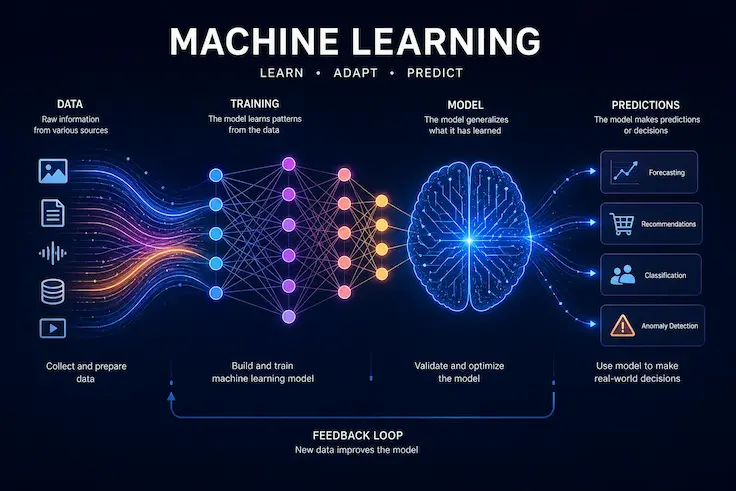
The process usually begins with collecting and preparing relevant data. For example, a spam filter may be trained using emails labelled as spam or legitimate messages. A voice assistant may use speech and language data to recognize spoken commands.
Next, the AI model learns patterns from the available examples. During training, its parameters are adjusted to improve performance on the task. Developers then evaluate the model using data it has not seen during training to determine how accurately it handles new inputs.
Once tested, the model can be integrated into an application. When a new email arrives, for instance, the system analyses its characteristics and estimates whether it is likely to be spam.
Some Narrow AI systems use predefined rules rather than machine learning, while others combine rules with learned models. Their decision-making methods depend on the task and system design.
Some models can be improved through retraining, updated data, or feedback. Others remain largely unchanged after deployment. These improvements do not automatically give Narrow AI general intelligence.
Understanding this process helps explain why these systems can perform specific tasks effectively while still struggling with unfamiliar problems.
2. What Are the Main Characteristics of Narrow AI?
The main characteristics of Narrow AI include task-specific design, dependence on data or predefined rules, specialized performance, and limited generalization beyond its intended purpose. These characteristics explain both its practical value and its limitations.
Task-specific design is one of its defining features. An AI system may be built to recognize faces, translate languages, recommend products, or detect fraudulent transactions. Its capabilities depend on the task it was designed or trained to perform.
Data dependence is another important characteristic. Machine learning systems rely on relevant training data to identify useful patterns. If the data is inaccurate, incomplete, outdated, or biased, the system’s results may be less reliable.
Narrow AI can also process large amounts of information quickly. A fraud detection model, for example, can examine numerous transactions and flag suspicious activity much faster than manual review alone.
However, its ability to adapt to unfamiliar situations is limited by its design, training, and available information. Some models can handle several related tasks, but this does not mean they can perform every intellectual task a human can.
Another important characteristic is the absence of established human-like consciousness. Producing convincing language or making accurate predictions does not demonstrate that an AI system has subjective experiences, emotions, or self-awareness.
These characteristics make Narrow AI useful for specialized work, but its results still require evaluation. The next section explores the different forms it takes in real-world applications.
3. What Are the Different Examples of Narrow AI?
Common examples of Narrow AI include recommendation systems, virtual assistants, spam filters, facial recognition tools, navigation applications, fraud detection models, and specialized chatbots. Each performs a defined task or a limited set of related tasks.

Virtual assistants such as Siri and Google Assistant can process spoken commands, answer questions, and perform supported actions. Their capabilities depend on the underlying models, connected services, and available features.
Recommendation systems used by Netflix, YouTube, and online retailers analyse signals such as viewing history, searches, ratings, or purchases to suggest relevant content and products. Their predictions help personalize the user experience.
Computer vision systems can recognize objects, identify visual patterns, inspect manufactured products, and assist with medical image analysis. Their accuracy depends on factors such as image quality, training data, and the specific task.
Navigation applications analyse map information, traffic conditions, and estimated travel times to recommend routes. Banking systems use specialized models to identify potentially fraudulent transactions, while email filters classify incoming messages.
Game-playing systems provide another useful example. IBM’s Deep Blue defeated chess champion Garry Kasparov in 1997, while DeepMind’s AlphaGo defeated Go champion Lee Sedol in 2016. Both demonstrated impressive performance within their respective games.
Generative AI tools can also fall within the broad category of Narrow AI. A system may generate text, images, or code across several related tasks without possessing general human-level intelligence.
Although these applications differ considerably in complexity, they share a central feature: their capabilities are determined by their design and the tasks they can perform.
4. How Is Narrow AI Used in Everyday Life?
Narrow AI is used in everyday life through smartphones, streaming platforms, email services, online shopping, navigation applications, banking systems, and smart home devices. Many people interact with AI-powered features throughout the day without noticing them.
When you type a message on your phone, predictive text may suggest the next word or correct a spelling mistake. Your camera may automatically adjust exposure, recognize a scene, or improve an image using AI-based processing.
Streaming platforms recommend films and television shows based on your viewing behaviour and other relevant signals. Online shopping websites suggest products that may interest you, while music applications create personalized playlists.
Navigation applications estimate arrival times, identify traffic patterns, and recommend alternative routes. Ride-hailing services may use AI models to estimate demand, match passengers with drivers, and support pricing decisions.
In banking, automated systems can flag unusual card transactions and alert customers to possible fraud. Email services use classification models to filter spam and identify potentially dangerous messages.
AI-powered language applications can adjust exercises based on a learner’s performance. Translation tools can convert text between languages, and some camera applications can recognize written text in photographs.
Smart home devices may use AI to recognize voice commands, detect activity, or support energy management. Wearable devices can also analyse patterns in activity and other sensor data, although their measurements should not automatically be treated as medical diagnoses.
These examples show how specialized AI can make routine activities faster and more convenient. Similar capabilities also help organizations improve their operations, which brings us to business applications.
5. How Do Businesses Use Narrow AI?
Businesses use Narrow AI to automate repetitive processes, analyse customer behaviour, detect risks, forecast demand, and support operational decisions. Companies often adopt these systems to address clearly defined problems and improve measurable business outcomes.

Customer service is one common application. AI chatbots can answer frequently asked questions, provide order updates, and direct complicated requests to human agents. This can reduce waiting times while allowing employees to focus on cases requiring judgment.
Marketing and sales teams use AI models to identify customer segments, prioritize leads, personalize campaigns, and predict purchasing behaviour. For example, an online retailer may use past purchasing patterns to recommend products to relevant customers.
Operations teams can apply AI to inventory planning, demand forecasting, route optimization, and predictive maintenance. A manufacturer may analyse equipment sensor data to identify patterns associated with potential failures before a breakdown occurs.
Financial institutions use specialized AI for fraud detection, transaction monitoring, and risk assessment. These systems can highlight unusual patterns for further investigation, although their outputs should not automatically determine every high-impact decision.
Human resources departments may use software to organize applications, schedule interviews, or match candidate information against job requirements. Such systems need appropriate oversight because biased data or poorly designed criteria can produce unfair outcomes.
Document-processing tools can also extract information from invoices, forms, and other business records, reducing manual data entry.
The best results usually come from matching the AI system to a clearly defined business objective, using appropriate data, and monitoring performance over time. Human oversight is especially important when decisions affect employment, finances, or customer rights.
6. How Does Narrow AI Use Machine Learning?
Machine Learning (ML) is one of the main approaches used to build Narrow AI systems. It allows a model to learn patterns from data and apply them to new examples instead of relying entirely on rules written by programmers.
Developers begin by identifying the problem and collecting relevant data. They then choose an appropriate learning method, train the model, and evaluate its performance. The model can subsequently be integrated into an application that uses its predictions or classifications.
Several machine learning approaches are commonly used in Narrow AI.
Supervised learning uses labelled examples. A spam filter, for instance, can learn from emails labelled as spam or legitimate messages. A model trained on labelled images can learn to classify objects in new photographs.
Unsupervised learning works with data that does not have predefined labels. It can identify patterns, similarities, or groups within a dataset. Businesses may use this approach to discover customer segments based on purchasing behaviour.
Reinforcement learning involves an agent learning through interactions with an environment and feedback about its actions. It can be used in game-playing systems, robotics, and certain optimization problems.
Deep learning is a specialized branch of machine learning that uses neural networks with multiple layers. It is particularly useful for tasks involving complex patterns in images, speech, and language.
Not every Narrow AI system uses machine learning. Some rely on predefined rules, while others combine rules with learned models.
Machine learning can make specialized systems more capable, but its effectiveness depends on the task, data, and training process. It does not automatically provide general intelligence or the ability to solve unrelated problems.
7. What Is the Difference Between Narrow AI and General AI?
The main difference between Narrow AI and Artificial General Intelligence (AGI) is the breadth of tasks a system can handle and how flexibly it can apply knowledge to unfamiliar problems.
Narrow AI is designed for a specific task or a limited range of related tasks. AGI, by contrast, is a theoretical concept describing AI that could learn, reason, and apply knowledge across a broad range of intellectual activities at a level comparable to human intelligence.
Consider a translation application. It may translate many languages accurately, but that capability alone does not mean it can independently learn accounting, plan a complex business, diagnose equipment failures, and adapt to all those tasks as a person might.
The distinction can be summarized through these differences:
- Task range: Narrow AI focuses on defined tasks, while AGI would be expected to handle a much broader range of intellectual problems.
- Knowledge transfer: Narrow AI may have limited transfer between tasks; AGI would be expected to apply knowledge flexibly across different domains.
- Adaptability: Narrow AI’s ability to handle unfamiliar situations depends on its design and training, whereas AGI would require broader adaptability.
- Status: Narrow AI is widely deployed, while AGI remains a debated research goal without an established demonstration of human-level general intelligence across domains.
Modern AI models can perform many different tasks, so the boundary is not always as simple as one application versus one task. However, broad capabilities alone do not establish that a system has achieved AGI.
Understanding this distinction helps explain why impressive AI performance should not automatically be confused with general human-like intelligence.
8. What Is the Difference Between Narrow AI and Generative AI?
Narrow AI describes the scope of an AI system, while Generative AI describes systems designed to create new content, such as text, images, audio, video, or code. These categories overlap rather than exclude each other.
A traditional classification model may identify whether an email is spam, estimate the risk of a financial transaction, or recommend a product. Its output is often a label, score, prediction, or recommendation.
A generative model, on the other hand, can produce a draft email, create an image from a prompt, summarize a document, or generate computer code. It learns patterns from training data and uses them to produce content in response to an input.
Generative AI systems can support several tasks within one model. For example, a language model may answer questions, summarize text, translate passages, and draft reports. However, this flexibility does not prove that the model has general human-like intelligence or that its outputs are always accurate.
Many generative AI systems use deep learning architectures, including transformers, while image-generation systems may use diffusion models or other approaches. Narrow AI applications can use these same technologies when they are designed for specific purposes.
Businesses can combine both approaches. A customer service workflow might use a classification model to identify the type of customer request and a generative model to draft an appropriate response.
The key distinction is that Narrow AI concerns the range of capabilities a system has, whereas Generative AI concerns its ability to create content. A generative model can still be a specialized AI system.
9. What Are the Benefits of Narrow AI?
The main benefits of Narrow AI include automation, speed, scalability, pattern recognition, and support for data-driven decisions. When a system is well designed for a clearly defined task, it can help people complete work more efficiently.

Efficiency and speed are major advantages. AI systems can process large volumes of information rapidly, making them useful for email classification, document processing, transaction monitoring, and customer support.
Consistency is another potential benefit. An automated system can apply the same procedure repeatedly without fatigue. However, consistent processing does not guarantee correct results; performance still depends on the model, input data, and operating conditions.
Cost management can improve when AI reduces manual work, prevents avoidable errors, or helps organizations use resources more effectively. The overall financial benefit depends on implementation costs, maintenance, and the value created.
Scalability allows some AI services to handle increasing volumes of requests without a proportional increase in manual effort. Businesses can use this capability to support customers, analyse records, or process routine transactions.
Narrow AI can also identify patterns that are difficult to detect through manual analysis alone. For example, a model may help flag unusual transactions or forecast changes in product demand.
In healthcare, appropriately validated AI tools can assist with selected image-analysis and administrative tasks. In manufacturing, AI-powered inspection systems can help identify defects.
These benefits are strongest when the system is evaluated against a clear objective and monitored after deployment. AI should support appropriate human judgment rather than replace it automatically in every situation.
10. What Are the Limitations of Narrow AI?
Despite its advantages, Narrow AI has important limitations. Its performance depends on its design, training data, operating conditions, and the problem it is intended to solve.
One limitation is restricted generalization. A system trained for one task may perform poorly when given unfamiliar inputs or asked to solve a substantially different problem. Its ability to handle related tasks depends on the capabilities built into the model.
Data quality can also affect reliability. If training examples are incomplete, inaccurate, outdated, or unrepresentative, a model may produce misleading results. Changes in real-world conditions can further reduce its accuracy.
Another limitation is the lack of established human-like understanding and consciousness. An AI system may generate convincing explanations or recognize patterns without demonstrating that it understands the world as a person does.
Some models are also difficult to interpret. Deep learning systems can contain many parameters, making it challenging to explain exactly why a particular output was produced.
Limited judgment is another concern. An AI system may optimize a predefined objective without adequately accounting for broader consequences. If the objective is poorly chosen, the result can be technically successful but practically harmful.
Narrow AI systems also require maintenance. Developers may need to update models when data patterns change or new risks emerge.
These limitations do not make Narrow AI ineffective. They mean that systems need appropriate testing, monitoring, safeguards, and human oversight, especially in areas involving health, finances, employment, and safety.
11. How Does Narrow AI Make Decisions?
Narrow AI makes decisions by applying predefined rules, learned patterns, or optimization methods to available information. Depending on the application, it may produce a classification, probability estimate, recommendation, or action.
A rule-based system follows conditions written by developers. For example, a basic security system may flag an event when a specified condition is met. Rule-based systems can be relatively easy to inspect, but they may struggle when situations become more complex than the rules anticipate.
Machine learning systems take a different approach. They use patterns learned during training to estimate likely outcomes. A fraud detection model, for example, may assign a risk score to a transaction based on characteristics associated with previous fraudulent or legitimate activity.
Developers or organizations then determine how those scores should be used. A high score might trigger further investigation, while a lower score might allow the transaction to proceed. The appropriate threshold depends on the application’s risks and costs.
Some AI systems use optimization methods to select an option that best meets a defined objective. A navigation application might compare routes using predicted travel times, road conditions, and other relevant information.
In each case, the system’s output depends on its model, available information, and decision criteria. It does not automatically understand every consequence of its recommendation.
This is why human review can be essential for high-impact decisions. Doctors, financial professionals, and managers may use AI outputs as supporting evidence while considering additional context before reaching a final decision.
12. What Industries Use Narrow AI?
Narrow AI is used across healthcare, finance, retail, manufacturing, transportation, education, agriculture, entertainment, and cybersecurity. These industries often have repeatable tasks, substantial data, or specific problems that can benefit from automated analysis.
The following examples show how its applications differ by industry:
- Healthcare: AI can support medical image analysis, appointment scheduling, and selected administrative tasks. Clinical decisions require appropriate professional judgment and validation.
- Finance: Banks use AI systems to flag suspicious transactions, monitor risks, and support customer service.
- Retail and e-commerce: Businesses use recommendation engines, demand forecasting, and inventory planning to improve operations.
- Manufacturing: Computer vision systems can inspect products, while predictive maintenance models analyse equipment data to identify possible failures.
- Transportation: Navigation and logistics systems use AI to estimate travel times, optimize routes, and support certain driver-assistance functions.
- Education: Learning platforms can adapt exercises to student performance, while software can assist teachers with selected routine tasks.
- Agriculture: AI can analyse images and sensor readings to support crop monitoring, irrigation planning, and the identification of potential plant problems.
- Entertainment: Streaming and gaming platforms use AI for content recommendations, personalization, and selected moderation tasks.
- Cybersecurity: AI models can analyse network activity and flag suspicious behaviour for investigation.
- Energy and telecommunications: AI can support demand forecasting, network monitoring, and the identification of potential service disruptions.
These applications demonstrate that Narrow AI is not limited to one industry. Its usefulness depends on whether the problem can be addressed effectively with available data and suitable methods.
Successful implementation also requires attention to privacy, reliability, cost, and the consequences of incorrect predictions.
13. What Are the Challenges of Using Narrow AI?
Organizations adopting Narrow AI face several challenges, including data quality, algorithmic bias, privacy risks, implementation costs, integration problems, and ongoing maintenance. Solving these issues is essential for responsible and reliable use.
Data collection and quality can be difficult. Training a model may require large quantities of relevant data and preparing that data can take considerable time. Smaller organizations may not have enough high-quality examples to build a reliable system.
Bias and fairness are also important concerns. If historical data reflects unfair treatment or underrepresents certain groups, an AI model may reproduce those patterns. Organizations need appropriate testing and ongoing evaluation to identify these problems.
Privacy and security require careful attention when AI systems process personal, financial, or medical information. Businesses should use suitable access controls, data protection measures, and practices that comply with applicable laws.
Costs and technical expertise can present additional barriers. Developing, testing, deploying, and maintaining an AI system may require specialist skills and computing resources. For some businesses, an existing commercial tool may be more practical than developing a custom model.
Integration with existing systems can also be challenging. An AI tool must work with current software, business processes, and employee responsibilities to provide real value.
Finally, organizations need clear accountability. They should establish who reviews important decisions, how errors are handled, and when human intervention is required.
Addressing these challenges takes planning and continuous monitoring. Responsible implementation helps organizations obtain the benefits of Narrow AI while reducing avoidable risks.
14. What Is the Future of Narrow AI?
The future of Narrow AI is likely to involve more specialized applications, improved performance, easier access to AI tools, and closer collaboration between people and automated systems.

One expected development is broader adoption by smaller organizations. As AI tools become easier to integrate into existing software, businesses with limited technical resources may be able to use AI for customer support, document processing, inventory management, and other routine tasks.
Another development is the growth of on-device AI, sometimes associated with edge computing. Some AI tasks can be performed directly on smartphones, computers, vehicles, or other devices. Depending on the application, this can reduce response times and limit the need to send information to remote servers.
Specialized AI tools may also become more common in areas such as agriculture, manufacturing, scientific research, and healthcare. Their effectiveness will depend on the quality of their data, the reliability of their methods, and how carefully they are evaluated.
Greater attention is also being paid to transparency, privacy, fairness, safety, and accountability. Organizations will need to assess not only whether a system performs well, but also whether it is appropriate for the decisions it supports.
Human-AI collaboration will remain important. Narrow AI can help process information and automate repetitive tasks, while people contribute contextual judgment, responsibility, interpersonal understanding, and oversight.
Whether progress in Narrow AI will lead to AGI remains uncertain. For now, many practical advances focus on making specialized AI systems more reliable, useful, and accessible.
15. How Can Businesses Choose the Right Narrow AI Tool?
Businesses should choose a Narrow AI tool by identifying a specific problem, defining measurable goals, evaluating available data, and comparing the expected benefits with the costs and risks.
The first step is to identify a task that would benefit from automation or improved analysis. Examples include responding to routine customer questions, classifying documents, forecasting product demand, or flagging suspicious transactions.
Next, define what success looks like. A business might measure reduced processing time, fewer classification errors, improved forecast accuracy, or faster customer response times. Clear metrics make it easier to determine whether the tool provides genuine value.
Data readiness is equally important. Businesses should assess whether they have relevant, accurate, and appropriately managed data. A tool cannot reliably compensate for every problem caused by missing or poor-quality information.
The organization should then compare potential solutions based on performance, ease of use, integration requirements, privacy protections, support, and total cost. A ready-made service may be sufficient for a common task, while a specialized application may require a more tailored approach.
Before full deployment, test the system in realistic conditions. Monitor incorrect outputs, evaluate performance across relevant user groups, and establish procedures for handling failures.
Finally, determine where human review is necessary. High-impact decisions should have appropriate safeguards, clear accountability, and a way to challenge or correct errors.
Choosing AI carefully helps businesses avoid adopting technology simply because it is popular. The objective is to solve a real problem and improve outcomes in a measurable, responsible way.
Conclusion
Narrow AI is the most widely deployed category of artificial intelligence, powering applications such as recommendation systems, spam filters, virtual assistants, fraud detection, and computer vision tools. Its defining feature is its specialized scope: it is designed to perform particular tasks rather than demonstrate general human-like intelligence across every domain.
Understanding how Narrow AI works helps explain both its value and its limitations. Machine learning, predefined rules, and other computational methods allow specialized systems to process data, identify patterns, and produce useful outputs. Businesses and individuals can benefit from these capabilities through automation, improved efficiency, and data-driven decision support.
However, Narrow AI is not infallible. Its results depend on the quality of its data, the design of its model, and the circumstances in which it operates. Bias, privacy risks, limited generalization, and incorrect outputs require careful attention.
As AI technology develops, specialized systems will continue to create opportunities across industries. The most effective approach is to use them for clearly defined purposes, evaluate their performance, and maintain appropriate human oversight.
By understanding what Narrow AI can and cannot do, readers and businesses can make better-informed decisions about using artificial intelligence in everyday life and professional settings.
Frequently Asked Questions (FAQs)
1. What is Narrow AI in simple words?
Narrow AI is a type of artificial intelligence designed to perform a specific task or a limited range of related tasks. Examples include spam filters, recommendation systems, voice assistants, and facial recognition tools.
2. What are some examples of Narrow AI?
Common examples of Narrow AI include Netflix recommendations, Google Maps route suggestions, email spam filters, virtual assistants, banking fraud detection systems, and AI-powered image recognition tools.
3. What is the difference between Narrow AI and General AI?
Narrow AI focuses on specific tasks, while Artificial General Intelligence (AGI) refers to a theoretical form of AI that could learn and perform a broad range of intellectual tasks at a human-like level. Narrow AI is widely used today, whereas AGI has not been established as an achieved capability.
4. What are the main benefits of Narrow AI?
The main benefits of Narrow AI include automating repetitive tasks, processing large amounts of data quickly, identifying patterns, supporting decision-making, and improving operational efficiency. Its actual performance depends on the quality of the system and the task.
5. What are the limitations of Narrow AI?
Narrow AI can struggle with unfamiliar situations, depends on suitable data or predefined rules, and may produce inaccurate or biased results. It does not automatically possess general intelligence or human-like understanding, so appropriate testing and human oversight remain important.