

Digital marketing channels help businesses connect with potential customers through online platforms, search engines, websites, email, social media, and other digital touchpoints. They allow brands to promote products, share useful information, generate leads, increase sales, and build long-term customer relationships.
But what are digital marketing channels, and which ones should a business use?
Digital marketing channels are the online platforms, and communication methods businesses use to reach, engage, and convert their target audiences. Some channels, such as search engine optimization (SEO), focus on attracting organic traffic, while others, such as pay-per-click advertising (PPC), help businesses reach potential customers through paid campaigns.
The right channel depends on your business goals, target audience, budget, industry, and customer journey. A small business might prioritize local SEO and social media, while an ecommerce company may combine paid advertising, email marketing, influencer partnerships, and content marketing.
In this guide, you will learn about the main types of digital marketing channels, real-world examples, the differences between owned, paid, and earned media, and how to choose and measure the channels that work best for your business.
How Do Digital Marketing Channels Work?
Digital marketing channels connect businesses with audiences at different stages of the customer journey.
A typical journey might look like this:
- Awareness: A potential customer discovers a brand through a social media post, search result, video, or online advertisement.
- Consideration: The customer visits the website, reads a blog post, watches a product demonstration, or compares available solutions.
- Conversion: The customer purchases a product, books a consultation, subscribes to a service, or submits a lead form.
- Retention: The business uses email marketing, helpful content, loyalty programs, or personalized communication to encourage repeat purchases.
- Advocacy: Satisfied customers recommend the business, leave reviews, or share their experiences with others.
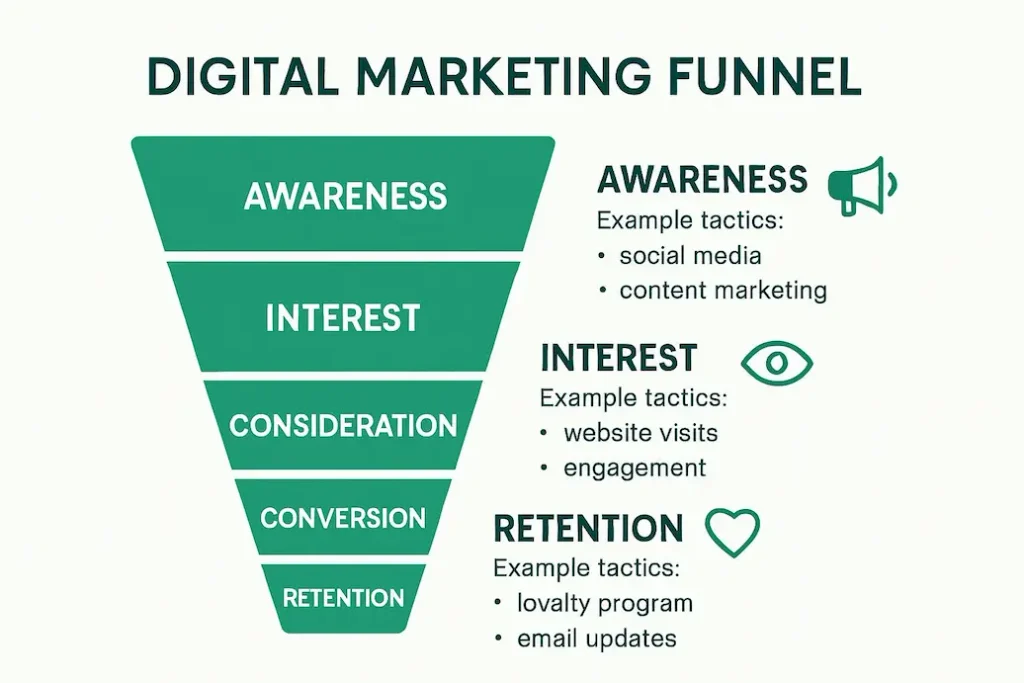
Not every customer follows this journey in the same order. Someone might purchase immediately after clicking an advertisement, while another person may interact with several channels before planning.
Digital Marketing Channels vs. Digital Marketing Strategies
A digital marketing channel is the medium through which a business reaches its audience. A digital marketing strategy is the broader plan that determines which audiences to target, what goals to achieve, what messages to communicate, and how to allocate resources.
For example, email is a digital marketing channel. Sending a welcome email series to new subscribers is a tactic, while using email automation to increase customer retention is part of a strategy.
Understanding this difference helps businesses choose channels based on their objectives instead of using platforms simply because they are popular.
2. Why Are Digital Marketing Channels Important?
Digital marketing channels are important because they help businesses reach potential customers, communicate value, and measure marketing performance. Instead of relying on a single source of traffic or sales, businesses can use different channels to create multiple opportunities for customer acquisition and retention.
Here are the main benefits of digital marketing channels.
Increase Brand Awareness
Digital channels make it easier for businesses to introduce their brands to relevant audiences. Search engines help people discover solutions, social media exposes users to products and services, and video platforms allow brands to demonstrate their expertise.
Consistent messaging across relevant channels can improve recognition and help customers become familiar with a business before they are ready to purchase.
Reach the Right Audience
Different channels attract people with different interests and intentions. Someone searching for a specific product may be closer to making a purchase than someone casually browsing social media.
SEO and search advertising can help businesses reach people actively looking for information or solutions. Social media advertising can target audiences using available demographic, interest, and behavioural criteria, subject to platform policies and privacy restrictions.
Generate Leads and Increase Sales
Businesses can use digital marketing channels to attract visitors and guide them toward meaningful actions. These actions may include requesting a quote, downloading a resource, booking a consultation, subscribing to a newsletter, or purchasing a product.
For example, a software company might publish educational blog posts to attract organic traffic and offer a free product demonstration to convert interested visitors into sales leads.
Build Customer Relationships
Marketing does not end when someone makes a purchase. Email newsletters, helpful social media content, customer education, and loyalty campaigns help businesses maintain relationships with existing customers.
These interactions can encourage repeat purchases, improve customer experience, and create opportunities for referrals.
Measure and Improve Performance
Many digital channels provide data about traffic, engagement, clicks, leads, and conversions. Businesses can use these insights to understand which activities contribute to their goals.
However, collecting data is only useful when the right metrics are selected and tracked consistently. A campaign that generates many clicks, but few qualified leads may require a different approach from one that attracts fewer visitors but produces more sales.
3. What Are the Main Types of Digital Marketing Channels?
There are several types of digital marketing channels, and each offers different ways to reach customers. The most suitable options depend on audience behavior, business objectives, available resources, and the time required to achieve results.

1. Search Engine Optimization (SEO)
Search engine optimization is the process of improving a website and its content so that relevant pages can appear more prominently in organic search results.
SEO helps businesses attract people who are actively searching for information, products, services, or solutions. Unlike paid advertising, organic search visibility does not require a payment for every click, although SEO requires time, expertise, content development, and ongoing maintenance.
Common SEO activities include:
- Keyword research to understand what people search for.
- Creating helpful, relevant, and original content.
- Improving page titles, headings, internal links, and website structure.
- Making websites accessible, mobile-friendly, and technically sound.
- Earning relevant links and building a trustworthy online presence.
For example, a digital marketing agency might publish a detailed guide about local SEO. When someone searches for local SEO services or advice, that guide may attract relevant visitors who later explore the agency’s services.
SEO is particularly useful for businesses that want to build long-term organic visibility and answer customer questions. However, rankings and traffic are not guaranteed, and results may take time.
For practical guidance, consult Google’s official SEO Starter Guide, which explains how to create useful, search-friendly content and improve website discoverability.
2. Pay-Per-Click Advertising (PPC)
Pay-per-click advertising is a form of paid digital marketing in which advertisers typically pay when users click on their ads. PPC campaigns can appear on search engines, social media platforms, websites, and other advertising networks.
Search advertising is especially useful for reaching people who are actively looking for a particular product or service.
For example, a plumbing company could run search ads for emergency plumbing services in its service area. When someone searches for an available plumber, the advertisement may direct them to a landing page with service details and contact information.

Common PPC channels include:
- Google Search Ads.
- Microsoft Advertising search campaigns.
- Paid social media campaigns.
- Display advertising networks.
- Shopping advertisements for eligible products.
PPC can generate traffic relatively quickly once a campaign is approved and launched. Businesses can also adjust targeting, budgets, advertisements, and landing pages based on performance.
However, advertising costs can increase in competitive markets, and traffic may decline when campaigns stop. Successful PPC requires careful budget management, relevant landing pages, conversion tracking, and ongoing optimization.
PPC is often a good choice when a business needs faster exposure, wants to test demand, or has a clear offer that can convert paid traffic into profitable sales.
3. Social Media Marketing
Social media marketing uses platforms such as Facebook, Instagram, LinkedIn, TikTok, and Pinterest to distribute content, engage audiences, promote products, and build communities.
Businesses can use organic social media posts, short-form videos, live sessions, stories, and paid campaigns to communicate with potential customers.

For example, a clothing brand might share outfit inspiration on Instagram, publish styling videos on TikTok, and use Facebook campaigns to promote a seasonal collection.
Social media marketing offers several benefits:
- Builds brand recognition and audience relationships.
- Provides opportunities for direct customer interaction.
- Encourages sharing, discussion, and community participation.
- Supports product discovery and promotional campaigns.
- Helps businesses test messages and creative ideas.
The best platform depends on where the target audience spends time and how it prefers to consume content. LinkedIn may be appropriate for business-to-business services, while Instagram or TikTok may be more relevant for visually appealing consumer products.
Social media also has limitations. Organic reach can fluctuate, platform algorithms change, and maintaining multiple active profiles requires time and resources.
Businesses should focus on platforms that support their goals rather than trying to maintain a presence everywhere.
4. Content Marketing
Content marketing involves creating and distributing useful, relevant content to attract a clearly defined audience and encourage profitable customer actions.
Unlike promotional messages that focus primarily on selling, content marketing provides information that helps people understand problems, compare options, and make informed decisions.
Common content marketing formats include:
- Blog posts and educational articles.
- Guides, eBooks, and downloadable resources.
- Case studies and customer success stories.
- Infographics and original research.
- Webinars, tutorials, and product demonstrations.
- Videos and podcasts.
For example, a company selling accounting software might publish articles about invoicing, expense management, and tax preparation. These resources can attract people researching financial processes and introduce them to the company’s solutions.
Content marketing often works alongside SEO, email marketing, and social media. A single article can attract organic search traffic, be shared on social platforms, and be distributed through an email newsletter.
Its main advantage is that useful content can continue helping customers after publication. However, producing high-quality content requires research, planning, subject knowledge, and regular updates.
The objective should be to answer genuine audience questions rather than publishing large quantities of content without a clear purpose.
5. Email Marketing
Email marketing uses email to communicate with subscribers, nurture leads, announce offers, share information, and maintain customer relationships.
It is especially useful for businesses that want to maintain a direct communication channel with people who have chosen to receive their messages.
Common email marketing campaigns include:
- Welcome emails for new subscribers.
- Educational newsletters.
- Product announcements and promotions.
- Abandoned-cart reminders where permitted.
- Customer onboarding sequences.
- Re-engagement and retention campaigns.
For example, an online store might send a welcome email explaining its products, follow up with helpful product information, and later share relevant offers with subscribers who have consented to receive marketing messages.
Email marketing can be valuable because businesses can segment subscribers according to relevant preferences, purchase history, and interactions, provided they handle personal data appropriately.
Important metrics include delivery rate, click-through rate, unsubscribe rate, conversion rate, and revenue attributable to campaigns.
Email is not automatically effective simply because a business has a large list. Results depend on list quality, message relevance, timing, deliverability, and the value offered to subscribers.
Businesses should use permission-based practices and comply with applicable privacy and email marketing laws.
6. Affiliate Marketing
Affiliate marketing is a performance-based marketing arrangement in which publishers, creators, or other partners promote a business’s products or services in exchange for an agreed commission or other compensation.
Affiliates may use websites, blogs, product comparison pages, videos, newsletters, or social media to introduce products to relevant audiences.
For example, a technology retailer could partner with a product review website. When readers follow a tracked link and complete an eligible purchase, the publisher may earn a commission under the affiliate agreement.
Affiliate marketing can help businesses expand their reach through partners who already have established audiences.
Its benefits include:
- Access to audiences beyond the company’s existing reach.
- Compensation structures linked to agreed performance outcomes.
- Opportunities to work with specialist publishers.
- Additional referral traffic and sales opportunities.
However, affiliate programs require clear commission terms, reliable tracking, quality control, and compliance monitoring. Poor-quality affiliates can generate misleading claims or irrelevant traffic.
Businesses should also ensure that affiliate relationships are disclosed appropriately and that promotional content follows applicable advertising rules.
7. Influencer Marketing
Influencer marketing involves collaborating with content creators who have an audience relevant to a brand’s products or services.
Influencers may promote products through sponsored posts, tutorials, product demonstrations, reviews, livestreams, or other content formats.
For example, a skincare brand might collaborate with a beauty creator to demonstrate how to use a product and explain its intended benefits.
Influencer marketing can be effective when a creator has a relevant audience, communicates authentically, and produces content that aligns with the brand.
Businesses should evaluate more than follower counts. Relevant considerations include audience fit, engagement quality, content quality, credibility, campaign objectives, and the creator’s track record.
Potential limitations include high collaboration costs, inconsistent campaign performance, fake engagement, and reputational risk.
Clear agreements should establish deliverables, usage rights, compensation, deadlines, and disclosure requirements. Brands should also avoid unsupported product claims and assess whether the creator’s audience matches their intended customers.
8. Video Marketing
Video marketing uses video content to educate audiences, demonstrate products, tell brand stories, and support customer acquisition.
Businesses can distribute videos through YouTube, social media platforms, their own websites, webinars, and other digital channels.
Common video formats include:
- Tutorials and educational videos.
- Product demonstrations.
- Customer testimonials.
- Explainer videos.
- Short-form social media videos.
- Webinars and recorded presentations.
For example, a software company might publish a tutorial showing how to use a specific feature. Potential customers can discover the video through search, learn how the software works, and visit the company’s website for additional information.
Video can communicate complex information in an accessible format and demonstrate how a product works. It can also support other channels when videos are embedded in blog posts, landing pages, or email campaigns.
However, video production can require equipment, editing skills, planning, and ongoing effort. A video also needs a clear purpose and distribution plan to reach the intended audience.
Businesses should measure performance using relevant indicators such as qualified views, watch time, engagement, referral traffic, leads, and conversions rather than views alone.
4. What Are Owned, Paid, and Earned Media Channels?
Digital marketing channels can also be classified into three categories: owned media, paid media, and earned media. This classification helps businesses understand which channels they control, which require advertising expenditure, and which depend on recognition or recommendations from others.

Owned Media Channels
Owned media includes digital properties and communication channels that a business controls. Examples include its website, blog, email newsletter, and customer resource library.
Businesses use owned media to publish information, communicate with subscribers, and create consistent customer experiences.
For example, a company can publish educational articles on its website and invite readers to subscribe to an email newsletter. It can then share additional resources with subscribers who have agreed to receive those messages.
Owned media offers greater control over content and messaging than most third-party platforms. However, ownership does not guarantee traffic or reach. Businesses still need effective distribution, relevant content, and ongoing maintenance.
Paid Media Channels
Paid media includes digital placements for which a business pays to reach an audience. Common examples include search ads, sponsored social media posts, display advertisements, and paid influencer collaborations.
For example, an ecommerce business might pay to promote a new product to a relevant audience while also investing in SEO to build organic visibility over time.
Paid media can provide greater control over campaign timing, targeting options, and budget allocation. Its performance depends on factors such as competition, advertising quality, audience relevance, and landing-page experience.
Earned Media Channels
Earned media refers to exposure a business receives through third-party mentions, recommendations, editorial coverage, reviews, and organic sharing rather than directly purchasing the placement.
For example, a customer might recommend a product in an online community, or an industry publication might reference a company’s original research in an article.
Earned media can strengthen credibility because the recognition comes from an external source. However, businesses cannot fully control whether others mention them or what those sources say.
How to Combine Owned, Paid, and Earned Media
These three categories work best when they support one another.
Consider a company launching a new service. It publishes an in-depth guide on its website, promotes the guide through paid advertising, and shares useful insights on social media. If readers find the information valuable, some may recommend it or reference it in their own content.
This approach allows businesses to use paid promotion for distribution, owned channels for deeper engagement, and earned exposure to expand reach.
5. What Are Some Examples of Digital Marketing Channels?
Examples make it easier to understand how digital marketing channels operate in real business situations. Although channels can be used independently, businesses often combine them to guide customers from discovery to purchase.
The following table compares common channels and their primary uses.
| Digital marketing channel | Main purpose | Example |
| SEO | Attract organic search traffic | Publishing an article answering a customer question |
| PPC advertising | Reach audiences through paid placements | Running search ads for a service |
| Social media marketing | Build awareness and engagement | Sharing product demonstrations on Instagram |
| Content marketing | Educate and inform potential customers | Publishing a practical industry guide |
| Email marketing | Nurture leads and retains customers | Sending a useful subscriber newsletter |
| Affiliate marketing | Generate partner referrals | Paying a commission on eligible sales |
| Influencer marketing | Reach an established creator audience | Sponsoring a relevant product demonstration |
| Video marketing | Explain products and engage viewers | Publishing a tutorial on YouTube |
| Display advertising | Build awareness and support remarketing | Showing banner ads to relevant audiences |
| SMS marketing | Send timely customer communications | Sending an opted-in customer an appointment reminder |
Example: Digital Marketing Channels for an Online Store
Imagine a business selling fitness equipment online. It wants to increase product sales and build a recognizable brand.
The business could use SEO to attract people searching for equipment comparisons, social media to demonstrate products, and video marketing to explain how the equipment works. Paid advertising could promote selected products, while email campaigns could share useful information and relevant offers with subscribers.
The business might also collaborate with fitness creators or affiliate publishers to reach new audiences.
Each channel contributes differently. SEO can support long-term discovery, paid advertising can generate targeted exposure, video can demonstrate product value, and email can support repeat purchases.
The important point is that using more channels does not automatically produce better results. Each channel should have a defined purpose and a way to measure its contribution.
Example: Digital Marketing Channels for a Service Business
A consulting firm could publish articles addressing common client problems, use LinkedIn to share professional insights, and offer a downloadable guide to generate leads.
It could then use permission-based email communication to nurture interested prospects and paid search advertising to reach people actively looking for consulting services.
This combination helps the business attract relevant visitors, demonstrate expertise, and encourage potential customers to book a consultation.
6. How Do You Choose the Right Digital Marketing Channels?
Choosing digital marketing channels requires understanding your audience, business objectives, budget, and available resources. Instead of investing in every popular platform, start with the channels most likely to reach your target customers and support your goals.
Identify Your Target Audience
Begin by identifying the people most likely to purchase your products or services.
Consider their needs, interests, location, buying behavior, preferred platforms, and the questions they ask before making a decision.
For example, a business selling professional software might prioritize search engines, LinkedIn, educational content, and webinars. A fashion retailer might place greater emphasis on visual social media, influencer partnerships, and ecommerce email campaigns.
Audience research should guide channel selection rather than assumptions about which platforms are popular.
Define Your Marketing Goals
Different channels support different objectives. Choose your channels according to the outcome you want to achieve.
- Brand awareness: Consider video marketing, social media, display advertising, and relevant public relations.
- Organic traffic: Focus on SEO and useful content.
- Lead generation: Consider search advertising, landing pages, webinars, and downloadable resources.
- Online sales: Evaluate PPC, product-focused content, email marketing, and affiliate partnerships.
- Customer retention: Prioritize email communication, customer education, and loyalty initiatives.
One channel can support multiple goals, but each campaign should have a clear primary objective.
Set Your Budget
Your budget should include more than advertising expenditure. Consider content production, software subscriptions, staff time, creative development, analytics, and ongoing maintenance.
SEO may avoid direct payment for each organic click, but it still requires resources. Paid advertising can generate traffic quickly, but it requires ongoing spending and careful monitoring.
Choose a sustainable budget that allows you to test your approach without putting unnecessary pressure on your business.
Evaluate Your Resources and Expertise
Some channels require specialized skills or substantial production effort. Video marketing, for example, may require scripting, recording, editing, and distribution. Email marketing may require segmentation, automation, and deliverability management.
Assess what your team can realistically maintain. It is generally more useful to manage a few channels consistently than to launch many channels that receive little attention.
Test and Optimize Your Channel Mix
Start with a manageable number of channels and establish a baseline for performance. Track results over a defined period appropriate to the channel and sales cycle.
Compare the quality of traffic, cost per lead, conversion rate, customer acquisition cost, and other relevant indicators.
For example, if a business receives substantial social media traffic but few qualified inquiries, it might need to improve its messaging, audience targeting, or landing page. If SEO produces fewer visitors but more qualified leads, the business may decide to invest more in organic content.
Testing should inform decisions rather than guarantee a particular outcome. Use the evidence available to refine your channel mix over time.
7. Which Digital Marketing Channels Are Best for Different Businesses?
There is no single best digital marketing channel for every business. The right choice depends on the product, audience, purchasing process, competition, and resources available.
Digital Marketing Channels for Small Businesses
Small businesses often benefit from channels that provide sustainable visibility without requiring a large marketing team.
SEO, local search optimization, helpful content, email marketing, and selected social media platforms can be useful starting points.
For example, a local bakery might maintain an accurate business profile, publish seasonal updates on social media, and collect customer email subscriptions with permission.
The priority should be consistency and relevance. A small business does not need to operate on every platform to develop an effective digital presence.
Digital Marketing Channels for B2B Companies
Business-to-business companies often have longer sales cycles and multiple decisionmakers. Potential customers may need detailed information before choosing a provider.
Useful channels can include SEO, thought leadership, LinkedIn, email marketing, webinars, case studies, and targeted search advertising.
For example, a cybersecurity consultancy could publish educational resources about common security risks, distribute professional insights on LinkedIn, and offer consultations to organizations seeking additional support.
The focus should be on attracting qualified prospects and building credibility rather than maximizing traffic alone.
Digital Marketing Channels for Ecommerce Businesses
Ecommerce businesses need to help shoppers discover products, evaluate their options, and complete purchases.
SEO, shopping advertisements, paid social media, product videos, influencer marketing, affiliate partnerships, and email campaigns can all contribute to this process.
For example, a home decor store might attract search traffic through product guides, use social media to showcase room designs, and send opted-in customers relevant product recommendations.
Channel performance should be evaluated against profitability, order value, customer acquisition cost, and repeat purchase behavior.
Digital Marketing Channels for Local Businesses
Local businesses generally need to reach people within a specific geographic area.
Local SEO, accurate business listings, customer reviews, location-relevant website content, social media, and carefully targeted search ads can support this objective.
For example, a dental clinic might publish service information, maintain accurate opening hours, provide directions, and run relevant search campaigns within its service area.
The most important consideration is whether a channel reaches people who can realistically use the business’s services.
8. How Do You Measure Digital Marketing Channel Performance?
Measuring digital marketing performance helps businesses understand which channels contribute to their goals and where improvements are needed. The right metrics depend on whether a campaign is intended to build awareness, generate leads, increase sales, or retain customers.

Website Traffic and Engagement
Traffic metrics show how people discover and interact with your website.
Useful indicators include:
- Sessions and users by acquisition channel.
- Organic search traffic.
- Referral traffic.
- Landing-page engagement.
- Click-through rate.
- Returning visitors.
These metrics help identify which channels attract visitors. However, traffic alone does not establish whether a campaign is profitable or whether visitors are likely to become customers.
Conversion Rate and Lead Generation
A conversion occurs when a user completes a desired action, such as purchasing a product, submitting a lead form, or booking a consultation.
Conversion rate measures the proportion of relevant visitors or interactions that complete the defined action.
For example, if 1,000 eligible landing-page visits produce 40 completed lead forms, the conversion rate is 4%, assuming those visits form the correct denominator for the calculation.
Businesses should track meaningful outcomes rather than treating every click or page view as a successful conversion.
Google Analytics provides tools for measuring important user interactions and understanding which channels contribute to them. See the official Google Analytics documentation on key events.
Customer Acquisition Cost (CAC)
Customer acquisition cost measures how much a business spends to acquire a customer over a defined period.
A simplified calculation is:
CAC = Total acquisition costs ÷ Number of new customers acquired
For example, if a company spends $2,000 on acquisition activities and obtains 40 new customers during the relevant period, its calculated acquisition cost is $50 per customer.
The calculation must use consistent definitions and an appropriate attribution period. Businesses should also distinguish paid advertising costs from broader acquisition expenses when making comparisons.
Return on Investment (ROI) and Return on Ad Spend (ROAS)
ROI and ROAS help businesses assess the financial performance of marketing activities.
Return on investment measures the return relative to the investment made. A simplified formula is:
ROI = (Net return from investment − Investment cost) ÷ Investment cost × 100
Return on ad spend measures revenue attributed to advertising relative to advertising expenditure:
ROAS = Attributed advertising revenue ÷ Advertising spends
For example, an advertising campaign that generates $5,000 in attributed revenue from $1,000 in advertising spend has a ROAS of 5:1.
However, a 5:1 ROAS does not automatically mean the campaign is profitable. Product costs, operating expenses, returns, and other costs must also be considered.
Businesses should compare channels using consistent measurement methods and account for attribution limitations. A customer might discover a brand through social media, research it through search, and later purchase after receiving an email. Assigning all credit to one interaction may obscure the contribution of other channels.
9. What Are the Common Digital Marketing Channel Mistakes to Avoid?
Even a well-planned digital marketing strategy can underperform when businesses choose unsuitable channels, overlook measurement, or expect immediate results from every activity.
Avoid these common mistakes to improve your approach.
Choosing Channels Without Understanding the Audience
A platform may be popular but still unsuitable for your target customers. Research audience behaviour and buying preferences before investing significant resources.
Spreading Resources Across Too Many Channels
Managing too many platforms can weaken content quality and consistency. Begin with a manageable channel mix and expand when you have the resources and evidence to justify doing so.
Ignoring Analytics and Conversion Tracking
Without reliable measurement, it is difficult to understand whether marketing activities contribute to business goals. Configure appropriate tracking and review meaningful outcomes regularly.
Expecting Immediate Results from Every Channel
Paid campaigns can generate exposure quickly, but performance depends on the offer, competition, targeting, and execution. SEO and relationship-building activities may require longer periods to produce meaningful results.
Set realistic expectations for each channel and evaluate performance over a suitable period.
Failing to Align Marketing Messages
Customers may encounter your business through several channels before purchasing. Inconsistent offers, confusing messaging, or outdated information can weaken trust.
Maintain accurate product information, consistent brand positioning, and a clear customer experience across relevant touchpoints.
Measuring Vanity Metrics Instead of Business Outcomes
Likes, impressions, and page views can be useful diagnostic indicators, but they do not always reflect commercial success.
Connect your reporting to outcomes such as qualified leads, purchases, customer retention, and profitability.
Conclusion
Digital marketing channels play an essential role in helping businesses reach their target audience, build brand awareness, generate leads, and increase sales. From search engine optimization (SEO) and PPC advertising to social media, content marketing, email marketing, and influencer marketing, each channel offers unique benefits. Understanding how these channels work can help you make smarter marketing decisions and achieve better results.
The key is to choose the right channels based on your business goals, target audience, budget, and available resources. By combining suitable channels, creating valuable content, and tracking performance regularly, you can improve your marketing strategy, strengthen customer relationships, and achieve sustainable business growth. Start with the channels that best fit your needs, measure their effectiveness, and optimize your approach as your business grows.
10. Frequently Asked Questions About Digital Marketing Channels
What Are the Five Main Digital Marketing Channels?
Five commonly used digital marketing channels are SEO, PPC advertising, social media marketing, content marketing, and email marketing. However, there is no universal five-channel classification. Other important channels include affiliate marketing, influencer marketing, and video marketing.
Which Digital Marketing Channel Is Most Effective?
The most effective channel depends on your audience, objectives, budget, and business model. SEO may support long-term organic discovery, PPC can provide targeted paid exposure, and email marketing can help nurture existing subscribers. Businesses should evaluate channels according to their actual results rather than assuming one option is always best.
What Is the Difference Between Organic and Paid Channels?
Organic channels attract attention without paying for each placement or click, although they still require resources. Examples include organic search traffic and unpaid social media content. Paid channels involve spending on advertising or sponsored placements, such as search ads and promoted social media posts.
Can Businesses Use Multiple Digital Marketing Channels?
Yes. Businesses can combine several channels to reach customers at different stages of the buying journey. For example, SEO can attract visitors, content marketing can educate them, paid advertising can promote relevant offers, and email marketing can nurture subscribers. The combination should be manageable and aligned with clear business objectives.
Which Digital Marketing Channels Are Best for Beginners?
Beginners can start with a website, basic SEO, useful content, and one relevant social media platform. Email marketing may be appropriate when there is a clear reason to build a subscriber list. The best starting point depends on the target audience, available skills, budget, and type of business.