

Imagine a small bakery competing with a large national brand. The bigger company may have a much larger advertising budget, but the bakery can still attract customers by appearing in search results, sharing useful content on social media, sending emails, and creating videos that people enjoy watching and sharing.
That is where digital marketing comes into the picture.
What is digital marketing? In simple terms, it is the practice of promoting a business, product, service, or brand through digital channels such as search engines, websites, social media, email, video platforms, and online advertising.
People now search online before buying products, compare different businesses, read reviews, watch product demonstrations, and communicate with brands through digital platforms. Because of this shift in consumer behavior, businesses need more than just a website. They need a way to reach the right people, provide useful information, and build relationships with potential customers.
Digital marketing includes several different strategies, and each one has a specific purpose. SEO can help people discover a website through search engines, content marketing can answer customer questions, social media can encourage engagement, and email marketing can maintain communication with an existing audience.
In this guide, you’ll learn how digital marketing works, its major channels, benefits, challenges, tools, skills, strategies, costs, and future. By the end, you’ll have a clearer understanding of how the different parts fit together.

How Does Digital Marketing Work?
Digital Marketing works by connecting a business with its target audience through appropriate online channels and carefully planned activities.
The process usually starts with audience research. Before creating an advertisement or publishing an article, a business needs to understand who its customers are, what problems they have, what questions they ask, and where they look for information.
Once the audience is understood, marketers can select suitable channels. A software company might focus on search engines, educational content, LinkedIn, and email. A fashion brand might rely more heavily on Instagram, short-form videos, influencers, and paid social advertising.
Content provides something useful for these channels to distribute. It could be a blog article, tutorial, product demonstration, social media post, newsletter, case study, or video.
The next stage is reaching the audience. Search engines can introduce people to a website, social media can distribute content, email can communicate with subscribers, and paid advertising can place a business in front of selected audiences.
After people interact with the business, marketers can examine what happened. They may look at website visits, clicks, leads, purchases, engagement, or conversion rates.
Suppose an online store receives a large amount of traffic but very few customers complete a purchase. The business might discover that the problem is not its advertising. Perhaps the product pages are unclear, the checkout process is difficult, or customers don’t have enough information to feel comfortable buying.
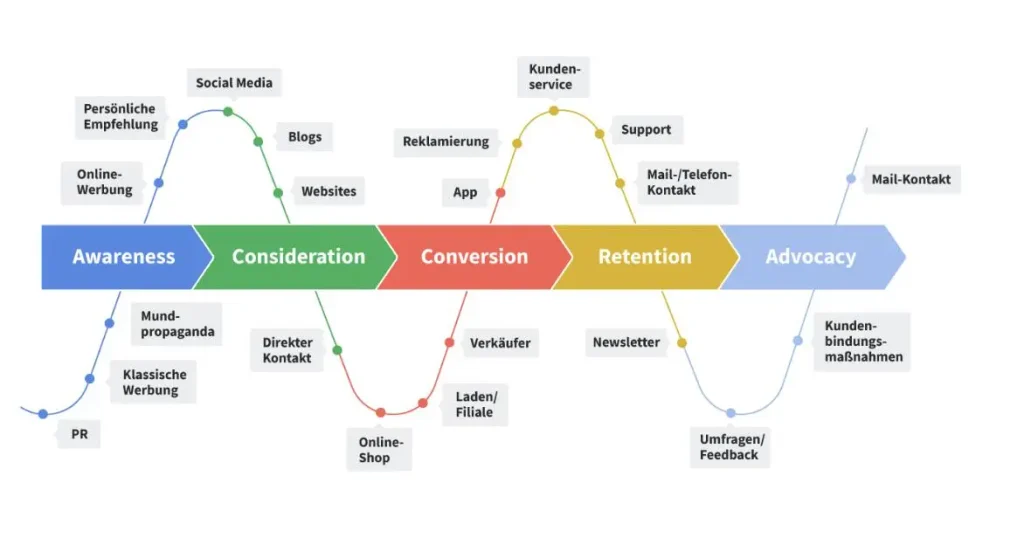
The business can then test improvements and measure the results again.
This creates an ongoing process of planning and improvement rather than a campaign that is launched once and forgotten.
Why Is Digital Marketing Important for Businesses?
Digital marketing is important because consumers increasingly use digital channels to discover businesses, research products, compare alternatives, and communicate with companies.
Think about how people often make purchasing decisions today. Someone might hear about a product from a friend, search for it online, read reviews, watch a video, compare prices, and then visit the company’s website before deciding whether to buy.
Each of these interactions can influence the customer.
Digital marketing allows businesses to participate in these different stages. SEO can help a company appear when people are actively searching. Content marketing can answer questions before customers are ready to buy. Social media can create awareness and interaction, while email can keep the relationship active.
Another important advantage is measurement. Digital platforms can provide information about traffic, clicks, engagement, leads, conversions, and other actions. This allows businesses to evaluate campaigns and make adjustments based on data.
Digital marketing can also create opportunities for smaller businesses. A local company can publish helpful content, improve its website, collect customer reviews, communicate through social media, and target people in its service area.

That doesn’t mean online marketing is automatically successful. Competition can be intense, and customers have countless businesses competing for their attention.
A company still needs a useful product or service, clear messaging, good customer experience, and a consistent strategy.
Digital marketing provides the tools to connect with customers more effectively, but businesses need to use those tools thoughtfully.
How Has Digital Marketing Changed Over the Years?
Digital marketing has changed significantly as internet technology, mobile devices, search engines, social platforms, and consumer habits have developed.
In the early days of online marketing, businesses often focused on basic websites, banner advertisements, email newsletters, and simple search strategies. As search engines became an important source of information, businesses began paying greater attention to SEO and online content.
Social media created another major shift.
Businesses gained the ability to communicate directly with audiences through posts, comments, messages, and online communities. Customers could also publicly share their experiences with brands, making online reputation increasingly important.
The widespread use of smartphones changed digital behavior again. People could search for products, watch videos, compare prices, read reviews, and communicate with companies almost anywhere.
Video also became a major part of online marketing. Businesses now use product demonstrations, tutorials, testimonials, livestreams, and short-form videos to communicate with audiences.
More recently, automation and artificial intelligence have started influencing marketing workflows. Technology can assist with research, data analysis, personalization, customer support, content development, and repetitive tasks.
Despite all these changes, the fundamentals of marketing have remained relatively stable. Businesses still need to understand their customers, communicate clearly, provide value, and build trust.
The platforms may change, but the importance of understanding the audience remains.
What Are the Main Components of Digital Marketing?
Digital marketing is made up of several different disciplines. These areas can be used separately, but they often become more effective when they support one another.
Search engine optimization helps websites gain organic visibility in search results. Content marketing focuses on creating useful information that attracts and educates an audience.
Social media marketing uses platforms such as Instagram, Facebook, LinkedIn, and TikTok to build awareness and engagement. PPC advertising allows businesses to purchase targeted advertising placements.
Email marketing provides a direct communication channel with subscribers and customers. Affiliate marketing involves partnerships where affiliates promote products or services in exchange for qualifying commissions or other compensation.
Influencer marketing involves collaborating with creators who have established audiences. Video marketing uses video content to educate, demonstrate, entertain, or promote.
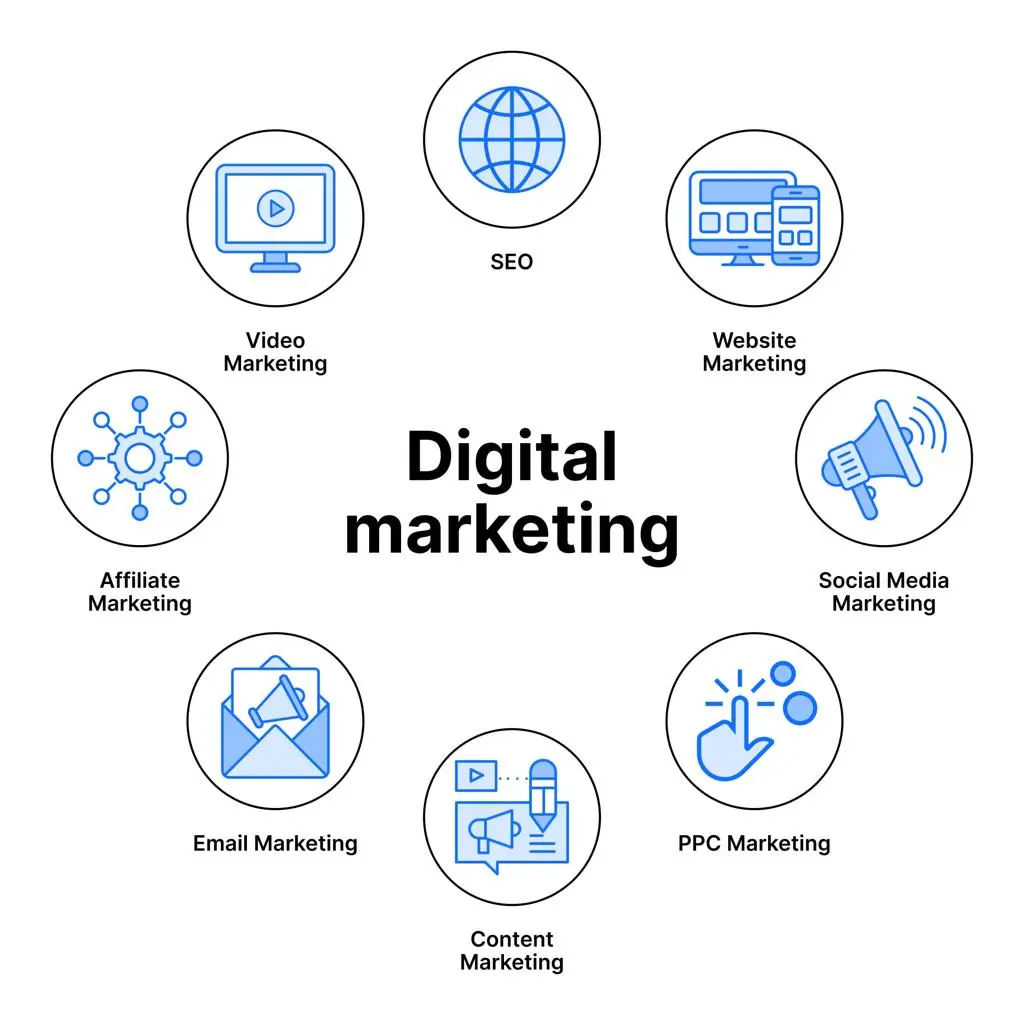
Analytics supports many of these activities by providing information about performance.
These components often overlap. A company might publish an SEO-focused article, share it on social media, use it to attract email subscribers, and eventually promote a related product through an email campaign.
That means digital marketing is better understood as an interconnected system than as a list of unrelated tactics.
The right combination depends on the business. A local service provider might rely heavily on local SEO and search advertising, while an ecommerce company may focus more on social media, email, content, and paid advertising.
Businesses don’t need to use every marketing method. They need to identify the channels most relevant to their customers and objectives.
What Are Digital Marketing Channels?
Digital marketing channels are the platforms and mediums businesses use to communicate with audiences online.
One common way to organize these channels is into owned, earned, and paid media.
Owned channels are digital properties controlled by the business. A company website, blog, email list, and mobile application are examples.
Earned channels involve exposure generated by other people. Customer reviews, organic social shares, media coverage, and online mentions can all fall into this category.
Paid channels involve purchasing visibility. Search advertisements, sponsored social posts, display advertisements, and other paid placements are examples.
Common digital marketing channels include:
- Search engines such as Google and Bing
- Business websites and blogs
- Social media platforms
- YouTube and other video platforms
- Online advertising networks
- Mobile applications
- Online communities
It is important to distinguish between a channel and a strategy.
Instagram is a channel, while social media marketing is the broader marketing activity performed through channels such as Instagram. Similarly, Google is a channel for search, while SEO and PPC are different strategies used within that environment.
A business might publish an article on its website, promote that article through paid social media, and receive organic shares from readers.
This shows how multiple channels can work together.
Instead of trying to appear everywhere, businesses can concentrate on the channels where their target audience is most likely to spend time and take meaningful actions.
How Does SEO Work in Digital Marketing?
Search engine optimization, or SEO, is the process of improving a website and its content so that it can gain visibility in organic search results.
When someone enters a query into a search engine, the search engine attempts to provide results that are relevant and useful to that person.
SEO helps businesses make their websites easier for search engines to understand while also improving the experience for visitors.
Keyword research is one part of SEO. It helps marketers identify the words and phrases people use when searching for information, products, and services.
However, successful SEO involves much more than placing keywords throughout an article.

Search intent is particularly important. Someone searching for “how to start a blog” probably wants an educational guide. Someone searching for a specific blogging platform may have a more commercial intention.
Understanding this difference helps marketers create content that actually answers the searcher’s needs.
On-page SEO can involve optimizing titles, headings, URLs, content structure, internal links, images, and other page elements. Technical SEO may involve website performance, crawlability, mobile usability, and site architecture.
Content quality also matters.
A page written mainly to repeat a keyword may not provide much value. A page that clearly answers a question, explains the subject thoroughly, and provides a useful experience is more helpful to the reader.
SEO generally requires patience because organic visibility may take time to develop.
The long-term objective is to build a website that both search engines and real users can understand and trust.
How Does Content Marketing Support Digital Marketing?
Content marketing is the process of creating and distributing useful, relevant content to attract, educate, and engage a specific audience.
Rather than asking every visitor to make a purchase immediately, content marketing can help a business become a useful source of information.
Imagine a company that sells accounting software. Instead of publishing only product advertisements, it could create articles about bookkeeping, cash-flow management, financial reporting, and other subjects that matter to business owners.
People searching for these topics might discover the company’s website before they are ready to purchase anything.
Content can take many forms, including:
- Blog posts
- Tutorials
- Videos
- Case studies
- Guides
- Infographics
- Newsletters
- Podcasts
- Webinars
- Social media posts
The goal isn’t simply to publish as much content as possible.
Each piece should have a purpose. An article might be designed to attract search traffic. A case study could demonstrate how a customer used a product. A tutorial might answer a common question, while a newsletter could maintain an ongoing relationship with subscribers.
Content marketing also supports other channels.
SEO can help people discover content through search. Social media can distribute it to followers. Email can bring existing subscribers back to the website.
This makes content a useful connecting element within a larger strategy.
Good content addresses a genuine question or problem and provides enough information for the reader to understand the subject.
Over time, consistently useful content can help a business develop audience trust.
How Does Social Media Marketing Work?
Social media marketing involves using social platforms to communicate with audiences, distribute content, build awareness, encourage engagement, and support business objectives.
Different social platforms have different audiences and content formats.
Instagram is heavily visual, LinkedIn is strongly associated with professional communication, TikTok emphasizes short-form video, and YouTube focuses primarily on video.
Because these platforms operate differently, businesses shouldn’t assume that one piece of content will work equally well everywhere.
A restaurant might use Instagram to showcase dishes and behind-the-scenes content. A software company might use LinkedIn for industry insights and YouTube for detailed tutorials.
Social media also provides an opportunity for direct communication.
Customers can ask questions, comment on posts, send messages, share experiences, and provide feedback. Businesses can use these interactions to learn more about what their audiences care about.

Paid social advertising provides another option. Companies can promote products, services, content, or offers through advertising systems available on social platforms.
However, social media success isn’t simply about gaining followers.
A smaller audience that is genuinely interested in the business can be more valuable than a large audience with little connection to the product or service.
The goal should be to create relevant content, communicate consistently, and develop meaningful engagement rather than simply chasing follower numbers.
What Role Does Email Marketing Play in Digital Marketing?
Email marketing involves sending messages to people who have chosen to receive communication from a business.
It remains useful because it gives companies a direct way to communicate with subscribers instead of relying entirely on the algorithms and visibility of social platforms.
Businesses can use email for welcome messages, newsletters, product announcements, promotions, educational content, customer follow-ups, and automated campaigns.
For example, an online bookstore might send a welcome email after someone subscribes. Later, it could recommend books based on the subscriber’s interests or previous activity.
Segmentation makes this communication more relevant.
Instead of sending exactly the same message to every subscriber, businesses can organize audiences according to interests, purchase history, engagement, or other appropriate criteria.
Automation can make email marketing more efficient. A company can create a sequence that automatically sends messages when someone subscribes, makes a purchase, or abandons a shopping cart.
Email performance can be evaluated through metrics such as clicks, conversions, engagement, and unsubscribes.
However, successful email marketing depends heavily on relevance and trust.
Sending too many messages or irrelevant promotions can cause subscribers to ignore emails or leave the list. Businesses therefore need to respect subscriber preferences and focus on useful communication.
When handled properly, an email list can become a valuable direct communication channel.
How Does PPC Advertising Work?
PPC stands for pay-per-click. It is a form of paid advertising in which advertisers generally pay when users click on their advertisements.
Search advertising is one of the most common examples.
Suppose someone searches for “emergency plumber near me.” Plumbing companies may compete for advertising placements related to that search.
PPC advertising also appears on social media platforms, video websites, display networks, and other digital services.
One reason businesses use PPC is speed. A properly configured campaign can begin generating paid traffic much faster than waiting for a new webpage to gain organic search visibility.
However, receiving clicks doesn’t necessarily mean a campaign is successful.
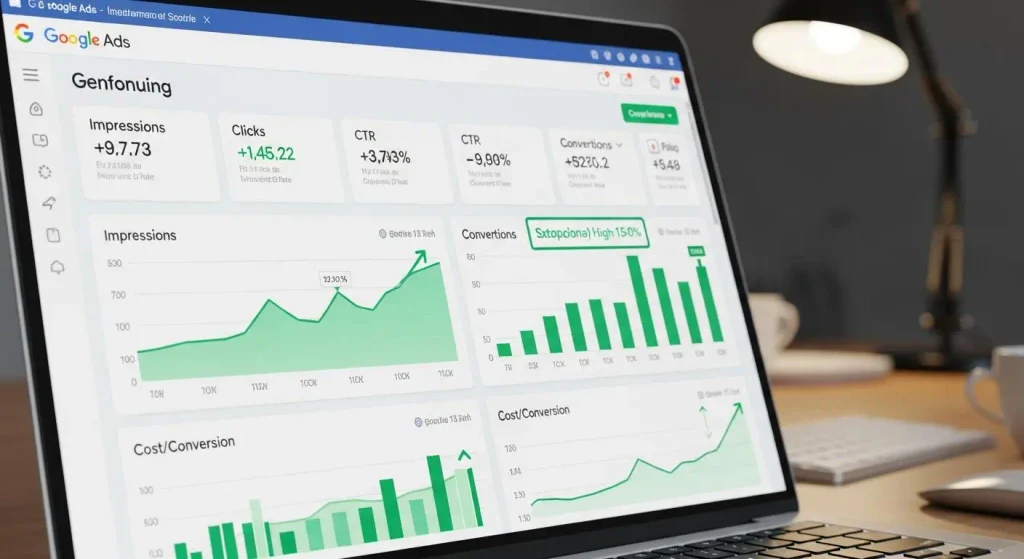
Advertisers need to consider the audience, keywords, advertisement, landing page, offer, budget, and conversion process.
For example, an online course company could attract thousands of visitors through paid advertising but still generate very few sales if its landing page doesn’t clearly explain the course or give visitors enough confidence to purchase.
PPC campaigns can be measured through impressions, clicks, click-through rates, cost per click, conversions, and cost per acquisition.
The most important question is not simply how many people clicked.
Businesses need to understand whether the traffic produced meaningful results.
Testing different audiences, messages, advertisements, and landing pages can help marketers improve campaigns over time.
What Are the Benefits of Digital Marketing?
Digital marketing offers several benefits that make it useful for businesses of different sizes and industries.
One major advantage is reach. A business can communicate with customers outside its immediate physical location through websites, search engines, social media, email, and paid advertising.
Targeting is another advantage. Depending on the platform, marketers may be able to reach audiences according to factors such as location, interests, demographics, search behavior, or previous interactions.
Measurement is also important.
Digital campaigns can provide information about website visits, clicks, engagement, leads, purchases, and other actions. This gives businesses more information for evaluating performance.
Flexibility is another useful feature. Online campaigns can often be adjusted after launch. If one advertisement performs poorly, marketers can change it. If a particular topic attracts strong interest, they can create additional content around it.
Digital marketing can also give smaller businesses opportunities to compete for attention.
A local company can create helpful articles, improve its search visibility, collect reviews, communicate through social media, and build an email audience without operating at the scale of a national corporation.
It can also support long-term relationships.
A person may discover a business through search, follow it on social media, subscribe to its emails, and eventually become a repeat customer.
However, these advantages aren’t automatic. Good results still depend on appropriate targeting, useful content, strong messaging, and a positive customer experience.
The real benefit comes from using digital channels to create measurable opportunities and improve marketing decisions over time.
What Are the Challenges of Digital Marketing?
Digital marketing creates many opportunities, but businesses also face several challenges.
Competition is one of the most obvious. Almost every industry has businesses competing for online attention. Creating a website or social media account is relatively easy; earning consistent attention is much harder.
The digital environment also changes frequently.
Search algorithms, social media features, advertising systems, privacy requirements, and consumer habits can all change. Marketers need to continue learning rather than assuming that one successful tactic will work forever.
Information overload is another problem.
People see advertisements, emails, notifications, videos, and social media posts every day. Businesses therefore need to give audiences a meaningful reason to stop, pay attention, and engage.
Measurement can also be complicated.
A customer may discover a business through social media, search for it later, visit its website, read an article, and eventually purchase through an email campaign. Understanding the contribution of each interaction isn’t always straightforward.
Privacy and data management create additional responsibilities. Businesses need to handle customer information appropriately and follow the rules that apply to their markets and platforms.
Another common challenge is trying to do too much.
A small team may attempt SEO, multiple social platforms, email marketing, PPC, influencer campaigns, video, and blogging simultaneously. Without enough time or resources, the quality of execution can suffer.
A focused strategy is often easier to manage.
Businesses can begin with the channels most relevant to their business objectives, measure the results, and expand when they have enough resources and evidence.
What Are Some Real-World Digital Marketing Examples?
Looking at real-world scenarios makes it easier to understand how digital marketing strategies work together.
Consider a local restaurant. It might use its website to display its menu, optimize pages for local searches, publish food videos on Instagram, respond to customer reviews, and run paid advertisements for a weekend promotion.
An online clothing retailer could optimize product pages for search, publish styling guides, send emails about new collections, create short product videos, and run advertisements aimed at previous website visitors.
A software company might publish detailed educational articles, create YouTube tutorials, share industry insights on LinkedIn, and offer a free trial to generate leads.
A local gym could create workout content, optimize its website for searches related to gyms in its area, collect customer reviews, collaborate with fitness creators, and use search advertising to attract potential members.
An ecommerce skincare business could combine product reviews, influencer partnerships, educational articles, email campaigns, and social advertising.
Notice that these businesses aren’t necessarily using every digital marketing technique.
Each one chooses activities based on its audience and goals.
The restaurant wants local customers. The software company wants qualified leads. The ecommerce store wants sales. The gym wants people who are interested in becoming members.
The strategy should therefore begin with the customer and the business goal, rather than starting with a particular platform simply because it is popular.
How Do Businesses Create a Digital Marketing Strategy?
A digital marketing strategy provides a framework for deciding what a business should do online and why.
The first step is defining a clear objective.
A company may want to increase website traffic, generate leads, increase sales, improve brand awareness, gain bookings, or retain existing customers.
Next comes audience research.
Businesses need to understand who their customers are, what problems they have, what questions they ask, how they make decisions, and where they search for information.
After that, marketers can choose suitable channels.
A company that depends heavily on search demand might prioritize SEO and PPC. A visual consumer brand may place more emphasis on social media and video. A company with an established customer base might invest more in email and retention.
Content planning follows.
Marketers decide what content will be created, who it is for, what purpose it serves, and how different pieces of content connect.
Then campaigns are implemented.
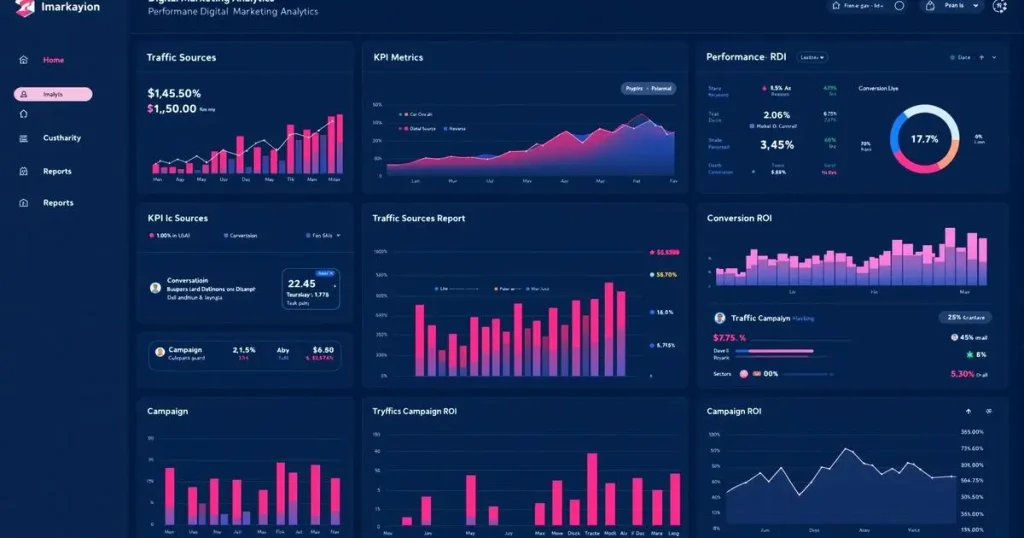
The final stage is measurement and optimization. Marketers review performance, identify weaknesses, test changes, and improve the strategy.
A good strategy doesn’t have to be complicated.
For a beginner, it may be more effective to choose one main goal and a few relevant channels rather than trying to manage every form of digital marketing at the same time.
The most useful strategies connect audience needs with business objectives and measurable actions.
What Digital Marketing Tools Do Businesses Use?
Digital marketers use different tools to plan, execute, and measure campaigns.
For SEO and website performance, tools such as Google Search Console can provide information about search visibility and website performance. Keyword research tools can help marketers identify relevant search terms and topics.
Analytics platforms can provide information about website traffic, visitor behavior, and conversions.
Content teams may use writing, graphic design, video editing, and content management tools.
Social media scheduling platforms can help marketers organize and publish posts across different networks.
Email marketing platforms can manage subscriber lists, segmentation, automation, and campaign performance.
For paid advertising, platforms such as Google Ads and Meta’s advertising tools provide systems for creating campaigns, defining audiences, managing budgets, and analyzing results.
Project management tools can also help teams organize content calendars, campaigns, deadlines, and responsibilities.
However, beginners don’t need dozens of tools.
It is easy to become focused on software instead of learning the marketing principles behind it.
A marketer who understands audience research, search intent, content strategy, analytics, and customer behavior can usually learn new platforms more effectively.
Tools should support the marketing process, not become a substitute for strategy.
What Skills Are Needed for Digital Marketing?
Digital marketing requires a combination of creative, analytical, communication, and technical skills.
Writing is useful because marketers create blog articles, advertisements, emails, landing pages, social media posts, and product descriptions.
SEO knowledge helps marketers understand search behavior, keyword research, content optimization, internal linking, and website visibility.
Analytical thinking is also important. Marketers need to understand data and use it to determine what is working and what needs improvement.
Communication skills are valuable when working with customers, business owners, designers, developers, sales teams, and other marketers.
Basic design and video skills can be useful for social media and content creation, although specialists can handle more advanced production.
Adaptability may be one of the most important long-term skills.
Digital platforms change quickly. New features appear, algorithms evolve, and consumer behavior shifts. Marketers need to remain willing to learn.
Beginners don’t need to master everything simultaneously.
Someone interested in SEO can start with keyword research, search intent, on-page optimization, and content creation. Later, they can learn analytics, technical SEO, and broader content strategy.
Practical experience is particularly valuable.
Creating a website, writing articles, managing a social page, building an email campaign, or analyzing a small project can teach lessons that theory alone cannot provide.
Over time, these individual abilities can develop into a broader digital marketing skill set.
How Do You Measure Digital Marketing Success?
Measuring digital marketing performance starts with identifying what the campaign is supposed to accomplish.
If the goal is increasing website visibility, marketers might examine organic traffic, search impressions, clicks, and other search-related indicators.
If the goal is generating leads, relevant metrics could include form submissions, qualified leads, conversion rates, and cost per lead.
For ecommerce businesses, purchases, revenue, conversion rate, customer acquisition cost, and advertising returns may be more useful.
Different channels also have different performance indicators.
SEO campaigns may focus on organic traffic, impressions, clicks, and conversions. Social media campaigns can involve reach, engagement, video views, and website visits.
Email campaigns may be evaluated using clicks, conversions, engagement, and unsubscribes.
Paid advertising often involves metrics such as cost per click, conversion rate, cost per acquisition, and return on advertising spend.
The goal isn’t to track every available metric.
Businesses can also use Google Analytics to understand website traffic, user behavior, and conversions, helping marketers evaluate whether their digital activities are producing useful results.
Businesses should focus on the numbers that help answer an important question: Did the marketing activity contribute to the desired business outcome?
For example, a social media post with 100,000 views may look impressive. But if the campaign’s goal was generating qualified leads and it produced none, the result needs to be examined more carefully.
Good measurement creates a feedback loop.
Marketers can identify what worked, understand what didn’t, test alternatives, and gradually make better decisions.
How Much Does Digital Marketing Cost?
There is no fixed price for digital marketing.
The total cost depends on factors such as business size, goals, industry, competition, chosen channels, available resources, and whether the work is handled internally or by outside professionals.
A small business might begin by managing its own social media, creating basic content, improving its website, and gradually investing in advertising.
A larger company may have an internal marketing department, work with agencies, produce professional video content, purchase specialized software, and operate larger advertising campaigns.
Different channels have different cost structures.
SEO may require investment in content creation, research, technical improvements, and expertise. PPC requires an advertising budget. Email marketing may involve platform fees and content production.
Social media can be managed organically, but businesses may also spend on creators, professional photography, video, advertising, or management.
The important question isn’t simply how much money is spent.
Businesses should consider whether the investment is helping them reach the desired audience and produce meaningful results.
For example, a relatively small campaign that generates valuable customers may be more useful than a much larger campaign that generates a lot of low-quality traffic.
A sensible approach is to establish a clear objective, create a realistic budget, measure results, and adjust spending based on evidence.
In other words, the goal is to make marketing investment financially meaningful, not simply to spend more.
What Is the Future of Digital Marketing?
Digital marketing will continue changing as technology and consumer behavior evolve.
Artificial intelligence is already becoming increasingly relevant to marketing. AI-assisted systems can help with research, data analysis, personalization, customer support, content ideation, automation, and other tasks.
However, technology doesn’t eliminate the need for human judgment.
Marketers still need to understand customers, evaluate information, create useful ideas, communicate clearly, and make strategic decisions.
Video is also likely to remain an important format. Short-form videos, tutorials, product demonstrations, livestreams, and educational content give businesses additional ways to communicate.
Privacy will continue to influence digital marketing as regulations, platform policies, and tracking technologies evolve. Businesses will need to think carefully about how customer information is collected and used.
Search behavior is changing as well. People increasingly discover information through search engines, social platforms, video websites, online communities, apps, and AI-powered systems.
This means marketers may need to think beyond a single platform.
The tools will change. New platforms will appear. Some existing channels will become less important.
But several fundamentals are likely to remain relevant: understanding the audience, providing genuine value, communicating clearly, building trust, and measuring meaningful outcomes.
For beginners, developing these fundamentals is more useful than trying to predict every future trend.
The future of digital marketing will depend not only on new technology, but on how effectively businesses combine technology with customer understanding and sound marketing principles.
Conclusion
Digital marketing is a broad field that brings together many different ways of reaching and communicating with customers online.
SEO can help businesses gain organic search visibility. Content marketing provides useful information. Social media creates opportunities for interaction and community building. Email supports direct communication, while PPC can provide targeted paid traffic. Analytics helps businesses understand performance and make better decisions.
For beginners, the number of platforms and strategies can initially seem overwhelming. The good news is that you don’t need to learn everything at once.
Start with the fundamentals. Understand your audience, choose a clear objective, select the channels that fit your goals, create useful content, measure the results, and improve your approach over time.
Digital marketing also offers many different career paths. You can specialize in SEO, content writing, social media management, PPC advertising, email marketing, analytics, video marketing, or broader digital strategy.
The tools and platforms will continue to change, but the underlying principles remain valuable. Businesses still need to understand their customers, communicate effectively, provide something useful, and build trust.
That is what makes digital marketing more than simply advertising online. It is a way to connect with the right people, provide value at different stages of their journey, and develop relationships that can support a business over the long term.
Frequently Asked Question About Digital Marketing
-
What is digital marketing?
Digital marketing is the practice of promoting products, services, or brands through online channels such as search engines, websites, social media, email, video platforms, and digital advertising.
-
What are the main types of digital marketing?
The main types include SEO, content marketing, social media marketing, PPC advertising, email marketing, affiliate marketing, influencer marketing, and video marketing.
-
Why is digital marketing important for businesses?
It helps businesses reach relevant audiences online, build brand awareness, generate leads, communicate with customers, and measure marketing performance.
-
How can a beginner start learning digital marketing?
A beginner can start by learning the fundamentals of SEO, content marketing, social media, email marketing, and analytics, then practice these skills through real projects.
-
How much does digital marketing cost?
There is no fixed cost. Expenses depend on the business goals, marketing channels, advertising budget, tools, content requirements, and whether the work is handled internally or by professionals.